






Alla auktioner / Mynt & Sedlar / 1851 Augustus Humbert $50. Lettered Edge. K-4. Rarity-5. 50 DC, 887
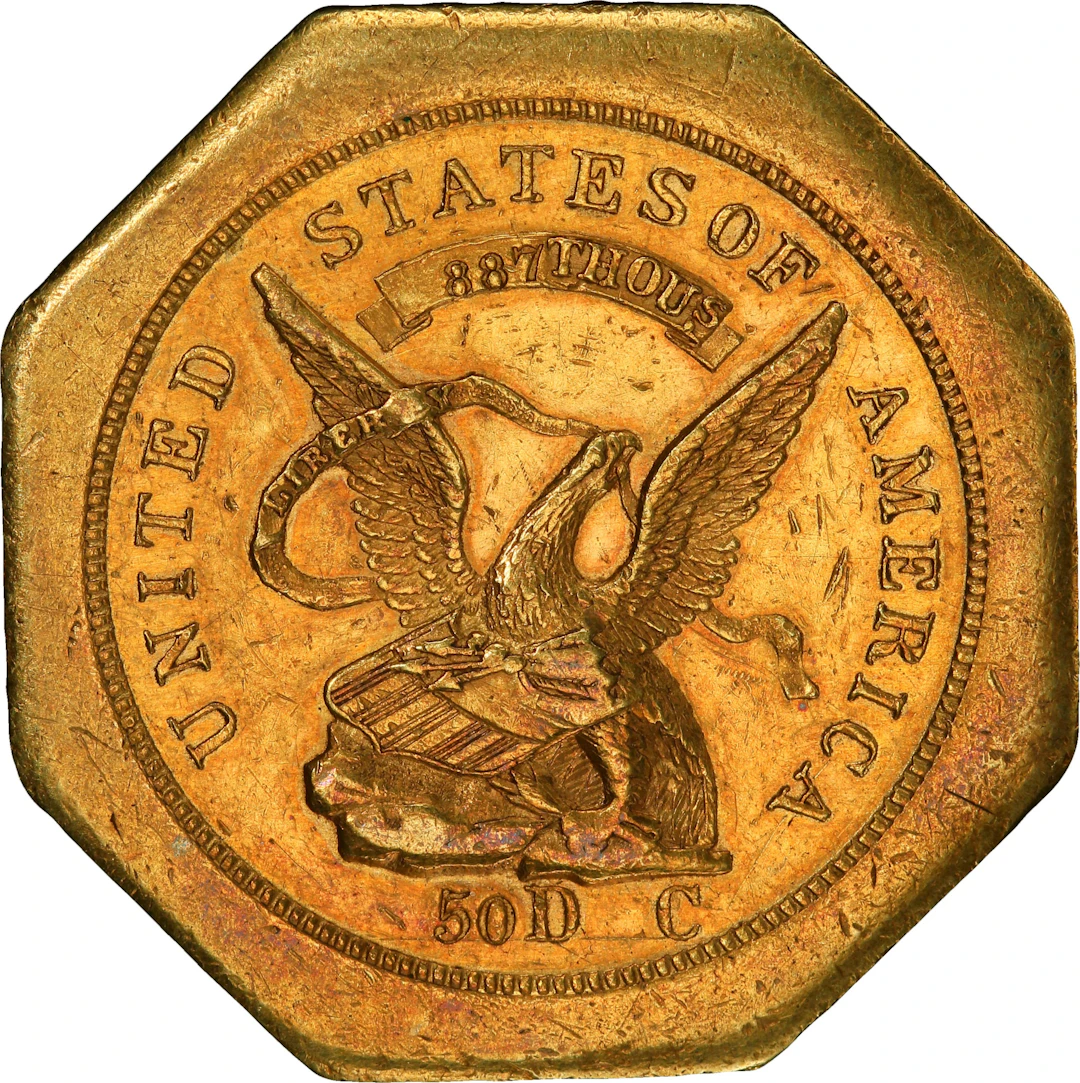
Superior Quality 1851 K-4 Humbert Octagonal $50 "Slug" Lettered Edge, 887 THOUS, 50 on Reverse 1851 Augustus Humbert $50. Lettered Edge. K-4. Rarity-5. 50 DC, 887 THOUS., 50 on Reverse. MS-61 (PCGS). A highly significant offering for the specialist, and even more so as one of the finest Lettered Edge Humbert "slugs" known to PCGS. Handsome surfaces display pleasing deep honey-olive gold color with iridescent reddish-rose highlights. Surprisingly well preserved with mostly small, singularly inconspicuous handling marks scattered about - far from serious and far less obtrusive than typically seen for the issue. We're certain that in-hand inspection will convince you this specimen is entirely deserving of the coveted Mint State rating assigned by PCGS. The edge of this elusive variety reads AUGUSTUS HUMBERT UNITED STATES ASSAYER OF GOLD CALIFORNIA 1851, while the reverse exhibits a sunken 50 at the center of the design. James Wilson Marshall's discovery of gold in California's American River on January 24, 1848 kicked off one of the largest, and certainly the most romanticized gold rush in United States history. As news of this discovery spread, 300,000 people from both the Eastern United States and abroad would eventually make their way to California seeking wealth and prosperity. Some did strike it rich, although the majority bettered themselves little, either financially or otherwise. A small settlement of 200 souls in 1846, San Francisco had grown exponentially into a city of 36,000 people by 1852. Such a tremendous surge in population in a short period of time resulted in an acute shortage of circulating currency. Gold dust, which was quickly adopted as a medium of exchange, proved difficult to work with in this regard and little more than a stopgap measure. Then there was the additional problem of what to do with all of the gold that was being mined. Clearly it needed to be converted into a form that was universally acceptable so that it could not only be used in commerce in California, but could also be transported to major economic centers so as to contribute to the nation's larger economy. As early as 1849 proposals were introduced both in the California Legislature and United States Congress calling for the establishment of an assay office or branch mint in California. Competing political interests delayed action on the federal government's part, and most Californians wanted more than simply a state-run assay office. To meet the immediate economic needs of Gold Rush California while final action on the part of the state and/or federal government was awaited, various private minting firms sprang up in and around San Francisco. The firm of Moffat & Co., however, became the most important private minter serving the California Gold Rush; its successors Curtis, Perry and Ward eventually sold their facility to the United States government, which reopened it as the San Francisco Mint in March 1854. While still under the auspices of Moffat & Co., the firm's reputation caught the eye of the federal government when the latter was finally able to take action in the establishment of a local coinage facility to service the Gold Rush. Unfortunately, however, Californians did not initially get the branch mint they desired, due to competing political interests. Rather, a compromise bill passed through Congress on September 30, 1850, and established the United States Assay Office, to be located in San Francisco. Moffat & Co. received the contract to operate as the United States Assay Office, with New York watchmaker Augustus Humbert appointed as United States Assayer. Humbert arrived in San Francisco on January 30, 1851, bringing with him the first dies for coinage that had been prepared by Charles C. Wright. The first coins - $50 gold pieces - were issued under Humbert's authority the following day, with ingots following on February 14. The United States Assay Office continued to operate with these principals until the dissolution of Moffat & Co. in early 1852, after which the federal contract was assumed by Curtis, Perry & Ward under the name of the United States Assay Office of Gold. Humbert remained as assayer under the successor firm until it ceased operations on December 14, 1853. Nearly a branch mint in its own right, the operations of the United States Assay Office in 1851 and 1852 represent an important and defining chapter in the coinage history of the California Gold Rush and, indeed, the nation as a whole. One of Humbert's $50 gold pieces from his first year as assayer in California, this virtually About Uncirculated coin offers the advanced collector with an important opportunity to own a truly memorable memento of this widely studied and avidly collected era in United States frontier history. While all Lettered Edge slugs are early productions of Humbert's United States Assay Office of Gold, the 2023 Kagin and McCarthy book suggests the Kagin-4 variety represented here was actually struck earlier than its K-2 counterpart. This variety, like Kagin-1, includes the denomination 50 at the center of the reverse. Kagin and McCarthy suggest, sensibly, that the slugs with a denomination were likely struck during the first two months of 1851 when the assay office was manufacturing ingots of substantially higher values. Once the U.S. Assay Office was out of that business, "sometime before March 1," they could safely leave off the denomination and likely struck the $50 slugs after that date with no reverse denomination. This explains why some slugs have the stamped 50 and some lack it; it also explains why this variety is so rare while the 880 THOUS / No 50 variety (Kagin-2) is somewhat more common. Provenance: Property from an Alabama Family. Earlier from Heritage's sale of the Bob R. Simpson Collection, Part III, January 2021 FUN Signature Auction, lot 3053. PCGS Population: 6; 2 finer (MS-62+ finest). PCGS# 10208. NGC ID: ANH4. Click here for certification details from PCGS. Image with the PCGS TrueView logo is obtained from and is subject to a license agreement with Collectors Universe, Inc. and its divisions PCGS and PSA.
Utropspris:SEK 9.93
Till auktionenVisa alla föremål frånStack's BowersellerMynt & Sedlar
Utropspris:
SEK 9.93
Nå samlare över hela världen med din auktion!
Lista er auktionGenom att prenumerera godkänner du integritetspolicyn. Avprenumerera när som helst.
Barnebys HQ
Brahegatan 10
BOX 5038
114 37 Stockholm
