




Alla auktioner / Etnografica / A beads sculpture - Yoruba - Nigeria (No reserve price)

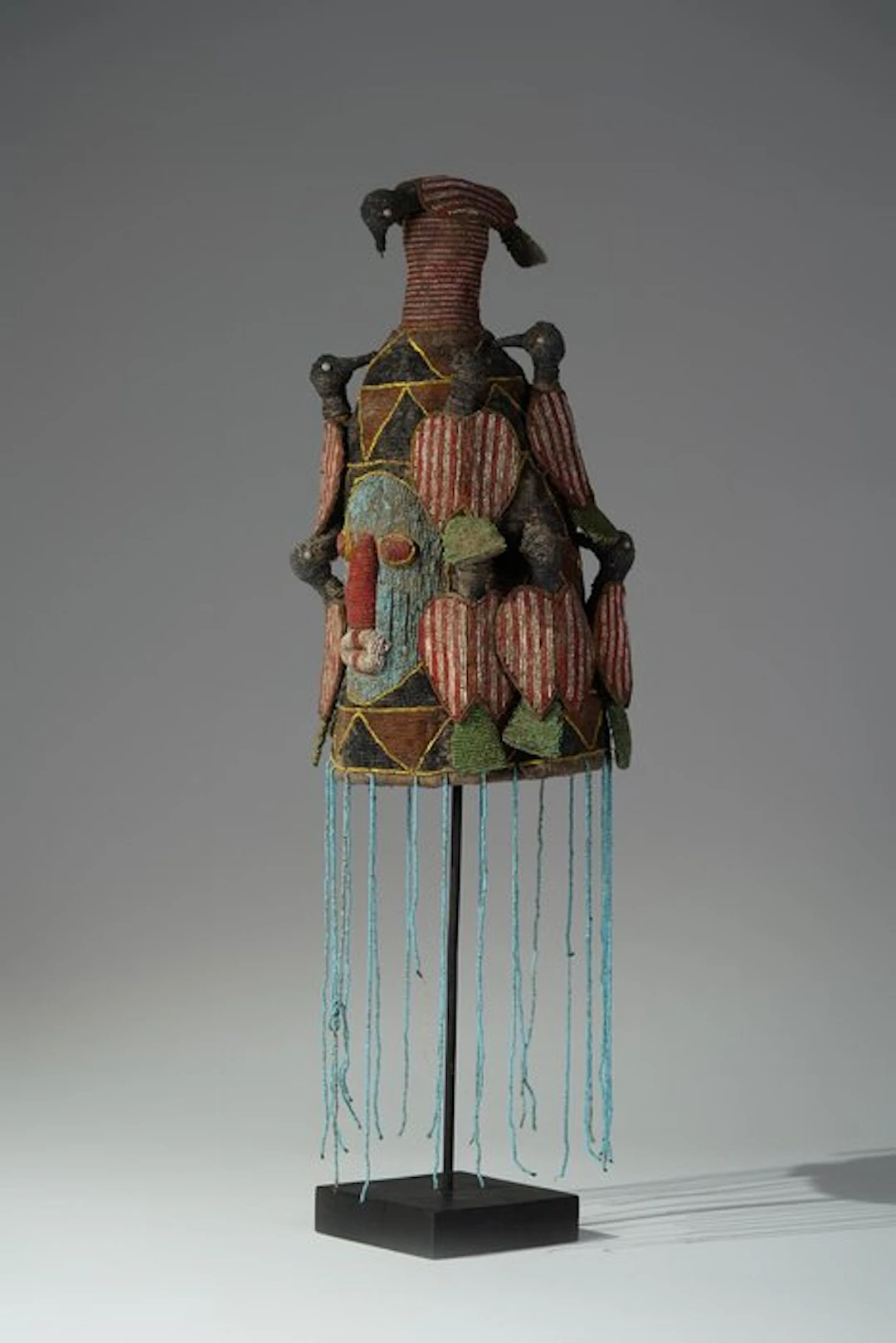
Yoruba Bead Sculpture – Figuratively Decorated Ceremonial Beaded Crown Provenance: Osogbo (Osogba) Region, Osun State, Southwest Nigeria Cultural Attribution: Yoruba, attributed Material: Glass beads of various colors, textile backing, presumably threads and other organic components, incl stand. Dating: Uncertain Description This exceptionally richly decorated beaded object has a tall, almost conical base, the entire surface of which is covered with densely packed, colored glass beads. The composition combines a strictly structured architectural form with a multitude of three-dimensional, anthropomorphic and possibly zoomorphic elements. The upper section is formed by an elongated, cylindrical finial, the surface of which is adorned with horizontally arranged rows of reddish-brown and light-colored beads. Several dark-colored, curved projections protrude from the sides, reminiscent of stylized animal heads or ornamentally designed pendants. The main body below widens into a bell shape and is divided into different pictorial sections. A dark, almost black beaded background is crisscrossed by geometric lines in yellow, red, and brown, forming a network of triangular and polygonal shapes. Particularly striking are the large, heart- or leaf-shaped ornaments made of red and white rows of beads, arranged in several layers. Smaller, three-dimensional heads with dark faces and green, cap-like headdresses appear between these ornaments. On the left front is a larger, light blue field, accentuated by a vertical red shape and smaller colored elements. The three-dimensional figures and ornaments are arranged to rhythmically encircle the conical base. Numerous long, light blue strings of beads hang from the bottom edge, which may originally have formed a movable veil or a decorative edging. The object is mounted on a modern black metal stand. Art Historical Analysis The beadwork of the Yoruba people is among the most important textile and craft traditions of West Africa. Particularly in connection with the historical kingship, a highly complex visual language developed, in which precious materials, figurative representations, and geometric ornaments were combined to create symbolically charged insignia. Within this tradition, the glass beaded crowns, known as adé, occupy a prominent position. They are among the most important symbols of dignity for the Yoruba rulers, the ọba, and embody not only political authority but also the sacred legitimacy of kingship. Particularly characteristic are tall, conical, or dome-shaped crowns whose surfaces are covered with colorful bead patterns and figurative representations. They often feature a hanging beaded veil that partially or completely conceals the ruler's face during certain ceremonial acts. The present work, with its tall form, figurative appliqués, and long strings of beads, shows clear parallels to this tradition. Nevertheless, its precise typological classification cannot be definitively determined based solely on the photograph. The unusually complex sculptural decoration could indicate a regional variant, a special ceremonial function, or an independent artistic interpretation of courtly beadwork. The stated origin from the Osogbo region is plausible from an art historical perspective, as southwestern Nigeria is one of the important centers of Yoruba culture. However, a specific workshop attribution or connection to a particular ruling dynasty is not documented. Symbolism and Iconography The iconographic design of the Yoruba beaded crowns is based on a sophisticated interplay of color, form, and figurative representation. Glass beads are considered precious materials in courtly contexts, and their use visibly signifies the wearer's special status. Their significance, however, is not limited to material value but is closely linked to notions of dignity, spiritual power, and social order. In Yoruba cosmology, the human head, orí, holds paramount importance as the seat of personal destiny and spiritual individuality. The royal crown can therefore be understood as a symbolic elevation of the head, expressing the ruler's exceptional position. The small anthropomorphic heads of the present object could refer to individuals, ancestors, or symbolic companion figures. Their precise identity remains unclear without additional information. The repeatedly depicted red and white ornaments possess a strikingly symmetrical. The ornaments have a figure-like form. They could represent plant motifs or abstracted emblems; a definitive identification is not possible. Particularly noteworthy is the combination of these ornaments with the three-dimensional, dark heads, creating a pictorial hierarchy between larger decorative areas and smaller figurative elements. The color scheme also contributes significantly to the overall effect. Red, white, blue, green, and yellow appear in carefully coordinated contrasts that vividly structure the object from different perspectives. Although individual colors may have specific religious or social associations within Yoruba culture, a definitive symbolic interpretation of each color area without a documented context of use would not be methodologically justified. Ritual Function and Social Significance The royal beaded crowns of the Yoruba were traditionally closely associated with the office of ọba. In numerous historical kingdoms, they were considered central symbols of legitimate rule and could be worn at enthronements, public ceremonies, religious festivals, and other important occasions. The hanging beaded veil, in particular, has an important ceremonial function. It can conceal the ruler's face from direct view, thus making the distance between the royal person and their surroundings visible. At the same time, the veil alters the appearance of the wearer, whose individuality recedes behind the sacred dignity of their office. The long, light blue strings of pearls on the present object are reminiscent of such a device. Their arrangement and length might indicate that they originally hung in front of the wearer's face or around their head. Whether the sculpture was actually used as a wearable crown or is perhaps a ceremonial piece not intended for wear cannot be determined from the illustration. This would require, in particular, an examination of the internal construction, weight, and possible fastening elements. The figurative finials could also point to a special ceremonial significance that extends beyond the general function of royal representation. Art Historical Assessment The exceptional artistic quality of this beaded object lies in its extraordinary combination of textile precision, sculptural design, and complex ornamentation. The densely packed glass beads create a vibrant, light-reflecting surface, the effect of which is enhanced by the different colors and the rhythmic repetition of geometric patterns. At the same time, the three-dimensional figures and ornaments transcend the boundaries of purely two-dimensional decoration, transforming the conical base into a multi-layered sculptural form. The composition unfolds its effect both from a distance, where the clear silhouette and large-scale color patterns dominate, and up close, where the meticulous craftsmanship of the individual beads becomes visible. Particularly striking is the relationship between the solid, densely ornamented main body and the freely hanging strings of beads, whose movement forms a deliberate contrast to the closed shape of the upper section. Within the Yoruba art tradition, the object illustrates the bead artists' unique ability to combine social representation with artistic invention. Subject to its function being determined more precisely, it can be considered a remarkable example of that courtly conception of art in which the interplay of material, ornament, and figurative symbolism makes the dignity and exceptional position of kingship visible. Literature Robert Farris Thompson: Black Gods and Kings: Yoruba Art at UCLA. Los Angeles: Museum and Laboratories of Ethnic Arts and Technology, University of California, 1971. Henry John Drewal, John Pemberton III, and Rowland Abiodun: Yoruba: Nine Centuries of African Art and Thought. New York: The Center for African Art, 1989. Ulli Beier: The Return of the Gods: The Sacred Art of Susanne Wenger. Cambridge: Cambridge University Press, 1975. Copyright and Scientific Documentation Some of the information and photographs have been generated with the assistance of artificial intelligence and are based on published sources in ethnography, archaeology, and art history. Original texts and photographs may be protected by copyright. All rights held by the respective rights holders are reserved. Inv. No. MAZ31792 Informant: Amadou Dogo
Utropspris:SEK 3,059.63
Till auktionenVisa alla föremål frånCatawikiellerEtnografica
Utropspris:
SEK 3,059.63

Nå samlare över hela världen med din auktion!
Lista er auktionGenom att prenumerera godkänner du integritetspolicyn. Avprenumerera när som helst.
Barnebys HQ
Brahegatan 10
BOX 5038
114 37 Stockholm
