
Alla auktioner / Etnografica / A bronze head - Head - Benin - Nigeria

A bronze head - Head - Benin - Nigeria
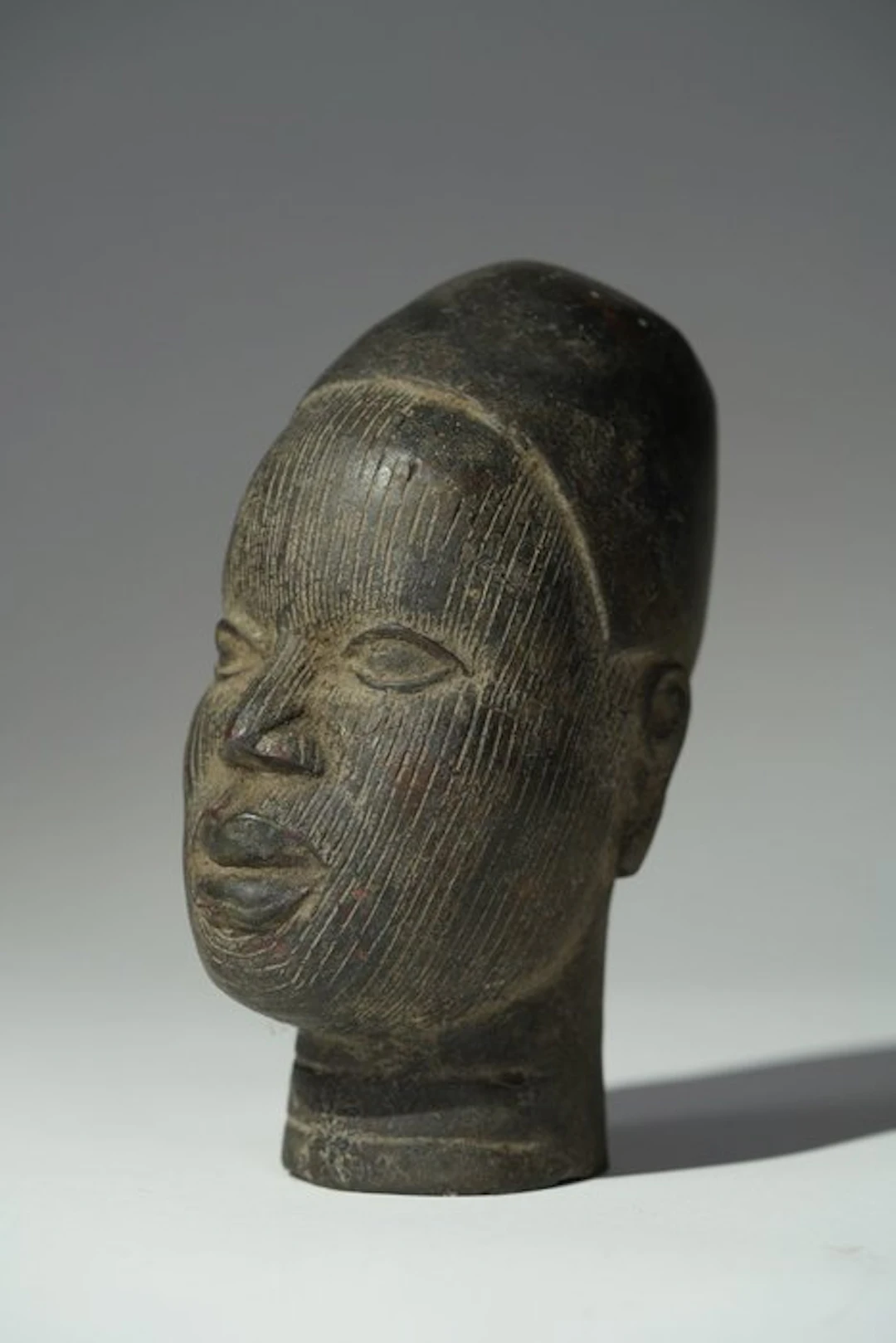
Benin Bronze Head, Benin City Region, Nigeria Bini (Edo), Benin City region, Nigeria Cast copper alloy No scientific test report is provided for this piece. Its age and geographical origin have therefore not been verified This striking cast head from the Benin City region is distinguished by its compact monumental form and, above all, by the dense system of fine vertical incisions covering almost the entire face. The sculpture reduces the human image to the head and neck, concentrating attention on facial presence, surface pattern and the carefully controlled transition between naturalistic modeling and graphic abstraction. The head is strongly rounded, with a broad cranial volume that extends backward from the face. A clearly defined line separates the smooth upper part of the skull or coiffure from the densely striated facial area below. The contrast is deliberate and visually effective: the upper section remains relatively unornamented, while the forehead, temples, cheeks and chin are transformed into an intricate field of parallel lines. The face itself is remarkably restrained. Almond-shaped eyes are set beneath gently modeled brows and outlined by raised contours. A broad, relatively short nose projects from the facial plane, while the full lips are carefully modeled and slightly parted. The ears are comparatively small and placed far back on the sides of the head. The rounded chin and full cheeks give the face a calm, self-contained expression. Most remarkable are the numerous vertical lines extending across the face. They follow its curvature rather than simply forming a flat decorative pattern, emphasizing the sculptural volume of the forehead, cheeks and jaw. Around the mouth and chin the lines curve subtly with the anatomy. Small traces of reddish coloration remain in some of the recessed passages, contrasting with the predominantly dark surface. The neck is short and cylindrical and terminates in a slightly expanded base, allowing the head to stand independently. Unlike many well-known royal commemorative heads from Benin, the present work lacks the massive coral-bead collar, elaborate crown and broad circular flange normally associated with representations of an Oba or Iyoba. For this reason, it would be premature to identify the figure specifically as a king, queen mother or other named category of court personage solely from its present appearance. Standard Benin royal commemorative heads generally use regalia as an important indicator of identity and rank. The dark surface varies considerably in tone. Raised areas have acquired a smoother appearance, while the incised lines retain lighter deposits that heighten their graphic effect. Scattered reddish-brown passages and minor greenish oxidation are compatible with a copper-alloy object, although the precise composition of the metal cannot be established visually. Regional characteristics Benin City was the political and ritual center of the Kingdom of Benin and the seat of the Oba. Its court supported highly specialized guilds of artists, among them the celebrated royal brass casters, whose lost-wax castings included heads, freestanding figures, plaques, bells, vessels and ceremonial objects. Copper alloy was particularly closely associated with royal authority and palace patronage. Within this artistic system, the human head had exceptional importance. Commemorative brass heads were placed on ancestral altars in the palace, where they participated in rituals maintaining the relationship between the reigning ruler and his royal predecessors. In Edo thought, the head was associated not merely with physical identity but with leadership, personal success and the capacity to direct the individual and, in the case of the Oba, the kingdom itself. The present head is unusual when compared with the best-known sequence of Benin royal altar heads. Those works can often be classified through changes in the form of coral-bead collars, crowns, casting thickness and base flanges. This example instead emphasizes the uninterrupted surface of the face and the extensive vertical striation. Its comparatively restrained regalia means that a precise place within the conventional typology of royal commemorative heads should not be asserted without further technical and provenance information. Facial markings nevertheless form part of the established visual vocabulary of Benin court art. Benin sculptures can use particular markings in conjunction with hairstyle, dress, jewelry and other attributes to distinguish categories of individuals. Their interpretation depends upon the entire iconographic context, however, and the extensive striation of this head should not automatically be assigned a specific social identity from the photograph alone. The treatment of the surface also invites comparison with the broader artistic exchanges of southern Nigeria. Fine facial striation is famously encountered in the sculptural traditions of Ife, whose historical and dynastic relationship with Benin occupies an important place in Benin traditions of origin. This does not mean that the present head should be classified as Ife. Rather, its linear treatment is a reminder that courtly artistic traditions in southern Nigeria developed through complex histories of interaction and reinterpretation. What makes this sculpture particularly compelling is the tension between volume and line. Viewed from a distance, it presents a calm and almost austere human head of great formal simplicity. At close range, the surface dissolves into hundreds of finely incised strokes. The sculptor has thus combined a highly concentrated monumental form with an exceptionally elaborate treatment of the skin. The result is a powerful work within the wider context of Bini metal sculpture. Rather than relying upon abundant jewelry and royal insignia, it derives its presence from the enlarged head, controlled facial expression and extraordinary density of surface articulation. The supplied attribution to the Benin City region provides an important context, while the precise identity and original function of the head should remain open in the absence of more specific documentation. Selected Literature Ben-Amos, Paula Girshick. The Art of Benin. London: British Museum Press, 1995. Dark, Philip J. C. An Introduction to Benin Art and Technology. Oxford: Clarendon Press, 1973. Ezra, Kate. Royal Art of Benin: The Perls Collection in the Metropolitan Museum of Art. New York: The Metropolitan Museum of Art, 1992. Plankensteiner, Barbara, ed. Benin: Kings and Rituals—Court Arts from Nigeria. Vienna: Museum für Völkerkunde, 2007. Blackmun, Barbara Winston. “Obas’ Portraits in Benin.” African Arts, vol. 23, no. 3, 1990. Some of the information and photos are generated by artificial intelligence and is based on published sources from the fields of ethnography, archaeology, and art history documents. All information and photos are protected by copyright. Inv. No. MAZ31036
Utropspris:SEK 10,083.18
Till auktionenVisa alla föremål frånCatawikiellerEtnografica
Utropspris:
SEK 10,083.18
Liknande föremål

Auktionsresultat för liknande föremål
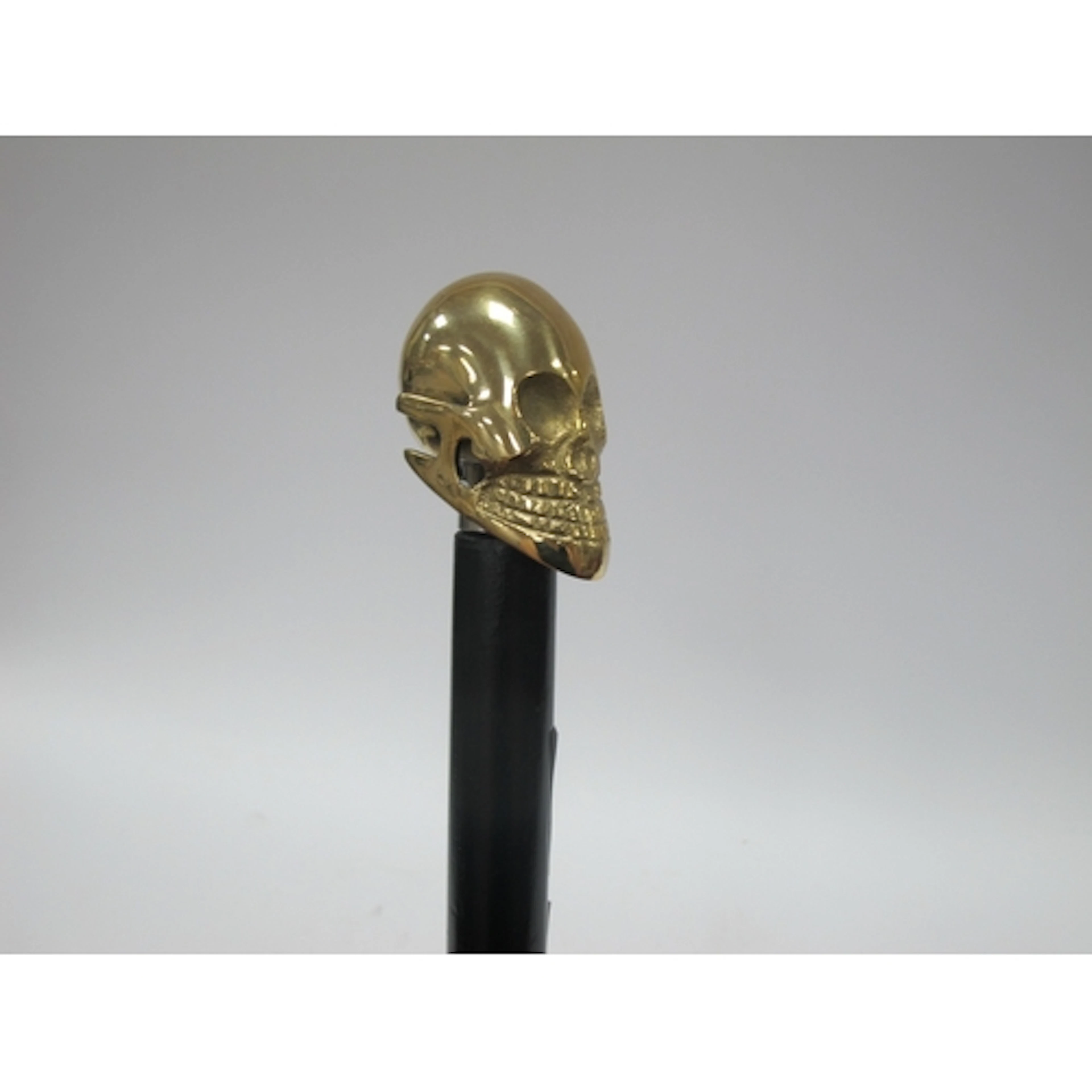
A Contemporary Walking Stick, with a brass skull handle.
10/09/2026

SEK 264.8
Uppsk.: SEK 265.92
Nå samlare över hela världen med din auktion!
Lista er auktion