



Alla auktioner / Etnografica / A bronze head - Uhunmwu-Elao - Benin - Nigeria

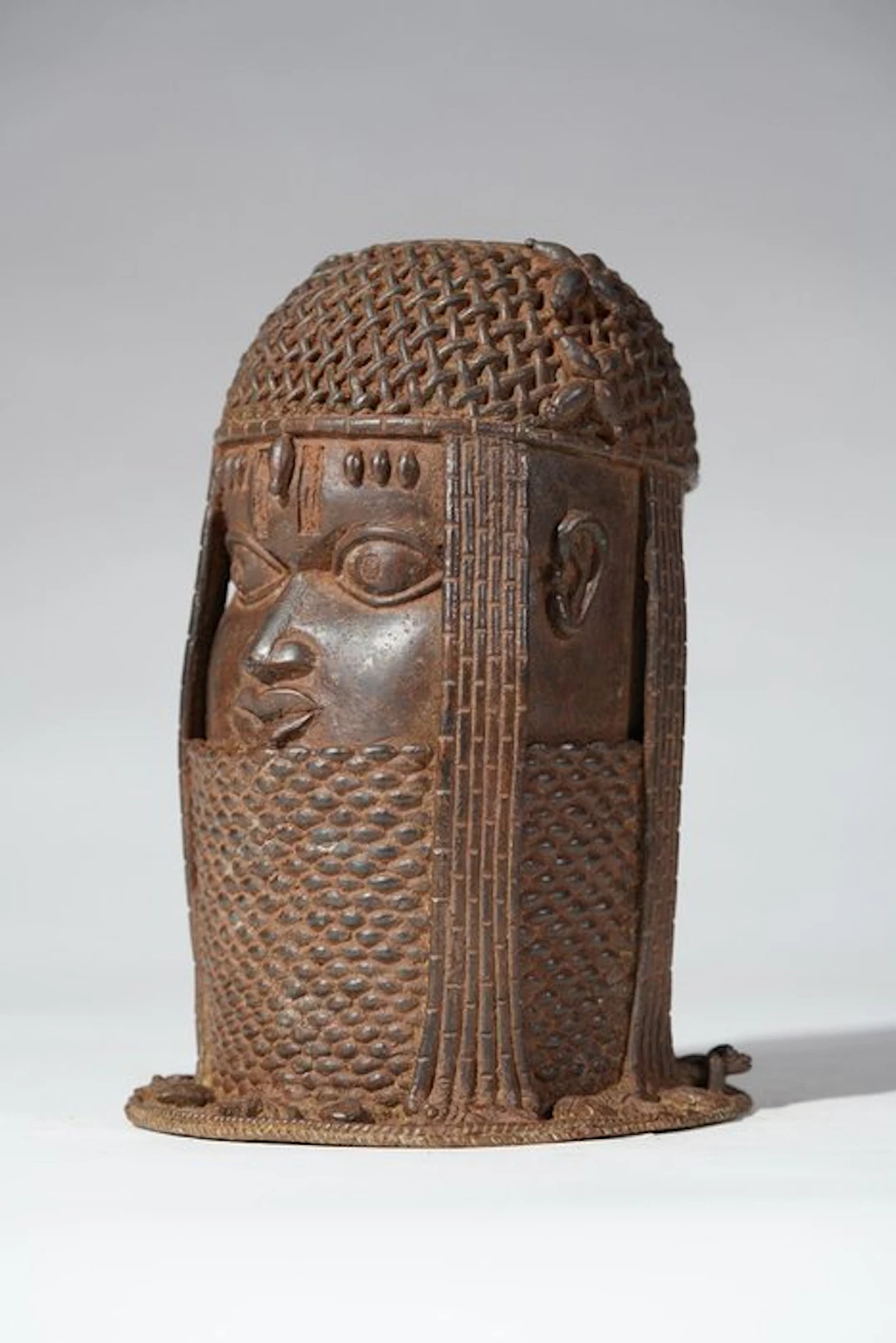
Benin – Commemorative Head of an Oba (Uhunmwu-Elao) Kingdom of Benin, Edo Culture, Nigeria Probably 17th century, possibly early 18th century Cast copper alloy, lost-wax casting technique Height: 23 cm Weight: 4.6 kg Description This remarkable commemorative head of an Oba, a king of the historical Kingdom of Benin in present-day Nigeria, belongs to the distinguished tradition of royal metal casting among the Edo people. The sculpture is characterized by its compact, almost cylindrical shape, the harmonious modelling of the face, and the elaborate representation of royal insignia. The face displays a highly idealized physiognomy, conveying an expression of dignity, serenity, and authority. The large, almond-shaped eyes, with their clearly defined eyelids and circular pupils, give the face a particularly alert and concentrated appearance. The prominent, slightly broad nose and the carefully modelled mouth, with its full, gently curved lips, are balanced by the smooth, softly rounded cheeks. Raised, drop-shaped ornaments and vertical markings appear above the eyes and on the forehead, characteristic features of the formalized visual language of Benin court art. The head is crowned by a closely fitting, dome-shaped cap, its intricate openwork lattice pattern representing the elaborate coral-bead crown traditionally worn by the Oba. Small raised ornaments accentuate its surface. On either side of the face, long, vertically arranged strands extend downwards to the base of the sculpture, representing the suspended beadwork associated with royal ceremonial regalia. Their carefully structured geometric patterns contrast effectively with the smooth modelling of the facial features. Particularly striking is the high collar surrounding the lower part of the face and extending almost to the mouth. Its densely arranged, oval-shaped projections reproduce the multiple strands of precious coral beads that formed one of the principal insignia of Benin kingship. Together with the elaborate crown, this ornamentation identifies the figure as a representation of royal and spiritual authority. he sculpture rests on a narrow, slightly projecting circular base with an ornamentally decorated rim. Its dark brown surface, showing areas of reddish oxidation and occasional darker and greenish tones, enhances the sculptural quality and visual depth of the metal casting. Art Historical Context The present sculpture belongs to the category of royal commemorative heads known as Uhunmwu-Elao, among the most important artistic creations of the Kingdom of Benin. These heads formed an essential part of the royal ancestral cult and played a central role in the spiritual and political organization of Edo kingship. Following the death of an Oba, his successor established a commemorative altar within a secluded courtyard of the royal palace. Among the most significant objects placed on these altars were cast copper-alloy heads representing the deceased ruler. Rather than individual portraits in the Western sense, these sculptures embodied an idealized conception of kingship, emphasizing the continuity, authority, and sacred status of the royal dynasty. Through elaborate ceremonies, offerings, and regular sacrifices performed at these ancestral altars, the reigning Oba maintained his relationship with his predecessors, reaffirmed his legitimacy, and strengthened his spiritual power. Within Edo religious thought, the head occupied a particularly important position as the seat of personal destiny, spiritual power, and royal authority. The coral-bead regalia represented on commemorative heads were therefore far more than decorative ornaments. They served as visible manifestations of sacred kingship, dynastic continuity, and the supernatural powers associated with the Oba. Stylistic Development and Dating The commemorative heads of Benin underwent a remarkable stylistic development between the 15th and 19th centuries. Early examples, particularly those of the 15th and 16th centuries, often display comparatively naturalistic facial proportions, relatively thin casting walls, and lower coral-bead collars. Their restrained ornamentation places greater emphasis on the modelling of the human face. During the late 16th and 17th centuries, the heads became increasingly formalized. Facial features developed a more standardized appearance, while the royal insignia became more elaborate and visually dominant. The coral-bead collars grew higher, often reaching the mouth, and the crowns became increasingly complex in their ornamental treatment. The commemorative heads produced during the 18th and 19th centuries frequently became larger and heavier, with substantially thicker casting walls and an even stronger emphasis on ceremonial decoration. The present example combines a comparatively sensitive treatment of the facial features with a pronounced geometric stylization of the royal regalia. The openwork coral-bead crown, the elongated lateral bead strands, the high and densely ornamented collar, and the idealized facial expression are characteristic of the classical tradition of Benin royal commemorative sculpture. These features suggest a probable date in the 17th century, although a production date extending into the early 18th century cannot be excluded on stylistic grounds alone. The compact proportions and carefully balanced relationship between the face and the surrounding ceremonial ornaments are particularly noteworthy. Comparative Examples An important comparison can be made with the commemorative head of an Oba in the collection of the British Museum, London, inventory number Af1897,1217.2, generally dated to approximately 1550–1650.This sculpture displays closely related stylistic characteristics, including the elaborate beaded crown, the vertically arranged strands of royal ornaments, the distinctive forehead markings, and the high coral-bead collar. Another relevant comparison is the commemorative head in the British Museum, inventory number Af1944,04.3, which likewise demonstrates the formalized facial features and elaborate royal regalia characteristic of the developed Benin casting tradition. Particularly relevant is the commemorative head of an Oba in the collection of the Stiftung Preußischer Kulturbesitz, Staatliche Museen zu Berlin, illustrated in the accompanying comparative photograph and described as a 17th-century example. The Berlin head displays the characteristic cap-shaped coral-bead crown and high collar made of multiple strands of coral beads. It exemplifies the increasing formalization of Benin commemorative sculpture during this period. Although the treatment of the mouth, eyes, and collar decoration varies between individual examples, the shared iconographic vocabulary clearly reflects the established artistic conventions of the Benin royal court. Such variations demonstrate the considerable technical and artistic sophistication of the royal bronze-casting workshops, whose craftsmen worked within a highly developed and symbolically structured artistic tradition. Ìgùn Ẹ́rọ̀nwwọ̀n (brass-casting guild) arti…o peoples - The Metropolitan Museum of Art (last photo sequence). Function and Ritual Significance From the 17th century onwards, and particularly during the 18th and 19th centuries, royal commemorative heads also frequently served as supports for large, elaborately carved elephant tusks. These ivory tusks were decorated with complex compositions of historical figures, ceremonial scenes, royal symbols, and supernatural beings. Many of these motifs had already appeared on the famous Benin palace relief plaques of the 16th and 17th centuries. The combination of a cast metal head and an intricately carved ivory tusk created a powerful symbolic ensemble on the royal ancestral altar. The ivory tusks referred to royal wealth, political authority, military achievements, and the spiritual relationship between the living king and his ancestors. Whether the present head was originally intended to support a carved ivory tusk would require a detailed examination of its upper opening, internal structure, and casting characteristics. Artistic Significance The present commemorative head is an expressive example of the sophisticated sculptural language associated with the royal court of Benin. Its artistic quality lies particularly in the harmonious combination of idealized facial modelling, intricate ornamental detail, and monumental compositional clarity. The finely articulated eyes, carefully shaped lips, openwork coral-bead crown, and rhythmically structured collar demonstrate a highly developed understanding of sculptural balance and surface decoration. Although relatively compact in size, measuring 23 cm in height and weighing 4.6 kg, the sculpture possesses considerable visual presence. The interplay between the smooth facial surfaces and the richly textured royal insignia creates a striking contrast that emphasizes the sacred dignity of the represented ruler. The head reflects the artistic conventions of a period during which Benin royal commemorative sculpture increasingly emphasized the symbolic significance of kingship through standardized facial features and elaborately represented ceremonial regalia. Within this tradition, the sculpture may be stylistically associated with the commemorative heads of the 17th century, while a slightly later date remains possible. Historical Provenance and Research The history of Benin royal art is inseparable from the events of the British military expedition against Benin City in February 1897, during which the royal palace was occupied and large numbers of ceremonial and sacred objects were removed. Many important examples of Benin commemorative heads subsequently entered European museum collections, including those in London and Berlin. This historical context is essential for understanding the collecting history of Benin art. However, the circumstances of the 1897 expedition do not, in themselves, establish the provenance of the present sculpture. A definitive assessment of its date, authenticity, and historical attribution would require further examination of its casting technique, metal composition, surface condition, and documented provenance. Conclusion This finely detailed commemorative head of an Oba (Uhunmwu-Elao) embodies the distinctive artistic and spiritual traditions of the historical Kingdom of Benin. The idealized royal features, elaborate openwork coral-bead crown, extended lateral ornaments, and high ceremonial collar reflect the sophisticated iconographic language of Edo court sculpture. Its compact proportions, carefully articulated facial features, and richly textured surfaces suggest a stylistic relationship with the classical commemorative heads of the 17th century. The sculpture represents the enduring importance of royal ancestral veneration and the sacred conception of kingship within Benin culture. Dating and attribution remain subject to further technical examination. Copyright and Scientific Documentation. Some of the information and photographs have been generated with the assistance of artificial intelligence and are based on published sources in ethnography, archaeology, and art history. Original texts and photographs may be protected by copyright. All rights held by the respective rights holders are reserved. Sold without TL test Catawiki's experts perform a virtual review based on the information, photographs, provenance and supporting documentation provided during the submission process. Acceptance of a traditional or ancient African art object for auction does not constitute independent authentication or certification by Catawiki, nor does it mean that Catawiki's expert has physically or scientifically authenticated, patina-analyzed, or dated the object. Under our Terms and Traditional African Art Submission Guidelines, the seller remains responsible for the accuracy, legality, provenance and authenticity of the object and the information provided.
Utropspris:SEK 24,477.08
Till auktionenVisa alla föremål frånCatawikiellerEtnografica
Utropspris:
SEK 24,477.08
Nå samlare över hela världen med din auktion!
Lista er auktionGenom att prenumerera godkänner du integritetspolicyn. Avprenumerera när som helst.
Barnebys HQ
Brahegatan 10
BOX 5038
114 37 Stockholm
