



Alla auktioner / Etnografica / A iron sculpture - Lobi - Burkina Faso (No reserve price)

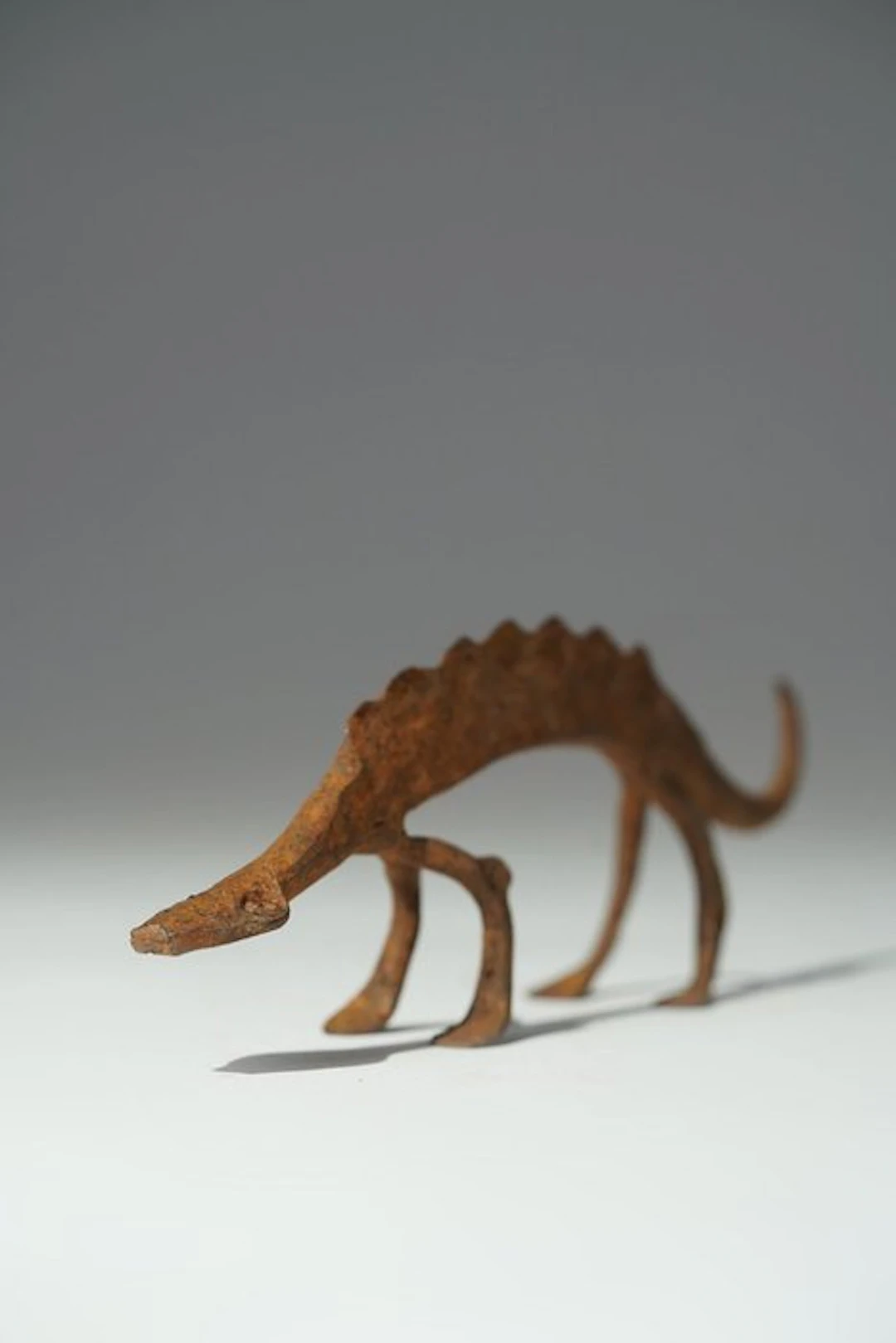
Zoomorphic black iron figure depicting a chameleon, lobi Origin: Kampti region, southwestern Burkina Faso Material: Black iron, reddish-brown to orange in color, with darker areas, pitting, and corrosion scales. Description The object depicts a quadruped with a very elongated, strongly arched body, shaped like a flattened metal blade. Its overall silhouette is low, almost crawling, but it retains a sense of movement thanks to the four curved legs that slightly lift the body. The head, situated at the end of a long, tapered neck or snout, is narrow and flattened. A small circular motif incised or carved on each side appears to indicate the eye. The mouth is only roughly suggested at the tip of the snout. The back features a series of triangular or undulating protrusions forming a serrated crest. This ridge, combined with the upward-curving tail and the feet ending in bifid shapes resembling claws, makes it possible to identify a chameleon rather than a crocodile or a monitor lizard. The coiled tail and prehensile limbs are, in fact, essential characteristics of this animal, although they have been heavily stylized by the blacksmith. The sculpture emphasizes the side view. It is constructed around a long horizontal line running from the snout to the tail, interrupted by the undulations of the back. The forelimbs and hindlimbs are drawn toward the ground by narrow curves, creating several voids beneath the body that play a full part in the composition. The surface now has a reddish-brown to orange coloration, with darker areas, pitting, and corrosion scales. The term "black iron" therefore refers more to the traditional nature of the material than to its current appearance, which has been significantly altered by oxidation. Historical, Artistic, and Technical Analysis This figure reflects an aesthetic based on anatomical simplification. The artisan did not seek an exact zoological reproduction: he selected the elements that make the animal immediately recognizable—dorsal crest, arched body, long head, hooked feet, and curved tail. Volumes are replaced by lines, outlines, and empty spaces. The animal thus appears both material and graphic, like a drawing executed in iron. The central section appears to have been fashioned from a heated iron bar or plate that was stretched and flattened. The legs were likely forged separately or cut out and then bent while hot. Their junction with the body should be examined by X-ray to determine whether they are forged welds, riveted joints, or part of a single piece of metal. The existence of Lobi iron sculptures is confirmed by several museum collections, notably that of the Metropolitan Museum of Art, which houses figures attributed to the Lobi of Burkina Faso and dated to the 20th century. The object's taut, almost calligraphic silhouette differs from anthropomorphic wooden bateba, but it stems from the same desire to give visible presence to a power or entity that is normally invisible. In Lobi art, an object's value does not depend solely on its likeness or formal beauty: it also stems from its origin, the ritual prescription that determined its creation, and the relationships maintained with it. Studies by Piet Meyer and Daniela Bognolo show that Lobi ritual objects must be understood in terms of their spiritual identity, location, and use, and not merely as standalone sculptures. Significant corrosion alone does not allow for the dating of the work or prove its former ritual use. It may result from prolonged exposure to a humid environment, being left on the ground, outdoor exposure, or poor storage conditions. A conservative dating to the 20th century can be proposed based on stylistic comparison, but this should be verified through an examination of provenance, forging techniques, and corrosion products. Ritual Function In Lobi religious beliefs, thila are invisible powers capable of imposing rules, prohibitions, and obligations on humans. When an illness, an accident, or a series of misfortunes occurs, the diviner can identify the power involved and prescribe the creation of an altar or an object made of a specific material and in a specific form. These objects are not necessarily considered to be the deity itself; rather, they facilitate an organized relationship between humans, the sanctuary, and the invisible entity. In this context, the figure shown may have been placed on a domestic, clan-based, or diviner's or healer's altar. It may have represented an animal associated with a thil, served as a prescribed offering, or acted as a protective object. Iron, transformed by fire and the blacksmith's specialized craftsmanship, is particularly suited to functions of defense, fastening, and strength. The identification with the chameleon reinforces the hypothesis of an apotropaic function. Michèle Cros's research in Lobi territory shows that this animal is perceived as an ambivalent being—feared for its ability to change color and render itself nearly invisible, yet also sought after as a protector. Children deemed vulnerable or at risk may, in particular, be given a chameleon-shaped amulet, ritually activated, so that they may symbolically go unnoticed by the forces likely to harm them. This large iron effigy could embody a similar logic on the scale of an altar: harnessing the chameleon's attributed abilities of adaptation, concealment, and vigilance. Its crawling posture may suggest a discreet yet attentive presence, while the lateral eyes recall the animal's ability to monitor multiple directions. However, without testimony from the original owner, the name of the thil, the context of its discovery, or analyzed sacrificial residues, it would be excessive to attribute a single function to it. Interpretations related to protection, healing, divination, and defense against malevolent forces must remain documented hypotheses. Selected Bibliography Bognolo, Daniela. Lobi. Milan, 5 Continents Éditions, 2007. A book devoted to the styles, religious functions, and regional contexts of Lobi statuary. Cros, Michèle. "The Chameleon: An Untouchable Turned Exotic Pet," in Sergio Dalla Bernardina (ed.), From Beast to Non-Human: Perspectives and Controversies Surrounding the Animal Condition. Paris, Éditions du Comité des travaux historiques et scientifiques, 2020. Labouret, Henri. The Tribes of the Lobi Branch. Paris, Institute of Ethnology, 1931. An important historical source, to be used with caution due to its vocabulary and colonial context. Meyer, Piet. Art and Religion of the Lobi. Zurich, Museum Rietberg, 1981, 184 pp. A seminal study of the relationship between sculpture, divination, altars, and spiritual powers. Schneider, Klaus. Lobi Crafts and Material Culture in Burkina Faso. Stuttgart, Franz Steiner Verlag, 1990, 409 pp. A study of Lobi techniques, crafts, and material culture The publications mentioned serve for comparative art historical classification. They do not establish the specific cultural attribution, dating, or original use of the sculpture in question. Copyright and Scientific Documentation Some of the information and photographs have been generated with the assistance of artificial intelligence and are based on published sources in ethnography, archaeology, and art history. Original texts and photographs may be protected by copyright. All rights held by the respective copyright holders are reserved. Inv. No. MAZ32835
Utropspris:SEK 2,336.44
Till auktionenVisa alla föremål frånCatawikiellerEtnografica
Utropspris:
SEK 2,336.44
Nå samlare över hela världen med din auktion!
Lista er auktionGenom att prenumerera godkänner du integritetspolicyn. Avprenumerera när som helst.
Barnebys HQ
Brahegatan 10
BOX 5038
114 37 Stockholm
