



Alla auktioner / Etnografica / A iron sculpture - Mumuye - Nigeria (No reserve price)

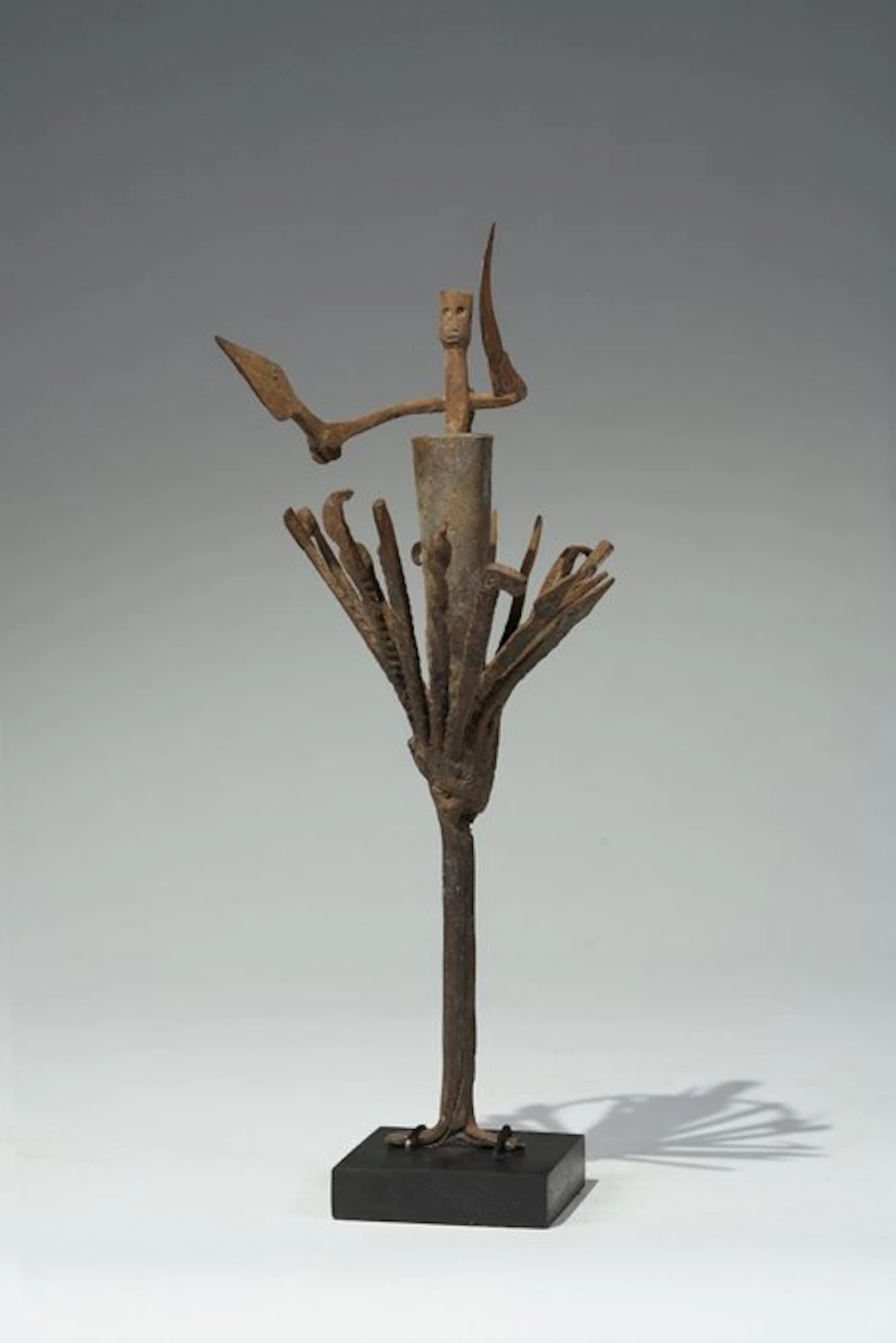
Iron Sculpture of the Mumuye – Anthropomorphic Composition with Radiating Iron Protrusions Provenance: Jalingo Region, Taraba State, Northeastern Nigeria Cultural Attribution: Mumuye, attributed Material: Wrought iron, dark brown to reddish-brown oxidation patina, incl stand. Dating: Uncertain Description This extraordinary iron sculpture is characterized by a complex, vertically organized composition in which anthropomorphic elements are combined with a multitude of ascending, partially curved iron protrusions. A long, narrow shaft forms the supporting central axis of the object and widens in the upper section into a fan-shaped structure of iron rods of varying lengths. These appear to grow from a common, dense center and unfold a dynamic, almost vegetative movement. Some of the protrusions end in irregular points, others are hook-shaped, or have flattened, leaf-like tips. Above this radial structure rises a cylindrical element, from whose upper opening a small anthropomorphic figure emerges. Its elongated neck and body are crowned by a schematically modeled head, whose face is characterized by two sunken eyes, a protruding nose, and a suggested mouth. Two asymmetrically arranged iron arms extend to the sides, their ends merging into flat, tapered forms. The left side appears to extend horizontally, while on the right, a narrow, crescent-shaped extension continues the vertical movement of the overall composition. The surface exhibits a pronounced oxidation structure with dark brown, grayish-black, and rust-red hues. The irregular material density and the visible transitions between the individual elements lend the work a distinctly archaic character. The sculpture is mounted on a modern black display pedestal. Art Historical Context The Mumuye people live primarily in the mountainous and savannah landscapes of what is now the state of Taraba in northeastern Nigeria, particularly in the regions around Jalingo, Zing, and the adjacent areas of the Benue River system. Their artistic traditions became internationally known primarily through anthropomorphic wooden sculptures, whose characteristic formal language is defined by elongated bodies, abstracted facial features, and a pronounced rhythmic structure. These figures, often discussed under the name iagalagana or related regional terms, are connected to the social, religious, and ritual beliefs of the Mumuye people. Alongside wood carving, ironworking held particular economic and symbolic significance in numerous societies of the Benue region of Nigeria. Blacksmiths possessed specialized technical knowledge that enabled the transformation of mineral raw materials into tools, weapons, and occasionally ceremonial objects. The present object, however, differs significantly from the canonical Mumuye wooden figures. Its construction, developed from numerous forged individual elements, is more reminiscent of an assemblage-like iron sculpture, whose form mediates between anthropomorphic representation and abstract symbolic form. A definitive typological classification within the documented Mumuye art is not possible based on the photograph alone. The combination of a small human head with outstretched, leaf- or blade-shaped protrusions, in particular, requires further comparative study. The cultural attribution should therefore be considered provisional until clarified by reliable comparative objects and provenance information. Symbolism and Iconography The iconographic distinctiveness of this sculpture lies in the combination of a human head with a complex structure of radially arranged iron forms. The anthropomorphic crowning element forms the visual focal point of the upper section and could refer to a personified force, a protective figure, or a symbolic embodiment of human agency. The two laterally extending elements, in their arrangement, are reminiscent of raised arms, while their flattened ends simultaneously evoke associations with blades, leaves, or abstracted tools. The wreath of ascending iron rods below can be formally interpreted as a kind of radiating beam. Its varying lengths and curvatures create the impression of movement directed outward and upward from the central shaft. An interpretation as a symbol of growth, expansion, or the unfolding of spiritual efficacy is conceivable, but remains speculative. Likewise, individual extensions could originally have represented concrete objects or attributes whose meaning of the original form is no longer immediately recognizable. The combination of human physiognomy and non-figurative iron forms points to a conception of art in which the human figure is not depicted naturalistically, but rather augmented by additional sculptural elements. Whether these augmentations symbolized specific forces, social relationships, or ritual acts in their original cultural context cannot be determined without corresponding ethnographic documentation. Ritual Function and Cultural Context Within various societies of the Benue region, wrought iron objects were not exclusively practical everyday items, but could also possess social, political, or religious significance. The special properties of iron—its durability and the technically demanding production process—gave the material a high status in different cultural contexts. However, no uniform, cross-cultural symbolism can be derived from this. For the Mumuye, the ritual functions of certain anthropomorphic wooden figures are particularly well documented; these figures were associated, among other things, with protective beliefs, healing practices, and the social authority of specialized individuals. Whether the present iron sculpture was used in comparable contexts has not been established. Its elaborate construction and the clearly emphasized human crowning feature could indicate a use outside of everyday life. It could have served as a symbolic representation, as part of a ceremonial display, or within a ritual ensemble. A later production inspired by traditional forms cannot be ruled out without a confirmed date and provenance. The visible oxidation indicates a change in the metal surface but does not allow for a reliable determination of its age or original use. Art Historical Assessment The exceptional artistic quality of this iron sculpture lies in its unusual combination of linear construction, sculptural density, and spatial openness. Unlike a sculpture developed from a solid block of material, the form here emerges from the interplay of individual forged elements, the spaces between which contribute to the composition as significantly as the iron itself. The slender shaft lends the work a clear vertical orientation, while the radially extending projections disrupt this order with a lively, asymmetrical movement. The small anthropomorphic crowning element forms a deliberate contrast to the abstract structure of the lower section. Its simplified physiognomy focuses attention on a few essential features of human appearance. Particularly noteworthy is the tension between the material weight of the iron and the almost graphic lightness of the sweeping forms. Subject to the reservation of its cultural attribution, which is yet to be verified, the object represents an interesting example of the sculptural possibilities of wrought iron within the broader context of West and Central African metalwork. Its art historical significance lies primarily in its unique formal conception, which unites anthropomorphic symbolism and abstract spatial design into an expressive sculptural whole. Literature Frank Herreman (ed.): Mumuye: Sculpture from Nigeria – The Human Figure Reinvented. Brussels: Mercatorfonds, 2016. Marla C. Berns, Richard Fardon, and Sidney Littlefield Kasfir (eds.): Central Nigeria Unmasked: Arts of the Benue River Valley. Los Angeles: Fowler Museum at UCLA, 2011. Copyright and Scientific Documentation Some of the information and photographs have been generated with the assistance of artificial intelligence and are based on published sources in ethnography, archaeology, and art history. Original texts and photographs may be protected by copyright. All rights held by the respective rights holders are reserved. Inv. No. MAZ31683 Informant: Amadou Dogo
Utropspris:SEK 3,059.63
Till auktionenVisa alla föremål frånCatawikiellerEtnografica
Utropspris:
SEK 3,059.63
Nå samlare över hela världen med din auktion!
Lista er auktionGenom att prenumerera godkänner du integritetspolicyn. Avprenumerera när som helst.
Barnebys HQ
Brahegatan 10
BOX 5038
114 37 Stockholm
