
Alla auktioner / Etnografica / A wooden sculpture - Ewe - Ghana (No reserve price)

A wooden sculpture - Ewe - Ghana (No reserve price)
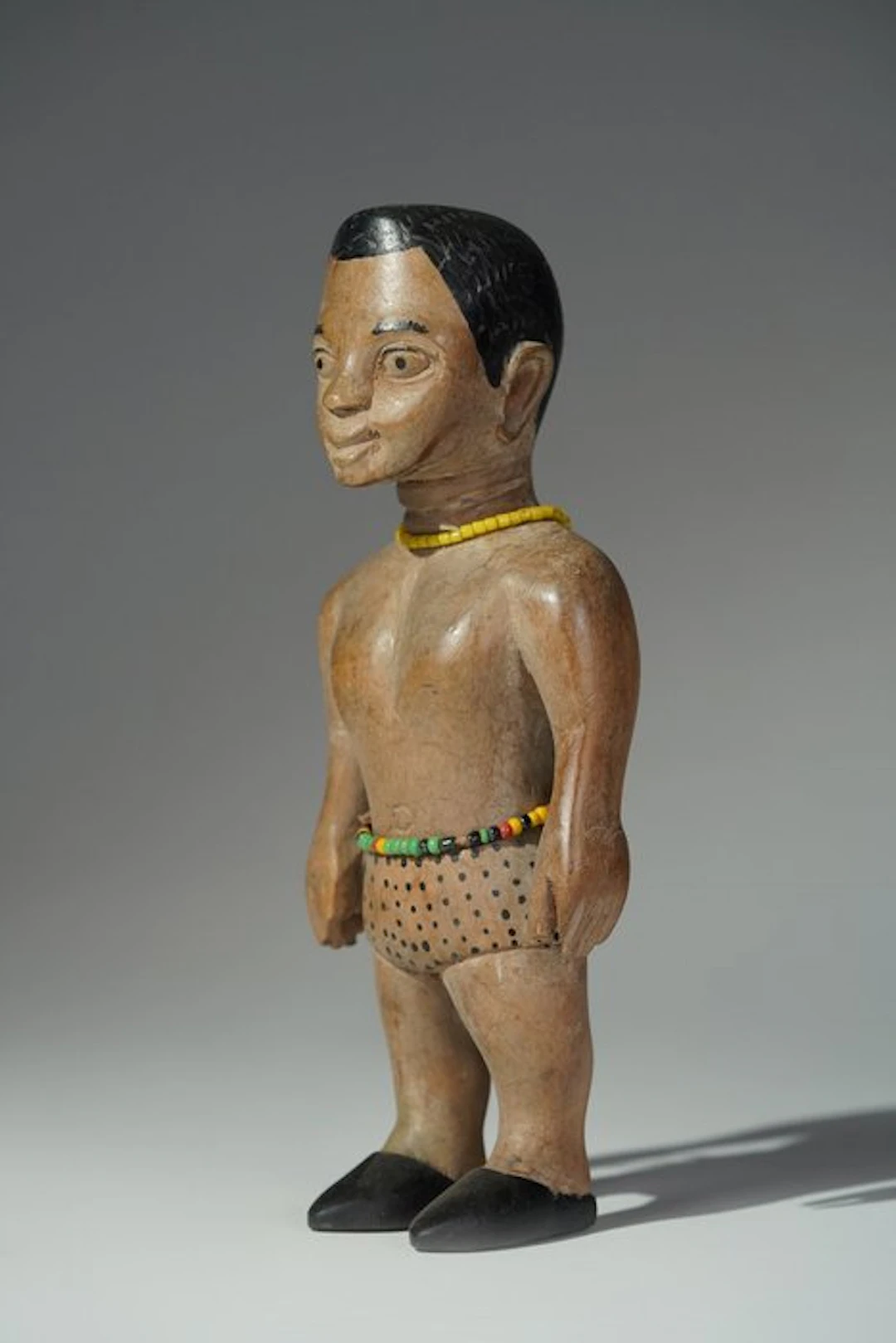
Ewe venavi/Hohovi sculpture, Ho region, Ghana Surface scratches and lighter-colored areas This polychrome wooden statuette, Ewe, depicts a standing male figure, bare-chested, with his arms lowered and his legs slightly apart. The head, which is proportionally large, features a broad forehead, large eyes with black pupils, a prominent nose, and a mouth whose lips form a slight smile; the black hair, marked by fine incisions, contrasts with the light brown hue of the face. Horizontal folds mark the neck, while the hands are simplified, with fingers indicated by notches. The figure wears short breeches adorned with black dots and shoes painted black; a necklace of yellow beads and a belt of multicolored beads complete the adornment. The surface, which is partially polished, shows scratches and lighter areas, though these marks do not indicate any specific ritual use. From an ethnological perspective, venavi are associated with practices related to twinning among the Ewe people, who live in Togo, Ghana, and Benin: when a twin dies, an effigy may be created to house their spiritual presence and preserve their place within the family. These figures may be given food, care, and clothing; their sometimes modern appearance—particularly their shoes and clothing—reflects the belief that the deceased remains connected to the world of the living. "These beautiful figures were used for the cult of the twins. Coming closer to Yoruba beliefs, the Ewe, on the death of a twin, had a statuette carved in his or her likeness and looked after it like a living child. "The Ewe, who live in southern Togo and Ghana are the eastern neighbors of Asante. They are probably best known for their textiles and also for small wooden dolls called "venovi" or "venavi" which are used like the Yoruba people in Nigeria used Ibeji twin figurines, for protection of survivor after death of a twin. Some scholars state that they are also used as children's dolls as well as sometimes used as fertility dolls by women who keep these dolls under their mattresses or were worn under the skirts of young women to ensure fertility. Scarifications and added clothing and strings of beads reveal family and clan religious and social affiliations." Source: ISN'T S/HE A DOLL. The Ho Region in Ghana's Volta Region is part of the western settlement area of the Ewe people. There, and in neighboring Togo, wooden surrogate figures for deceased twins are known as venavi. They were not merely memorial images but could be cared for, washed, clothed, and looked after like living family members. Characteristic features often include an upright posture, light-colored wood, and partially blackened hairstyles or feet. Doro theum: The strikingly modern appearance of the man in question simultaneously illustrates that venavi are not static representations, but rather mutable embodiments of social memory. Literature (Selection): Hans Scheutz: The Twin Figures of the Ewe (Venavi Figures). Vienna 2022. Lit Verlag Henricus Simonis: EWE – Twin Figures. Cologne 2008. csaamilano.it Karl-Ferdinand Schädler: Encyclopedia of African Art and Culture. Munich 2009. Some of the information and photos are generated by artificial intelligence and is based on published sources from the fields of ethnography, archaeology, and art history documents. All information and photos are protected by copyright. Inv. No. MAZ29732 Informant Ouro
Utropspris:SEK 1,680.53
Till auktionenVisa alla föremål frånCatawikiellerEtnografica
Utropspris:
SEK 1,680.53
Liknande föremål

Auktionsresultat för liknande föremål

Nå samlare över hela världen med din auktion!
Lista er auktion