




Alla auktioner / Etnografica / A wooden sculpture - Lobi - Burkina Faso (No reserve price)

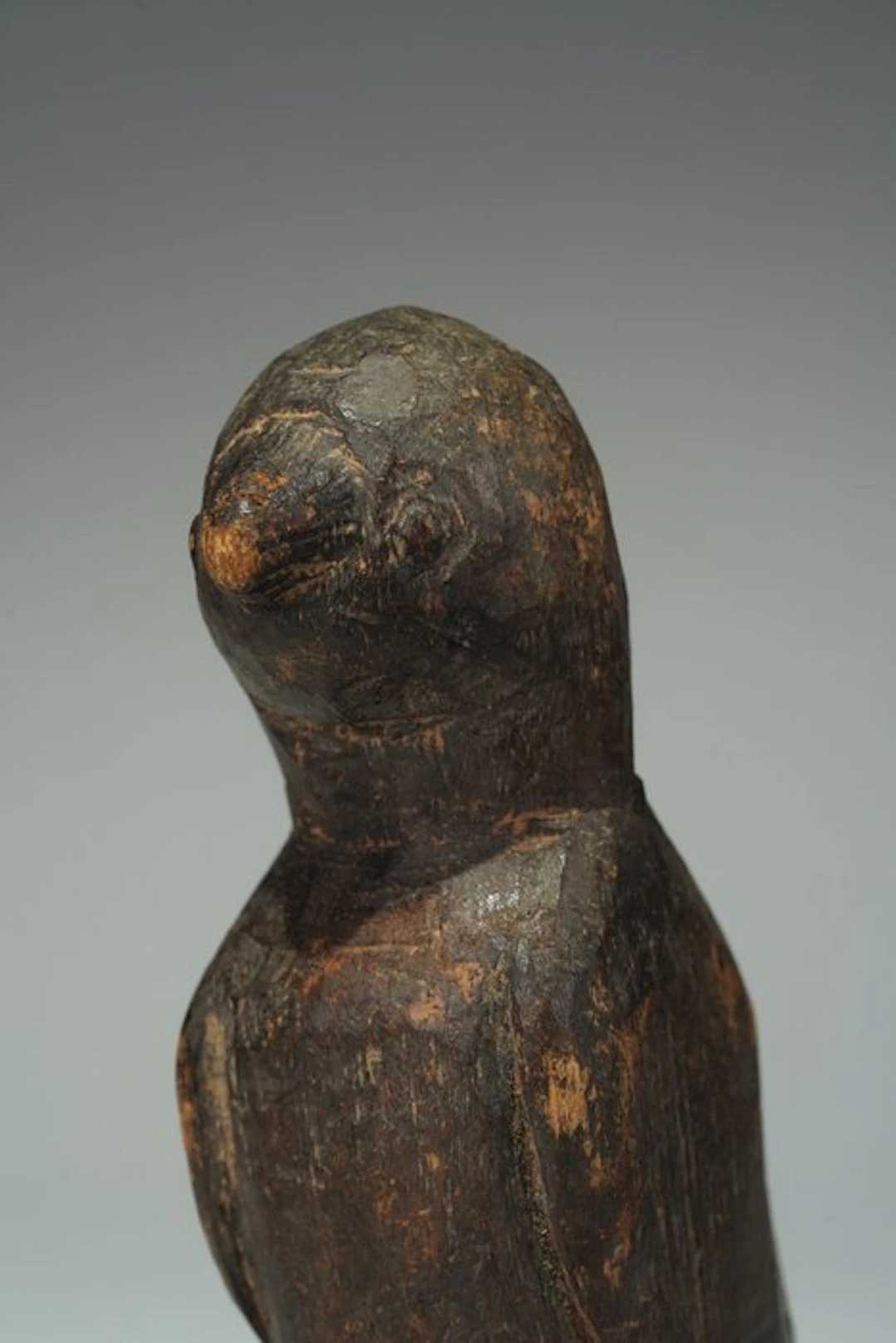
Lobi Bird Sculpture Origin: Loropéni Region, southwestern Burkina Faso Cultural Attribution: Lobi Material: Wood, carved, with a dark, partially worn surface patina, incl stand. Inventory/Photo Reference: MAZ30651 Description This bird sculpture from the Loropéni Region in southwestern Burkina Faso is characterized by remarkable formal unity and a design that is both minimalist and expressive. Carved from a single piece of wood, the figure depicts an upright bird with a slightly forward-leaning body, a strong neck, and a comparatively large, rounded head. The short, forward-pointing beak, together with the subtly suggested eyes, forms the physiognomic focal point of the representation. The compact body develops from a narrow neck and widens into an elongated, almost closed volume. The folded wings are set off from the body by shallow, longitudinal incisions and gentle, three-dimensional gradations. Their lower ends transition into a slightly backward-pointing, pointed shape, reminiscent of the tail feathers. The short, sturdy legs form a solid base, their vertical notches suggesting a simplified representation of the toes. The dark brown to blackish surface exhibits numerous lighter abrasions, fine cracks, and irregular indentations. Warmer, ochre-colored wood tones are particularly prominent on the head, breast, and base. These variations lend the figure a vibrant, historically evolved surface texture, but in themselves do not permit a reliable dating or any conclusions about a specific ritual use. The bird's overall serene, almost monumental posture is emphasized by its closed silhouette and the balanced proportions between head, body, and base. Cultural and Geographical Context The Lobi are among the ethnic groups of southwestern Burkina Faso whose historical settlement areas extend across the current national borders into northern Ghana and northeastern Côte d’Ivoire. The region around Loropéni lies within a culturally diverse landscape where the Lobi, Birifor, Dagara, and other neighboring communities have been in contact with one another for a long time. Lobi religious beliefs are traditionally characterized by a complex relationship between humans, ancestors, and supernatural powers. Of particular importance are the spiritual entities known as thila, whose influence can manifest in various aspects of individual and communal life. Material objects associated with them, including anthropomorphic and zoomorphic wooden figures, are often collectively referred to as bateba, with their specific meaning depending significantly on their production, ritual activation, and integration into religious practices. Such sculptures could be placed in domestic shrines and associated with protection, illness, fertility, or the resolution of social conflicts. However, not every carved animal figure from the Lobi cultural sphere can necessarily be considered a bateba. Without additional information about its original placement and use, the functional classification of the present bird remains unclear. Symbolism and Possible Ritual Function Birds possess a multifaceted symbolic meaning in numerous West African societies. Their ability to move between earth and sky can make them symbols of the transition between different realms of existence. Certain bird species appear in regional traditions as bearers of messages, as omens, or as beings with special spiritual qualities. However, these general notions cannot simply be applied to every Lobi bird representation. For the present object, neither the depicted bird species can be definitively identified, nor is a specific mythological or religious identity documented. The stocky body, the short beak, and the upright posture could be reminiscent of a bird of prey or another powerfully built bird; A zoologically precise identification would be speculative given the deliberate stylization. If the figure was originally part of a shrine, a connection to a spiritual guardian spirit would be conceivable. Likewise, the possibility of another, as yet undocumented, use must be considered. The object's symbolic message therefore lies primarily in its sculptural presence and in the artistic condensation of the characteristic appearance of a bird. Art Historical Analysis The Special Quality The strength of this sculpture lies in its consistent reduction to a few, carefully coordinated formal elements. The sculptor largely forgoes naturalistic details, instead developing a sculptural structure in which volume, contour, and posture are the essential means of expression. The large head appears to have grown directly from the powerful neck, while the laterally positioned wings enclose the body like a protective shell. The minimal differentiation between the anatomical parts creates a cohesive, architecturally striking overall form. Particularly characteristic is the interplay between the softly rounded sections of the head and the more angular surfaces of the wings and legs. The irregular surface, marked by signs of use and aging, reinforces the impression of material density. Within the broader context of wood sculpture in southwestern Burkina Faso, the figure can be attributed to an artistic tradition in which expressiveness often arises less from anatomical accuracy than from a conscious focus on posture, presence, and sculptural effect. Nevertheless, it would be methodologically problematic to deduce a specific workshop, an individual sculptor, or a narrower chronological classification from this formal similarity. The cultural attribution to the Lobi people and the provenance designation of Loropéni form the established framework for art historical analysis. Art Historical Appraisal The bird sculpture from Loropéni impresses with its quiet, concentrated expressiveness. Its effect arises from the combination of a clear, almost abstract silhouette with a vibrant, nuanced wooden surface. The bird appears neither as a mere study of nature nor as an ornamentally embellished animal representation, but as an independent sculptural form of remarkable presence. The very restraint of the sculptural means lends the object a special aesthetic intensity. Within West African sculptural traditions, the figure illustrates how animal representations, through formal simplification, can develop an expressiveness that transcends their immediate representational appearance. Their art historical value lies in this combination of regional formal language, material-related design, and a possible, though not definitively established, spiritual meaning. Literature Piet Meyer: Art and Religion of the Lobi. Museum Rietberg, Zurich, 1981. Daniel Bognolo: Lobi. 5 Continents Editions, Milan, 2007. Copyright and Scientific Documentation Some of the information and photographs have been generated with the assistance of artificial intelligence and are based on published sources in ethnography, archaeology, and art history. Original texts and photographs may be protected by copyright. All rights held by the respective copyright holders are reserved.
Utropspris:SEK 2,338.12
Till auktionenVisa alla föremål frånCatawikiellerEtnografica
Utropspris:
SEK 2,338.12
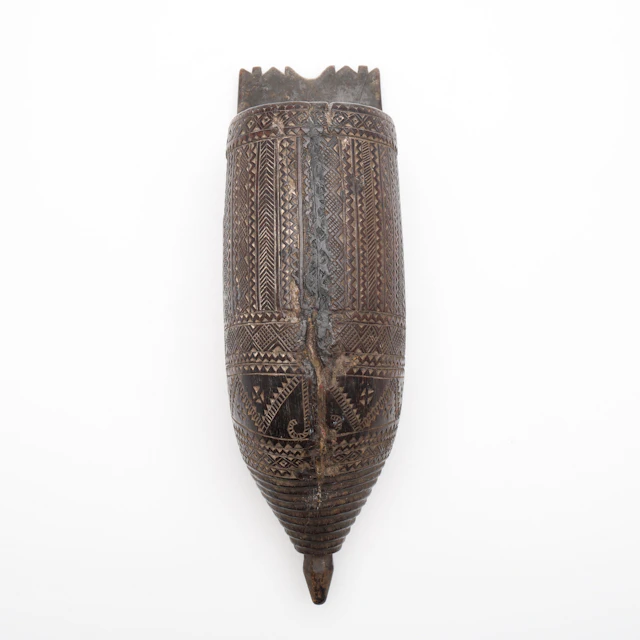
KOGER/BEHÅLLARE, TONGAÖARNA, DATERAD 1938.
10/24/2026
SEK 1,500
Uppsk.: SEK 800
Nå samlare över hela världen med din auktion!
Lista er auktionGenom att prenumerera godkänner du integritetspolicyn. Avprenumerera när som helst.
Barnebys HQ
Brahegatan 10
BOX 5038
114 37 Stockholm
