

OCT 8 | 3:00 PM

Nå samlare över hela världen med din auktion!
Lista er auktionGenom att prenumerera godkänner du integritetspolicyn. Avprenumerera när som helst.
Barnebys HQ
Brahegatan 10
BOX 5038
114 37 Stockholm
Alla auktioner / Böcker, Kartor och Texter / Alberto da Castello - Rosario della Gloriosa Vergine Maria - 1616

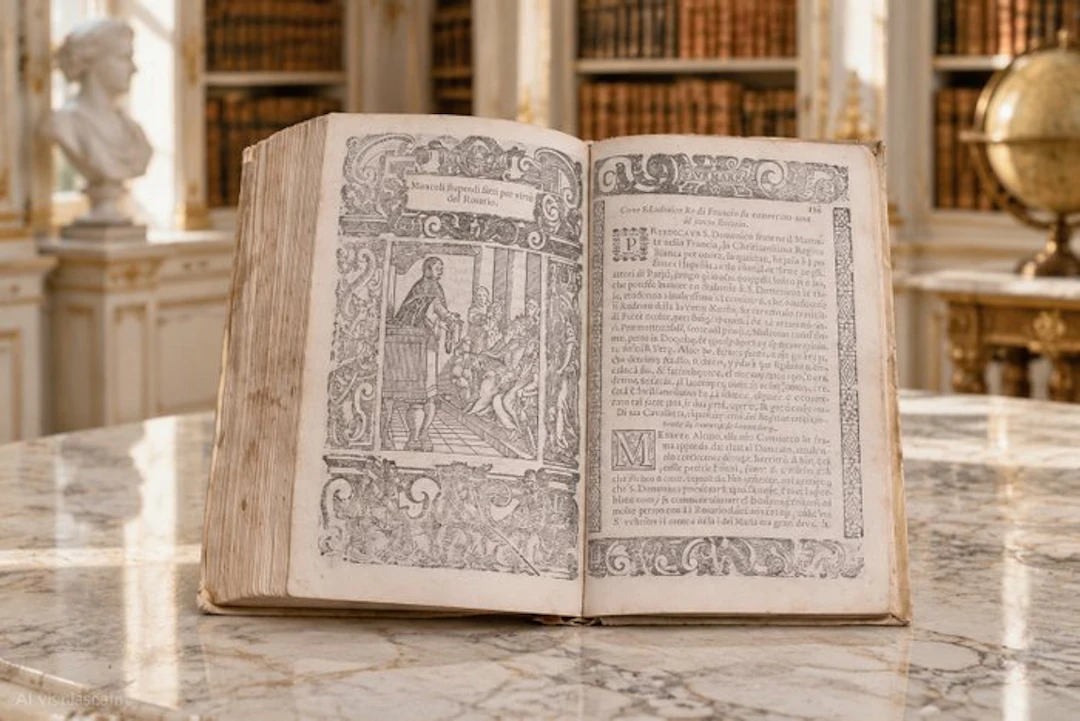
A RENAISSANCE ROSARY IN WOODCUTS: VENICE 1616 AND THE VISUAL DEVOTION OF ALBERTO DA CASTELLO ABSTRACT A rare Venetian edition from 1616 of one of the most celebrated illustrated devotional books of the Sixteenth and early Seventeenth century. The Rosary of the glorious Virgin Mary, attributed to the Dominican Alberto da Castello, combines prayer, meditation, indulgences and an extraordinary sequence of woodcuts dedicated to the life of Christ and of the Virgin. This edition, printed in Venice by Comino Gallina, preserves the characteristic figurative structure of the work: each page is set within rich woodcut borders and numerous scenes occupy entire pages. The book enjoyed enormous editorial fortune and was reissued for nearly a century, becoming one of the most recognizable illustrated Rosary manuals in post-Tridentine Italy. A contemporaneous parchment exemplar, with signs of use and ancient handwritten notes, but with a largely preserved interior and strongly decorative. WHY TO BUY EARLY SEVENTEENTH-CENTURY VENETIAN EDITION – Venetian edition of 1616, printed by Comino Gallina, of a work born in the early Sixteenth century and reissued for generations. A MASTERPIECE OF DEVOTIONAL WOODCUT – All pages are enclosed by elaborate woodcut frames and the text is accompanied by numerous full-page scenes, creating an effect resembling a popular book of hours. ALBERTO DA CASTELLO – Work attributed to the Dominican Alberto da Castello, who died in 1522, first published in Venice in the same year, 1522. STRONG COLLECTING APPEAL – Combines Marian devotion, religious iconography, Venetian woodcuts and the history of printing, thus appealing to multiple collecting interests simultaneously. MARKET VALUE Editions of the Rosary of the glorious Virgin Mary show highly variable values depending on date, completeness, quality of the woodcuts, conservation and binding. Sixteenth- and early Seventeenth-Century editions are significantly more interesting than late reprints, especially when they preserve the iconographic sequence and decorative borders. For the present 1616 exemplar, in contemporary parchment, with a rich woodcut apparatus, it represents an antique market range of about €600–900. PHYSICAL DESCRIPTION AND CONDITION Contemporary full parchment binding, with flat spine, signs of use, stains, waviness and small losses, particularly near the headcaps and edges. Marbled parchment and time-stained, yet coherent with ancient devotional use. The title page is fully figured in woodcut, within a rich architectural and ornamental frame, with Marian and Christological scenes. All pages are framed by elaborate woodcut borders; numerous full-page woodcuts illustrate episodes from the life of Christ, of the Virgin, of the saints, of the Rosary and of miracles connected to Marian devotion. A dark ink blot at the upper margin of the title page, not substantially compromising the title. Presence of ancient handwritten notes in the flyleaves. Some leaves show small halos, browning, sporadic creases, abrasions and marginal wear. Some numbering errors. In old books, with a centuries-long history, a few imperfections may be present, not always noted in the description. This listing contains AI Visualizations. Please refer to the original photographs to verify the object's actual condition. The images form an integral part of the description. Pp.: (2); 504, 8nn; (2). FULL TITLE AND AUTHOR Rosary of the glorious Virgin Mary. In Venetia, appresso Comino Gallina, 1616. Alberto da Castello. CONTEXT AND SIGNIFICANCE The Rosary of the glorious Virgin Mary belongs to one of the most important currents of Catholic spirituality in the 16th century: the diffusion of the Rosary as a daily practice of meditation accessible even to laypeople. The work combines devotional text, indulgences, liturgical instructions, meditations on the life of Christ and the Virgin and an exceptionally rich figurative apparatus. Its strength lies precisely in the integration of image and prayer. The woodcuts are not mere ornaments, but meditative tools: they guide the reader through the Annunciation, the Visitation, the Nativity, the Passion, the Crucifixion, the Resurrection, Marian episodes, miracles and scenes related to the spread of the Rosary. The 1591 edition preserved and digitized on Internet Archive is described with numerous woodcuts and decorative frames, mostly obtained from multiple blocks, and with each page set within an ornamental apparatus. The present 1616 exemplar clearly follows the same iconographic model. Also particularly important is the link with Dominican devotion. The Rosary was vigorously promoted by the Order of Preachers and Alberto da Castello’s work contributed decisively to its standardization of iconography and meditational structure. BRIEF BIOGRAPHY OF THE AUTHOR Alberto da Castello was an Italian Dominican active between the late 15th and early 16th centuries, who died in 1522. He is best known as a compiler and promoter of devotional texts related to the Rosary and Marian spirituality. His most famous work, the Rosary of the glorious Virgin Mary, enjoyed vast editorial fortune. Sixteenth- and Seventeenth-Century reprints attest to the text’s ability to adapt to the new post-Tridentine religious culture while maintaining the original figurative framework. Modern bibliography consistently identifies the author as Alberto da Castello and links the first Venetian edition to 1522. PRINTING HISTORY AND CIRCULATION The first known edition of the Rosary of the glorious Virgin Mary was published in Venice in 1522 by Melchiorre Sessa and Pietro de Ravani. The work was later reprinted many times throughout the 16th century and in the early 17th, with documented editions in 1551, 1564, 1566, 1587, 1591, 1599, 1608 and 1616, among others. Google Books and Open Library preserve digitizations of various reprints; the 1591 edition, for example, is described with 252 leaves and a richly carved woodcut apparatus. The 1599 edition is registered by LILLIT/SBN with 252 + [4] leaves, woodcut illustrations, frames, vignettes and a figured title page. The 1616 edition at Comino Gallina is documented by Google Play Books with an attribution to Albertus Castellanus and 504 scanned pages, corresponding to 252 leaves. This long editorial continuity demonstrates the extraordinary success of the work and its centrality in Italian Marian devotion between the Renaissance and the Counter-Reformation. BIBLIOGRAPHY AND REFERENCES EDIT16, repertory of Italian editions of the XVI century, entry Alberto da Castello / Rosario della gloriosa Vergine Maria. LILLIT – Libri Illustrati Italiani 1501–1800, card ICCU CNCE 075102, Venice edition, Giorgio Varisco, 1599; 252 + [4] leaves; silographs, frames, vignettes and title page. Google Books / Google Play Books, Albertus Castellanus, Rosario della gloriosa virginis Maria, Venice, Comino Gallina, 1616. Wikimedia Commons / Internet Archive, Rosario della gloriosa Vergine Maria, illustrated exemplar of the 1591 edition, with bibliographic note on the first edition of 1522. Open Library, Rosario della gloriosa Vergine Maria, 1591 edition, 252 leaves, attribution to Alberto da Castello and EDIT16 references. Google Books, Alberto da Castello, Rosario della gloriosa Vergine Maria, 1566 edition. PatER – Regione Emilia-Romagna, references to the iconographic influence of Alberto da Castello’s Rosario della gloriosa Vergine Maria on Italian figural culture of the Sixteenth century. WorldCat, Alberto da Castello, Rosario della gloriosa Vergine Maria. CERL Heritage of the Printed Book Database, Venetian editions of the Rosary and printers active in the early modern period. SBN – Servizio Bibliotecario Nazionale, repertories of illustrated Italian editions of the Rosary.
Utropspris:SEK 3,359.85
Till auktionenVisa alla föremål frånCatawikiellerBöcker, Kartor och Texter
Utropspris:
SEK 3,359.85
OCT 8 | 3:00 PM
Nå samlare över hela världen med din auktion!
Lista er auktion
SEK 3,317.83
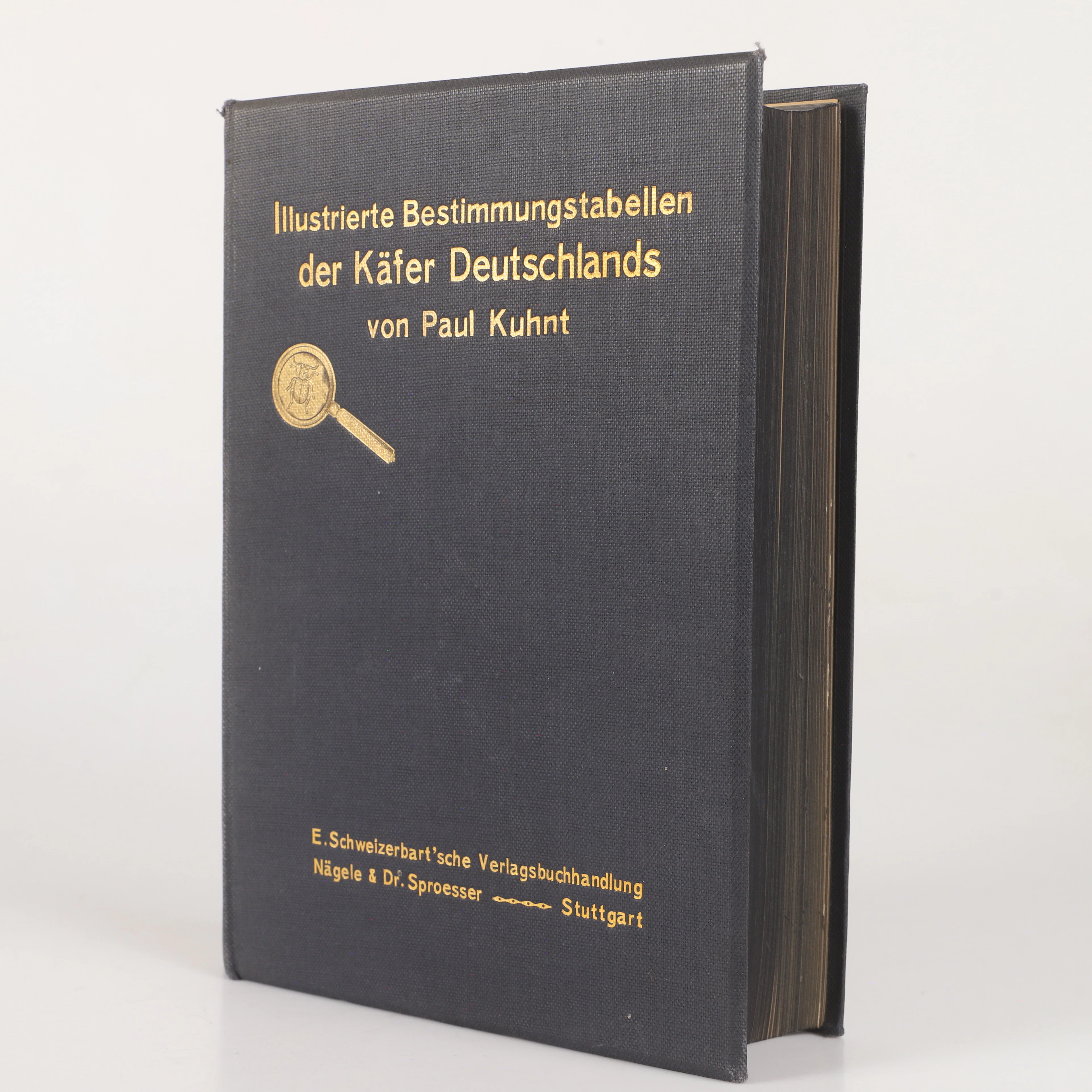
BOK, "Illustrierte bestimmungstabellen der käfer Deutschland"Paul
10/06/2026

SEK 300
Uppsk.: SEK 400