

OCT 8 | 3:00 PM

Nå samlare över hela världen med din auktion!
Lista er auktionGenom att prenumerera godkänner du integritetspolicyn. Avprenumerera när som helst.
Barnebys HQ
Brahegatan 10
BOX 5038
114 37 Stockholm
Alla auktioner / Böcker, Kartor och Texter / Ambrosio Calepino; Luc'Antonio Beuilacqua...

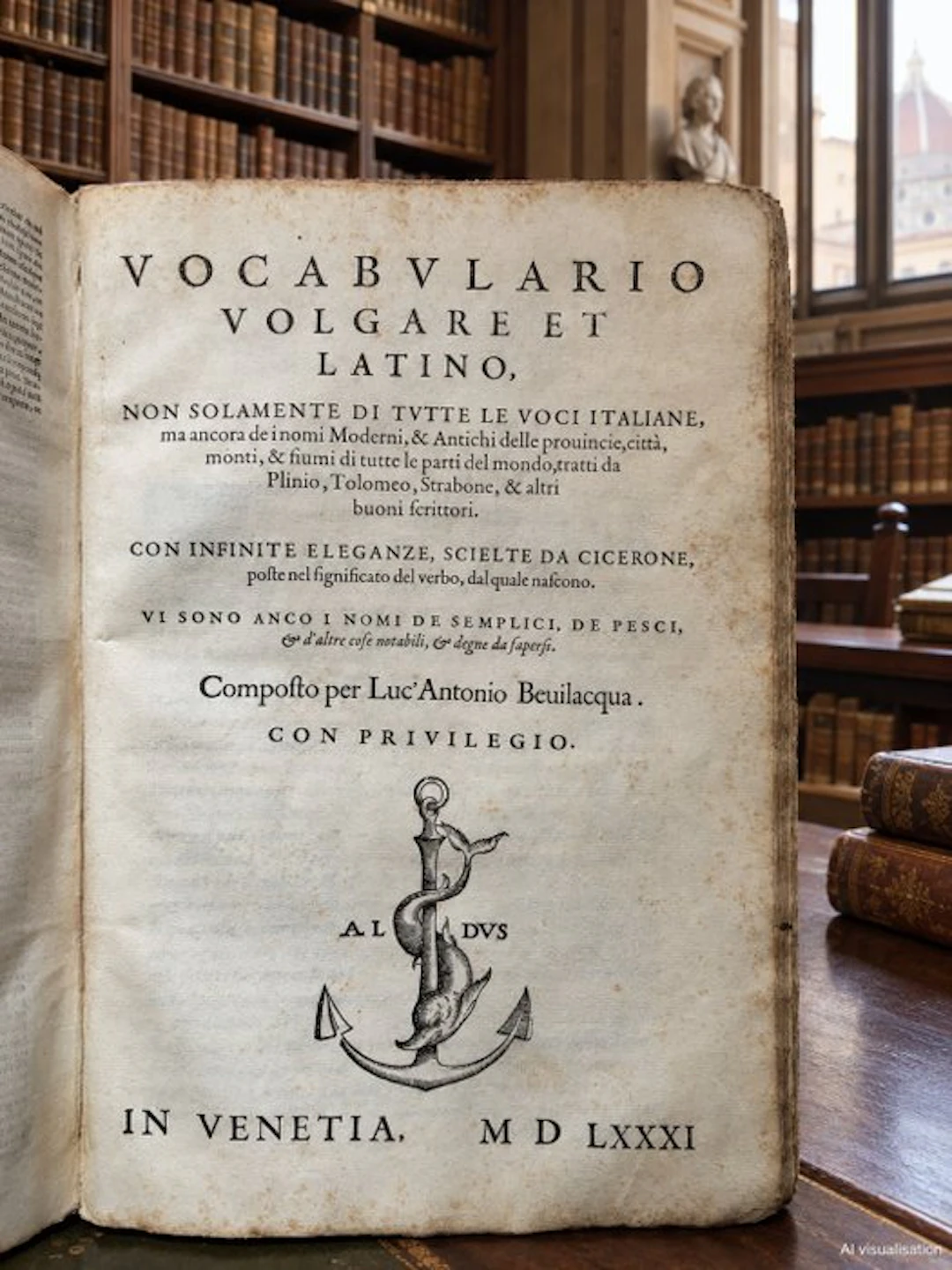
The two volumes we present, Ambrogio Calepino's Dictionarium and Luca Antonio Bevilacqua's Vocabulario volgare et latino, belong to the great tradition of European Renaissance lexicography. Both works were published in Venice in 1581 by Aldo Manuzio the Younger and testify to the importance that, in the culture of the sixteenth century, the study of languages, translation, and the Latin language assumed. The two books can be considered complementary: the Dictionarium stems from the long tradition of Ambrogio Calepino's great Latin dictionary, while Bevilacqua's Vocabulario starts from the words of the Italian vernacular to relate them to Latin and to the classical cultural heritage. Ambrogio Calepino and the Dictionarium Ambrogio Calepino, also known as Calepino, was born in Bergamo around 1435 and entered the Order of the Hermits of Saint Augustine in 1458. He devoted much of his life to the study and compilation of his great Latin dictionary. The first edition of the Dictionarium appeared in 1502, and the work subsequently enjoyed extraordinary editorial success, being continually revised, expanded, and enriched. Calepino's original objective was not simply to provide a list of words. His project belonged to the culture of Humanism, which sought to recover the Latin of classical authors and to move away from forms considered corrupt or too distant from the language of ancient times. The dictionary thus becomes a tool for understanding, translating, and using classical Latin correctly. The 1581 Venetian edition is, however, the result of a long evolution of the work. The text had been deeply revised and expanded, also thanks to the contributions of Paolo Manuzio, father of Aldo the Younger. The frontispiece of the 1581 edition indeed recalls the Additamenta Pauli Manutii, dedicated to the comprehension and elegance of the Latin language and to knowledge of Roman antiquities. The Dictionarium is therefore not merely a dictionary in the modern sense: it is also a genuine instrument for studying classical culture. The Latin entries are accompanied by linguistic explanations and interpretations; in the sixteenth-century versions there were also additions of equivalents in modern languages. The 1581 edition belongs to a tradition that includes, alongside Latin, Italian, French, and Spanish interpretations. Luca Antonio Bevilacqua and the Vocabulario volgare et latino The second volume is Bevilacqua's Vocabulario volgare et latino, published also in Venice in 1581. Already the long title makes clear the work's ambition: it does not limit itself to Italian words, but also includes modern and ancient names of provinces, cities, mountains, and rivers from different parts of the world, drawn from ancient authors such as Pliny, Ptolemy, and Strabo. The title also recalls the numerous elegances drawn from Cicero and used to explain the meanings of verbs. The Vocabulario thus occupies a particularly interesting crossroads between the Italian language and Latin. The vulgar Italian is used as a starting point to arrive at the correct Latin expression, while ancient authors constitute the cultural and linguistic model of reference. The work also has an important encyclopedic dimension: through the words one is provided with information about places, geographic names, ancient culture, and language use. The presence of references to Pliny, Ptolemy, Strabo, and Cicero shows that the vocabulary was not conceived merely as a practical manual, but as a tool for engaging with the literary and scientific heritage of antiquity. The printer: Aldo Manuzio the Younger One element that unites the two books in a particularly meaningful way is the printer. The 1581 editions are attributed to Aldo Manuzio the Younger, born in Venice in 1547, son of Paolo Manuzio and grandson of the famous Aldo Manuzio the Elder. He thus belonged to the renowned family of printers and publishers who had made a fundamental contribution to Venetian and European book culture. It is important to note that when one speaks of “Manuzio” for these 1581 editions one should not think of Aldo the Elder, who died in 1515, but of Aldo Manuzio the Younger. The latter had inherited the family printing tradition, while also dedicating himself to humanistic studies and teaching. Aldo the Younger was, in fact, above all a scholar, philologist, and teacher, as well as a printer. He taught in Venice, Bologna, Pisa, and Rome and possessed a very important personal library. In 1590 he also took on the direction of the Vatican Press, a position he held until his death, which occurred in Rome in 1597. The presence of Manuzio's name on both volumes is thus particularly meaningful: it links two lexicographic works to the great Humanistic tradition of Venetian printing. The significance of the two books Seen together, the two volumes well represent a fundamental aspect of sixteenth-century culture: the conviction that the study of language was inseparable from the study of history, literature, and culture. The Dictionarium primarily starts from Latin and offers the reader the tools necessary to understand its vocabulary, expressions, and classical tradition. Bevilacqua's Vocabulario performs, in many ways, a complementary journey: it starts from vernacular Italian and leads toward Latin, also incorporating geographical information and references to ancient authors. In both cases the dictionary becomes much more than a simple alphabetical repertory. It is a tool for transmitting knowledge. Words are connected to the authors' texts, to places, to history, and to the various European languages. This also explains why Calepino enjoyed exceptional fortune: the dictionary born from the work of a fourteenth-century Bergamasque priest continued to be modified and reprinted for centuries, becoming one of the most important lexicographic tools of modern Europe. Conclusion The two 1581 books thus constitute a precious testimony of Renaissance book culture and humanism. Calepino's Dictionarium represents the long tradition of studying and rediscovering classical Latin; Bevilacqua's Vocabulario volgare et latino shows instead the ever-closer relationship between vernacular Italian and Latin, enriched by references to geography and to authors of antiquity. The fact that both works were published in Venice in 1581 by Aldo Manuzio the Younger adds further historical value to their joint presence. They are books born in an environment where printing was not merely a means to reproduce texts, but a fundamental instrument to preserve, correct, organize, and disseminate knowledge. Ultimately, these two volumes tell more than a simple story of words: they recount the passage from Humanism to modern European culture, the dialogue between Latin and vernacular, the rediscovery of antiquity, and the decisive role that Venetian printing and the Manuzio family played in disseminating knowledge. For this reason, two seemingly specialized works like these can be considered today as important testimonies of the history of culture, language, and the book. Collation and state of preservation. Dictionarium Ambrosii Calepini: 4pp, (246pp)- (243pp)- (20pp) Vocabulario volgare et latino: 4pp. (50pp) excellent state of preservation; to be noted are restorations to the frontispiece, minor foxing; contemporary binding, slightly bumped at the spine, as shown in the photo; overall a respectable copy Shipping Express shipping that will allow you to receive the volume in only 24 working hours for EU countries and 48 hours for non-EU countries
Utropspris:SEK 2,477.24
Till auktionenVisa alla föremål frånCatawikiellerBöcker, Kartor och Texter
Utropspris:
SEK 2,477.24
OCT 8 | 3:00 PM
Nå samlare över hela världen med din auktion!
Lista er auktion
SEK 3,317.83
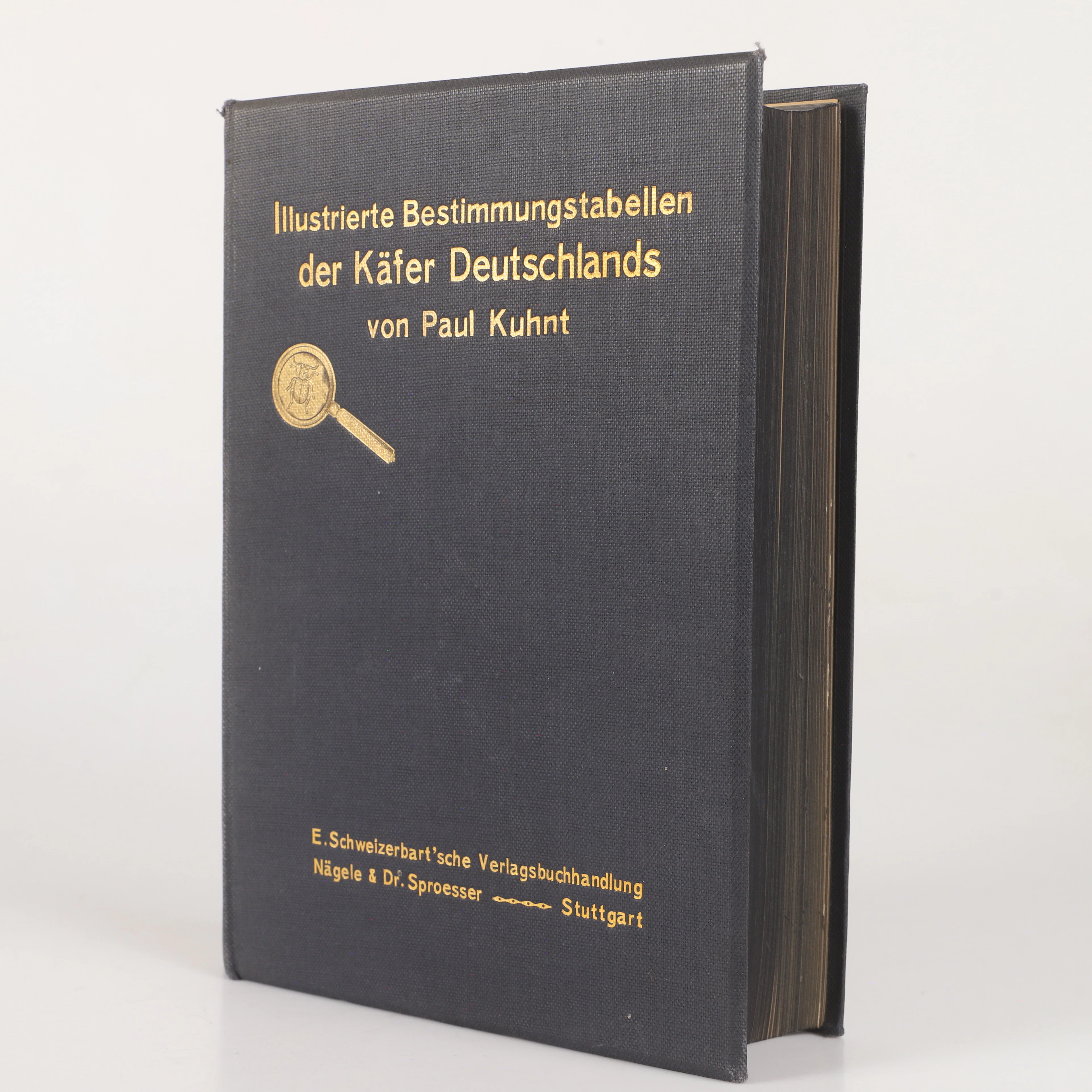
BOK, "Illustrierte bestimmungstabellen der käfer Deutschland"Paul
10/06/2026

SEK 300
Uppsk.: SEK 400