[Carel Lodewijk Baron de Pagniet/Heer van Kermenstein]...
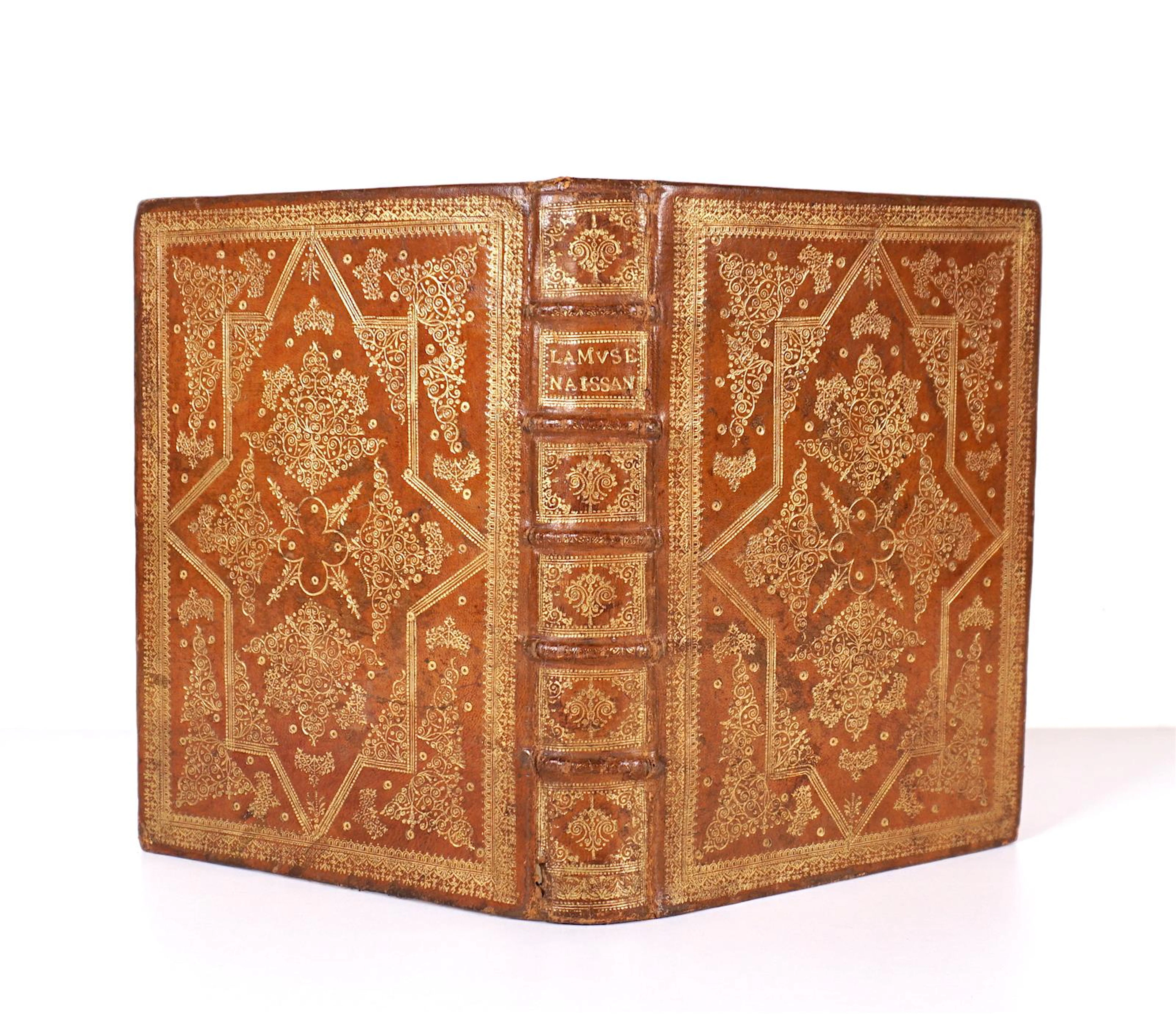
The Book of Psalms, together with the hymns used by the Reformed Church of the Netherlands; By command of the High Mighty Lords States General of the United Netherlands, From three Metrical Versions, in the year 1773, chosen, with the necessary changes made therein. In Amsterdam. By the heirs Henrik van der Putte, Paper- and Booksellers, on the Water, in the Lootsman. 1774. Special item! The first printed Psalm version of 1773 with historical provenance of Betouw (Betuwe) importance! On the front and back cover in gold letters printed: C.L. DE PAGNIET LORD OF KERMENSTEIN A° 1774 Carel Lodewijk de Pagniet: closely connected with the history of the city of Tiel and the village of Lienden and IJzendoorn. This Book of Psalms belonged to Carel Lodewijk Baron de Pagniet, Lord of the Castle Kermestein in the High Lordship of Lienden (Betuwe) and of the Lordship and Fortress IJzendoorn (Neder-Betuwe). He belonged to the political and economic elite of his time, particularly in the Gelderland region. He was a member of the States General for Gelderland, mayor of Tiel, and for three years Governor of the Dutch West India Company (W.I.C.) in Amsterdam. This indicates that he held a powerful position within the colonial trade of the era. Castle Kermestein/Kermesteyn (in historical documents also referred to as 'Carmestein' or 'the high house Kermestein') was an noble house or castle with double moats near the village Lienden in the Betuwe (Gelderland province). The castle formerly stood between the Dutch Reformed Church and the Rhine dike. Kermestein: The ancestral castle of the noble family Van Brakell and De Pagniet. The castle was owned by the prominent noble family Van Brakell from 1462 to 1714. Afterwards it came into the hands of the De Pagniet family. Carel Lodewijk de Pagniet is a direct descendant of the Van Brakell family, as his father Abraham de Pagniet married Dorothea Henriëtte van Brakell, lady of Kermenstein until 1751. Carel Lodewijk de Pagniet was lord of Kermestein from 1752 until his death in 1789. In 1774, after purchase, C.L. de Pagniet was also enfeoffed with the Lordship and the Fortress IJzendoorn. History of Kermestein The (manorial) estate Kermestein was a fief of the lords of Lienden and from 1656 of the lords of Culemborg. The house was described in that year as the high house Kermesteijn with its orchards, courts, courtyards, moats and ditches, comprising about 4 morgen, with its back lands, feudal rights, cijnsen and the new meadow beyond the dike. The first owner we encounter in relation to Kermestein is squire Johan van Brakell. He is mentioned in 1456. The noble house was rebuilt by Cornelis van Brakell in the first half of the 16th century. The Van Brakell family remained owners until 1714. In that year Johan Frederik van Brakell left it to his sister Dorothea Henriëtte van Brakell, who was married to Abraham de Pagniet, whereby Kermestein came into the possession of the De Pagniet family. After the death of Abraham, Kermestein passed in 1724 to his son Carel Lodewijk de Pagniet, who in 1789 was succeeded by his son Reinier (Reinout) Johan Christiaan. In 1803 it was sold to Willem van Brughem, after which in 1825 the house with stables, coach house and gardener’s house was sold to the van der Mey family. Until 1840 Kermestein was inhabited by Sir Jean Charles Francois de Meij van Streefkerk. When it was offered for rent in 1840, it is described as an estate with a large house containing 10 rooms with a large hall, a kitchen and cellars. Beside the house stood a stable and a coach house. The rent of f. 700 per year included two church benches. In 1848 it was offered for sale as a ‘knightly, income-producing country estate with castle, stables, coach house and gardener’s house and over 17 juger land’ (about 17 acres). Around 1855 Johan Frederik Veeren, then mayor of Lienden, owned it. Kermestein was after the death of the last owner, the broker Willem Jacobus Scheurleer (1809-1877), a member of the Scheurleer family, demolished in 1879. It was then only a farmstead. Thus this stately building, that had weathered centuries, disappeared from the Lienden village landscape. From 1774 Cornelis Lodewijk de Pagniet also became Lord of Slot IJzendoorn. (He was already 22 years lord of Kermestein by then!) Let 1774 also be the year that is mentioned on the front and back cover of the book. C.L. de Pagniet thus obtained this book in the year he had appropriated Slot and Lordship IJzendoorn. The provenance is thus as old as the book itself. Most likely this Book of Psalms resided more often in Slot IJzendoorn than in Huis Kermestein and was frequently used by Cornelis Lodewijk de Pagniet in the Reformed Church of IJzendoorn. But undoubtedly also in the Reformed Church of Lienden and who knows in the Grote Kerk of Tiel. Throughout his entire career until his death, C.L. de Pagniet alternated as mayor and alderman of Tiel. The distance from Tiel to his lordship at IJzendoorn is slightly shorter than from Tiel to the Castle Huis Kermestein northeast of Lienden. Remember that in his time there were no cars yet. In the countryside, the horse-drawn carriage was the most obvious means of transport for people. Luxurious horse carriages were in the 18th and 19th centuries the ultimate status symbol for noble people and that certainly applied to C.L. de Pagniet. A journey from IJzendoorn or Lienden to Tiel and back by horse carriage was no trifle at the time. It is plausible to suppose that Cornelis Lodewijk de Pagniet stayed more often at Slot IJzendoorn than at Huis Kermestein from 1774 onward. Add that the city of Tiel and the village IJzendoorn lie almost on a single line with the river Waal. C.L. de Pagniet could easily travel by boat or ship from IJzendoorn to Tiel and vice versa. Due to the exceptional provenance, this Book of Psalms is a true collectors item! A personal possession of the Lord of Kermestein himself. It is part of Betuwe regional history! Today, only historical documents and archives in the Rivierenland region remember a book from 2019 titled "Kermestein and its inhabitants" by writer Joke Honders, an authentic photo from 1875, and a gravestone in the Lienden Reformed Church, as a reference to the castle and lordship. Hence it is very remarkable that this object now (as of 2026) comes to light. It is tangible evidence of a historic noble figure from the 18th century and a direct reference to a historic house and estate with a rich noble history. Condition of the object: The book is well preserved. A full-leather binding with blind-stamping and copper studs on the front and back covers for protection. Binding is fine. Contents complete and in good condition. One page with restoration tape. Otherwise the pages are nearly clean and fresh. A splendid antiquarian and historical object! Number of pages: 636 Dimensions: 22.8 x 18.7 x 4.8 cm Carel Lodewijk de Pagniet (Nijmegen, 10 June 1715 – Tiel, 26 March 1789) was a son of Abraham de Pagniet (1662-1724), major of the infantry regiment Friesheim, and Dorothea Henriëtte van Brakell, lady of Kermenstein (1677-1751). He married on 17 September 1750 to Henrietta Margaretha van Haeften, lady of Wadenoijen (1725-1785), daughter of Barthold van Haeften, lord of Wadenoijen, Ophemert, Zennewijnen and Delwijnen (1692-1772) and Margriet baroness van Lynden, lady of Hemmen (1700-1761). His sister, Maria Louisa de Pagniet (1720-1766), married Alexander van Capellen (1713-1772); they were the parents of Jhr. Theodorus Frederik van Capellen (1761-1824). Carel Lodewijk de Pagniet began his career in his home town of Tiel. In 1749 he joined the vroedschap and became alderman. Throughout his life he alternated as alderman or mayor of Tiel. In addition to his political career he became in 1750 administrator of the W.I.C. This continued until 1753. In the same year he bought the “Ingensche Veer” ferry from David ten Hove, who had inherited the ferry in 1750 from his father Melchior ten Hove. In 1786 De Pagniet sold the ferry to his son-in-law Vincent Maximiliaan van Tuyll van Serooskerken. After the purchase in 1753 the ferry remained in the family until 1912. On 23 August 1757 De Pagniet was appointed a drost, judge, dijkgraaf and stadholder of the free lordship of Lede and Oudewaard and the high lordship Lienden. In 1758 he became a member of the admiralty of Rotterdam, remaining a member for one year, after which in 1763 he became a member of the admiralty of Amsterdam. He remained a member here until 1 May 1765. In the meantime, on 17 November he was appointed a member of the States-General for Gelderland, from 17 November 1762, which he held until 1786, with a break in 1763–1765. On 26 March 1789 Carel Lodewijk de Pagniet died in Tiel. Explanation of photos A through E (at the very end of the photo section): - Photo A: Oil painting on canvas portrait of Carel Lodewijk de Pagniet. The canvas actually measures 83 x 65 cm. It comes from a private collection. The painting dates from 1769 and was painted by Arnold Kaldenbach. - Photo B: Oil painting on canvas portrait of his wife Henriette Margaretha Baroness van Haeften tot Wadenoijen. Also painted by Arnold Kaldenbach in 1769 with the same dimensions. - Photo C: Copy/loan letter from 1752 (Source: Regional Archive Rivierenland) in which Carel Lodewijk de Pagniet is enfeoffed by Willem V, Prince of Orange and Nassau, with the high house Kermestein. - Photo D: Black-and-white photo of Huis Kermestein/Kermesteyn from around 1875. This is the only known photo of the castle. On the left you see the noble house, in the middle the coach house, and on the right a gatehouse. At the time this photo was made, Huis Kermestein was still just a farmstead. - Photo E: An original framed “Genealogy of the Van Brakell family” with a family tree of the Van Brakell lineage from 1321, produced by Carel Lodewijk de Pagniet. The genealogy is in the possession of Collectie Gelderland. It can also be viewed digitally on the Collectie Gelderland website. - Photo F: Gravestone of Johan van Brakell (?-1580) and Johanna van Meerten (?-1600) that was uncovered during restoration of 1978–1980 in the Reformed Church of Lienden. The name KERMESTEIN is clearly readable on the gravestone. In the Reformed Church of Lienden there was for centuries a burial vault for members of the Van Brakell to Kermestein lineage and in-laws, such as De Pagniet. We know this because in Lienden’s DTB (baptism, marriage and burial records) there are entries stating that certain members of this lineage were laid to rest there, such as Johan Frederick van Brakell (1670-1714) and Abraham de Pagniet (1662-1724), the father of Cornelis Lodewijk de Pagniet. His father was the last who was interred in the vault. - Photo G: The Reformed Church of IJzendoorn with burial vault, the probable resting place of Carel Lodewijk de Pagniet. C.L. de Pagniet himself died in Tiel on 26 March 1789 at the age of 73. It is very likely that he, together with his wife Henriette Margaretha van Haeften, shares a tomb or funerary monument in the Reformed Church of IJzendoorn. The explanation for why Carel Lodewijk is probably buried in (the church vault of) IJzendoorn is given below: The Reformed Church of IJzendoorn (Dorpsstraat 30) is a late-Gothic village church from the 14th/15th century with a historic graveyard directly behind the building, tucked between the church and the dike. The church includes, among other things, an 18th-century gentleman’s pew with a hood and carved heraldic arms, indicating notable local families who were buried here. The lords and ladies of this (high) lordship historically possessed various rights in the village, including the collatierecht (the right to appoint the pastor and schoolteacher), a private lord’s pew, and a private crypt in the local church. The noble house De Pagniet became closely linked to this crypt when Carel Lodewijk Baron de Pagniet in 1774 bought the lordship and the IJzendoorn castle from the Van Wijhe family. As the new ‘Vrijheer of IJzendoorn’ (and also mayor of Tiel), he and his family made use of the associated lordly rights and the crypt. After the death of Carel Lodewijk de Pagniet in March 1789, a special mourning board for him was produced in 1790 by D. Rootbol, commissioned by the heirs. Such mourning boards were hung in the local church at the time to remember the deceased lord of the lordship. In the archives of the Lordship IJzendoorn at the Gelders Archive there are several accounts (including a receipt for making a mourning board for the late Lord Pagniet) and deeds of division of the heirs’ estates from 1789–1790. After the male line of the De Pagniet family died out, the lordship IJzendoorn (and the associated rights) passed via daughter Dorothea Henriëtte Maria Louise de Pagniet to the Van Tuyll van Serooskerken family. - Photo H: Drawing of the Slot of IJzendoorn (’t Slot van Isendoorn), as it presumably looked in 1524. This drawing was made in 1723 by Jacobus Stellingwerf, a Northern Dutch draughtsman of landscapes and topographic objects. [Source: collectiegelderland.nl; kasteleninnederland.nl; Wikipedia; regionaalarchiefrivierenland.nl; oorsprong.info; archieven.nl; arend-datema-instituut.nl]
Utropspris:SEK 6,211.71
Till auktionenVisa alla föremål frånCatawikiellerBöcker, Kartor och Texter


![[Carel Lodewijk Baron de Pagniet/Heer van Kermenstein]...](https://bbys.imgix.net/34/cdde837d835979834fcc750ee7ef9be2069a723ff4ad14e0523e542a4cd50ab6.jpg?auto=format&w=1080&q=75)