CIRCLE OF MICHELE PACE DEL CAMPIDOGLIO (ITALIAN 1625-1670), STILL-LIFE
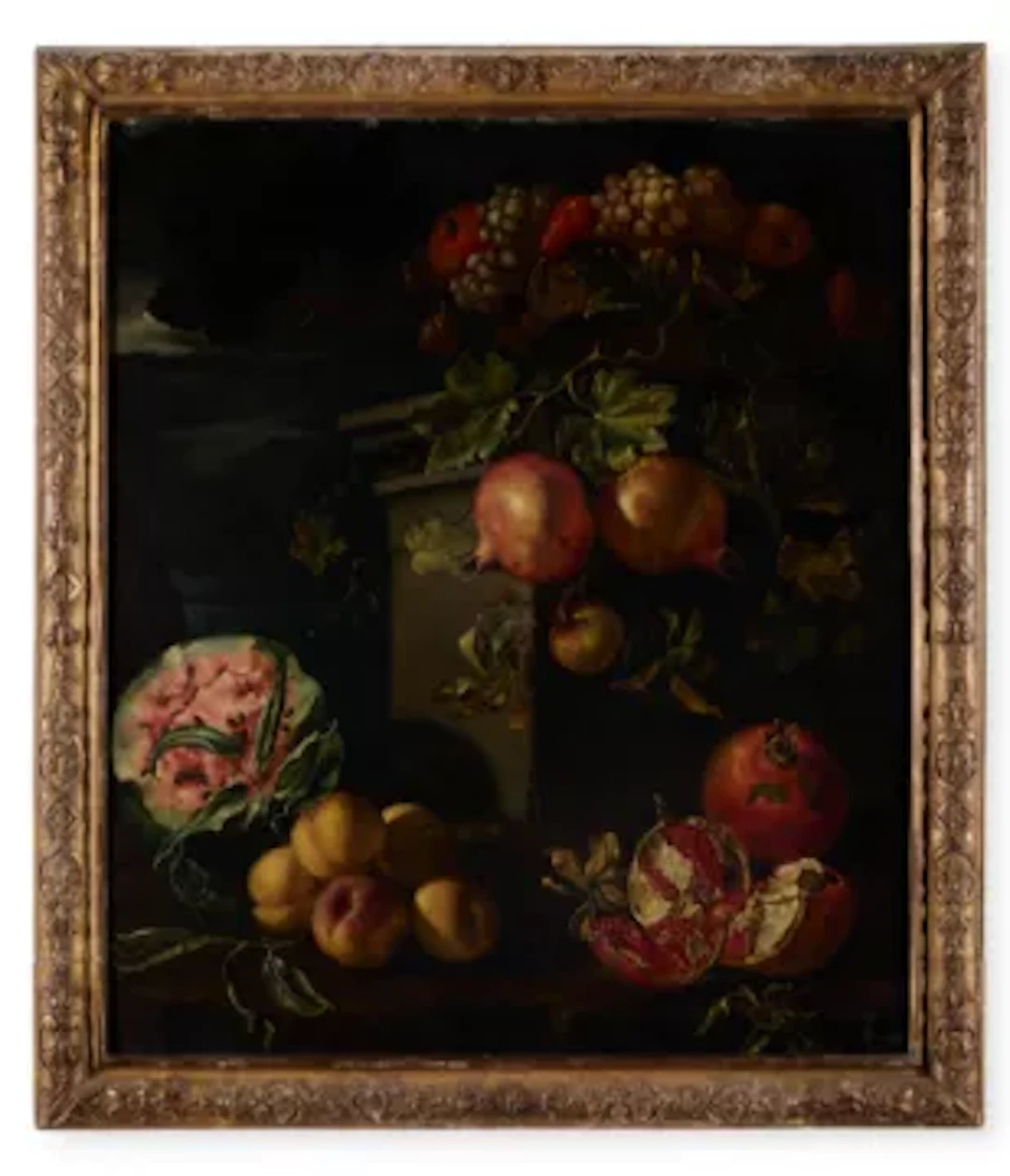
CIRCLE OF MICHELE PACE DEL CAMPIDOGLIO (ITALIAN 1625-1670) STILL-LIFE OF POMEGRANATES, MELON AND GRAPES BY MOONLIGHT Oil on canvas 99.5 x 86cm (39 x 33¾in.) Michelangelo Pace was particularly celebrated as a painter of still-lifes, and in particular of fruit, and sometimes worked in collaboration with figures such as Il Borgognone. He was described by the early 19th-Century art historian, Luigi Lanzi, as an ‘excellent painter of fruit, almost the Raphael of such paintings’.[1] He took the nickname ‘di Campigdoglio’ as a reference to his family’s residence on the Capitoline Hill. As was usual for painters of natura morta at that time, little was recorded about their lives in artists' biographies and, consequently there is a lack of firm agreement on his birth and death dates and actual place of birth. He was a pupil of Francesco Fieravino (1611-1654) and was influenced by Michelangelo Cerquozzi (1602-1660). His first recorded commission was in 1654 for Marcantonio Colonna, and the Colonna inventories show that a further seven pictures were subsequently commissioned for the family collections. From 1658 he was in the service of Cardinal Flavio Chigi (1631-1693), the nephew of the incumbent Chigi Pope Alessandro VII for whom he executed portraits of dogs, hunting scenes and other genre scenes. The collaboration with Cardinal Flavio Chigi, the greatest collector of 17th-century Roman dog portraits, led to the production of the group of four canvases depicting the cardinal's greyhounds. The four canvases were placed in the specially named ‘Hall of Dogs’ at the Palazzo Chigi in Ariccia. They represent one of the most emblematic cycles of animalist genre painting in seventeenth-century Rome. From 1665 he was a member of the Academy of San Luca. Notwithstanding his success with the Papal Curia and the noble families of Rome, it was only after his premature death in 1669 that his national and international reputation began to flourish. His works became highly sought after in English aristocratic circles during the 18th Century. His corpus of work was discussed by Italo Faldi in 1966 (‘I dipinti chigiani di Michele e Giovan Battista Pace’, Arte Antica e Moderna, 1966, pp. 144-158), when he published the series of four Ariccia paintings together with other paintings which up until then had only been known from archival documents and old inventories. The present work depicts some of the artist’s most popular motifs – the roughly split watermelon and the torn open pomegranate, which allows the artist to juxtapose the differing textures and colours of his subject. The moonlight landscape glimpsed beyond gives a context for the dramatic light source which heightens the contrast. [1] L. Lanzi, Storia pittorica dell'Italia: Dal risorgimento delle Belle Arti fin presso al fine del XVIII secolo, Florence, 1834, II, p. 52 Saleroom Notice: Please note the cataloguing of this work should read Circle of Michele Pace del Campidoglio and not as stated in the printed catalogue Condition Report Disclaimer, CIRCLE OF MICHELE PACE DEL CAMPIDOGLIO (ITALIAN 1625-1670), STILL-LIFE OF POMEGRANATES, MELON AND GRAPES BY MOONLIGHT, CIRCLE OF MICHELE PACE DEL CAMPIDOGLIO (ITALIAN 1625-1670) STILL-LIFE OF POMEGRANATES, MELON AND GRAPES BY MOONLIGHT Oil on canvas 99.5 x 86cm (39 x 33¾in.) Michelangelo Pace was particularly celebrated as a painter of still-lifes, and in particular of fruit, and sometimes worked in collaboration with figures such as Il Borgognone. He was described by the early 19th-Century art historian, Luigi Lanzi, as an ‘excellent painter of fruit, almost the Raphael of such paintings’.[1] He took the nickname ‘di Campigdoglio’ as a reference to his family’s residence on the Capitoline Hill. As was usual for painters of natura morta at that time, little was recorded about their lives in artists' biographies and, consequently there is a lack of firm agreement on his birth and death dates and actual place of birth. He was a pupil of Francesco Fieravino (1611-1654) and was influenced by Michelangelo Cerquozzi (1602-1660). His first recorded commission was in 1654 for Marcantonio Colonna, and the Colonna inventories show that a further seven pictures were subsequently commissioned for the family collections. From 1658 he was in the service of Cardinal Flavio Chigi (1631-1693), the nephew of the incumbent Chigi Pope Alessandro VII for whom he executed portraits of dogs, hunting scenes and other genre scenes. The collaboration with Cardinal Flavio Chigi, the greatest collector of 17th-century Roman dog portraits, led to the production of the group of four canvases depicting the cardinal's greyhounds. The four canvases were placed in the specially named ‘Hall of Dogs’ at the Palazzo Chigi in Ariccia. They represent one of the most emblematic cycles of animalist genre painting in seventeenth-century Rome. From 1665 he was a member of the Academy of San Luca. Notwithstanding his success with the Papal Curia and the noble families of Rome, it was only after his premature death in 1669 that his national and international reputation began to flourish. His works became highly sought after in English aristocratic circles during the 18th Century. His corpus of work was discussed by Italo Faldi in 1966 (‘I dipinti chigiani di Michele e Giovan Battista Pace’, Arte Antica e Moderna, 1966, pp. 144-158), when he published the series of four Ariccia paintings together with other paintings which up until then had only been known from archival documents and old inventories. The present work depicts some of the artist’s most popular motifs – the roughly split watermelon and the torn open pomegranate, which allows the artist to juxtapose the differing textures and colours of his subject. The moonlight landscape glimpsed beyond gives a context for the dramatic light source which heightens the contrast. [1] L. Lanzi, Storia pittorica dell'Italia: Dal risorgimento delle Belle Arti fin presso al fine del XVIII secolo, Florence, 1834, II, p. 52 Saleroom Notice: Please note the cataloguing of this work should read Circle of Michele Pace del Campidoglio and not as stated in the printed catalogue, [1], natura morta, Francesco Fieravino, Michelangelo Cerquozzi, Arte Antica e Moderna, Storia pittorica dell'Italia: Dal risorgimento delle Belle Arti fin presso al fine del XVIII secolo, Saleroom Notice:, Condition Report Disclaimer
Utropspris:SEK 526,166.8
Till auktionenVisa alla föremål frånDreweattsellerKonst & Grafik