


Alla auktioner / Förhistorisk Konst / Europe – Late Bronze Age Bronze Chisel with Fan-Shaped...

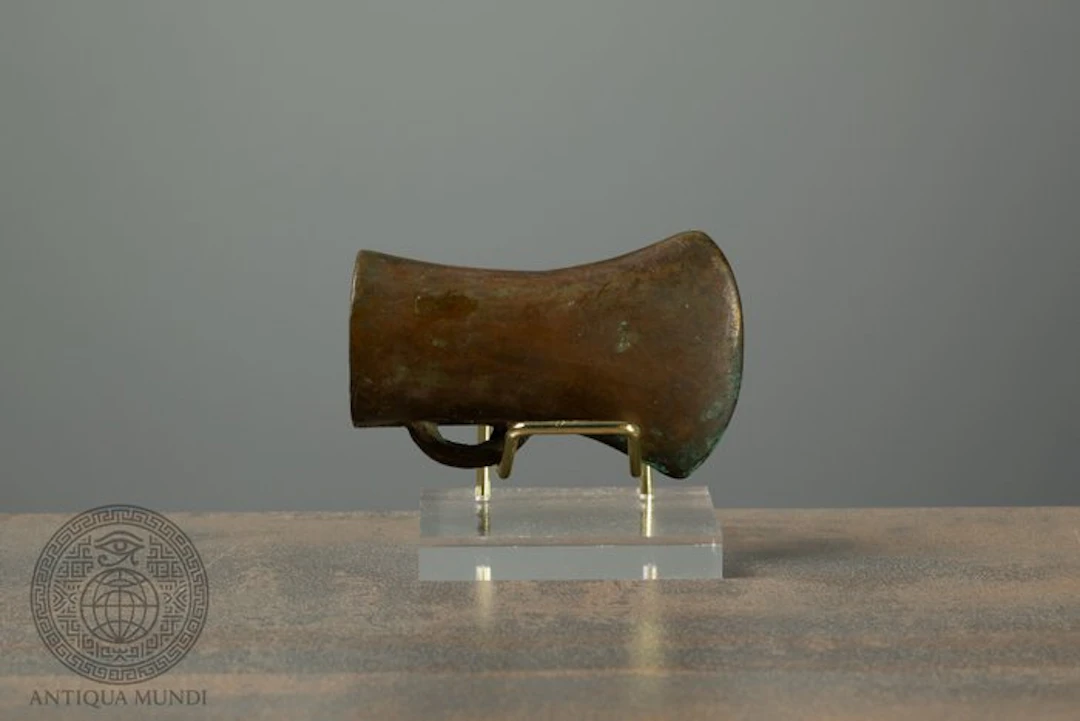
A well-preserved European Late Bronze Age bronze socketed axe, distinguished by its hollow shaft socket, integral lateral attachment loop and broad, slightly curved cutting edge. The compact axe head has an oval socket opening, originally intended to receive a suitably shaped wooden handle. From the relatively narrow socket section, the body gradually expands towards the broad cutting edge, which forms a gently curved profile with slightly projecting corners. Immediately below the socket opening is a substantial integrally cast side loop, forming a characteristic feature of this type of Late Bronze Age axe. The loop was probably used to secure the axe head to its wooden haft by means of a cord or leather binding. The sides are largely smooth and undecorated, with gently tapering contours that emphasise the transition between the narrower socket and the expanded blade. The well-balanced proportions, clearly defined socket and carefully formed cutting edge illustrate the practical construction of bronze tools during the later Bronze Age. The surface displays an attractive dark brown to reddish-brown patina, with localised green oxidation and mineral deposits, particularly around the cutting edge and inside the socket. Typology and Dating Socketed bronze axes are among the characteristic metal implements of the European Late Bronze Age and represent an important development in prehistoric bronze tool manufacture. Their hollow sockets allowed wooden handles to be inserted directly into the metal head, while the integral side loops could provide additional security through binding. Such axes were widely distributed throughout Europe during the later Bronze Age, including regions associated with the Urnfield cultural tradition. The present example displays several characteristic features of this broader typological group, including the oval socket, lateral loop, compact body and expanded cutting edge. On typological grounds, an attribution to the European Late Bronze Age, probably circa 1100–800 BC, appears plausible. In the absence of a documented archaeological find context, a more precise regional attribution or narrower chronological classification cannot be established with certainty. Function Socketed bronze axes were primarily functional tools, particularly associated with woodworking and the preparation of timber. The hollow socket accommodated a wooden handle, while the lateral loop probably allowed an additional binding to secure the axe head during use. Comparable implements could also occur in weapon assemblages or as components of Late Bronze Age metal hoards. Without a documented archaeological context, the precise original use of the present example cannot be determined. The compact dimensions and carefully formed construction nevertheless demonstrate the practical and efficient design of Late Bronze Age bronze tools. Surface and Patina The bronze displays a predominantly dark brown to reddish-brown patina, with scattered areas of green oxidation and mineral deposits. The patina is particularly visible around the cutting edge, within the socket and in recessed areas of the surface. Minor surface irregularities and variations in colour contribute to the object's aged appearance. The largely undecorated sides retain their original cast form, while the socket and integral attachment loop remain clearly defined. Condition Good condition considering its considerable age. The axe head is substantially complete, retaining its hollow socket, lateral attachment loop and broad cutting edge. The cutting edge displays minor irregularities and signs of wear. The bronze surface shows age-related oxidation, minor abrasions, localised mineral deposits and small surface irregularities. The socket opening remains clearly recognisable and illustrates the original hafting construction. Please examine all photographs carefully, as they form an integral part of the condition description. The modern display stand is used solely for presentation and is not included in the sale. Provenance Formerly in the Madeleine & Erich Dammann Collection, Germany. Acquired during the collectors’ extensive travels between 1950 and 1970. The collection is documented in Germany by 1970 through historical photographs of the family residence and subsequently remained in continuous family ownership. The objects were acquired privately during the collectors’ travels. As was customary for private purchases made at local markets during the 1950s and 1960s, purchase receipts or invoices were generally neither issued nor requested. Historical photographs and biographical documentation relating to the Dammann Collection are available and support the long-standing provenance of the collection.
Utropspris:SEK 3,894.08
Till auktionenVisa alla föremål frånCatawikiellerFörhistorisk Konst
Utropspris:
SEK 3,894.08
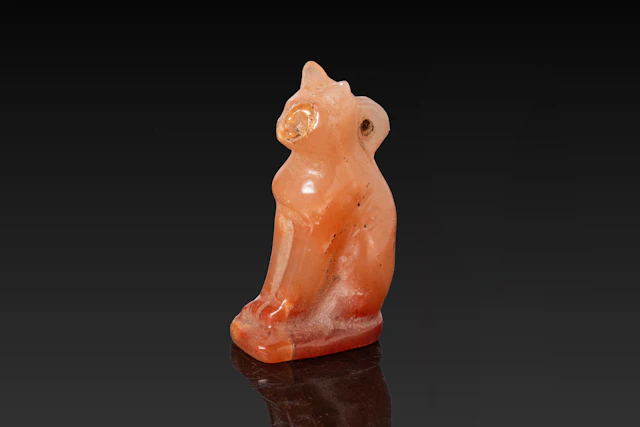
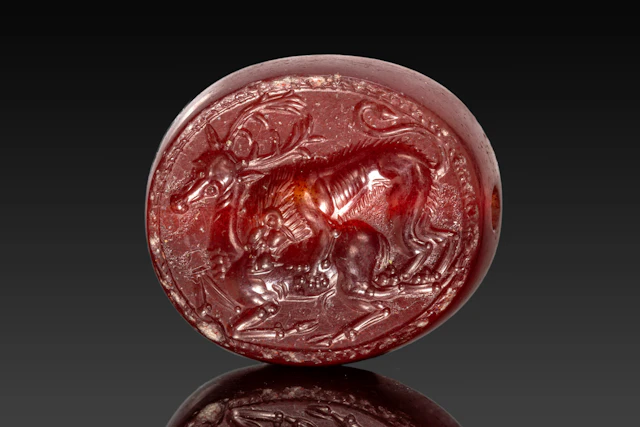
ETRUSCAN CARNELIAN STAMP SEAL WITH A LION ATTACKING A STAG
06/21/2026

SEK 63,747.68
Uppsk.: SEK 62,424.02
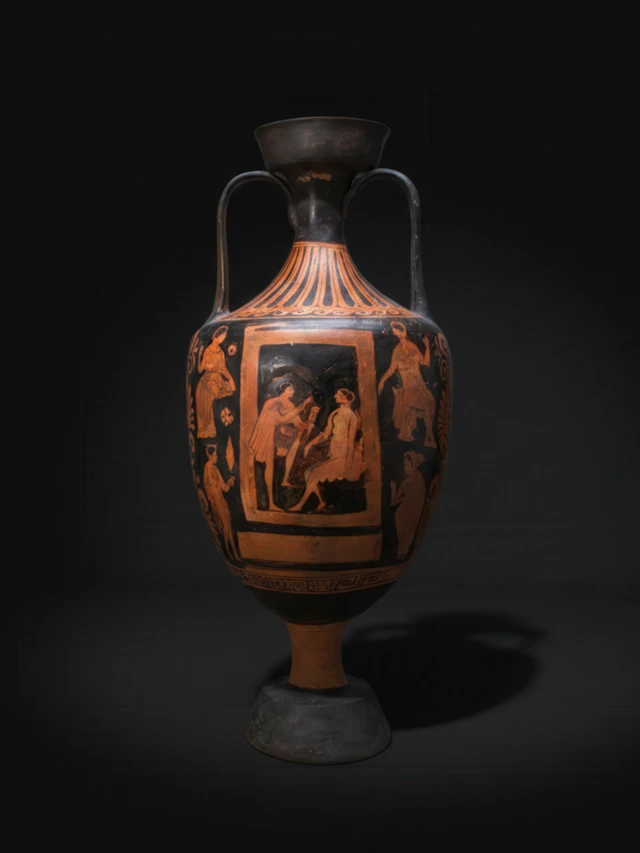
LARGE APULIAN RED-FIGURE AMPHORA WITH NAISKOS SCENE AND ALTAR
06/21/2026
SEK 70,122.44
Uppsk.: SEK 62,424.02

Nå samlare över hela världen med din auktion!
Lista er auktionGenom att prenumerera godkänner du integritetspolicyn. Avprenumerera när som helst.
Barnebys HQ
Brahegatan 10
BOX 5038
114 37 Stockholm
