
Alla auktioner / Diverse / Francesco Lojacono (1838-1915) - Chiostro di San Giovanni...

Francesco Lojacono (1838-1915) - Chiostro di San Giovanni...
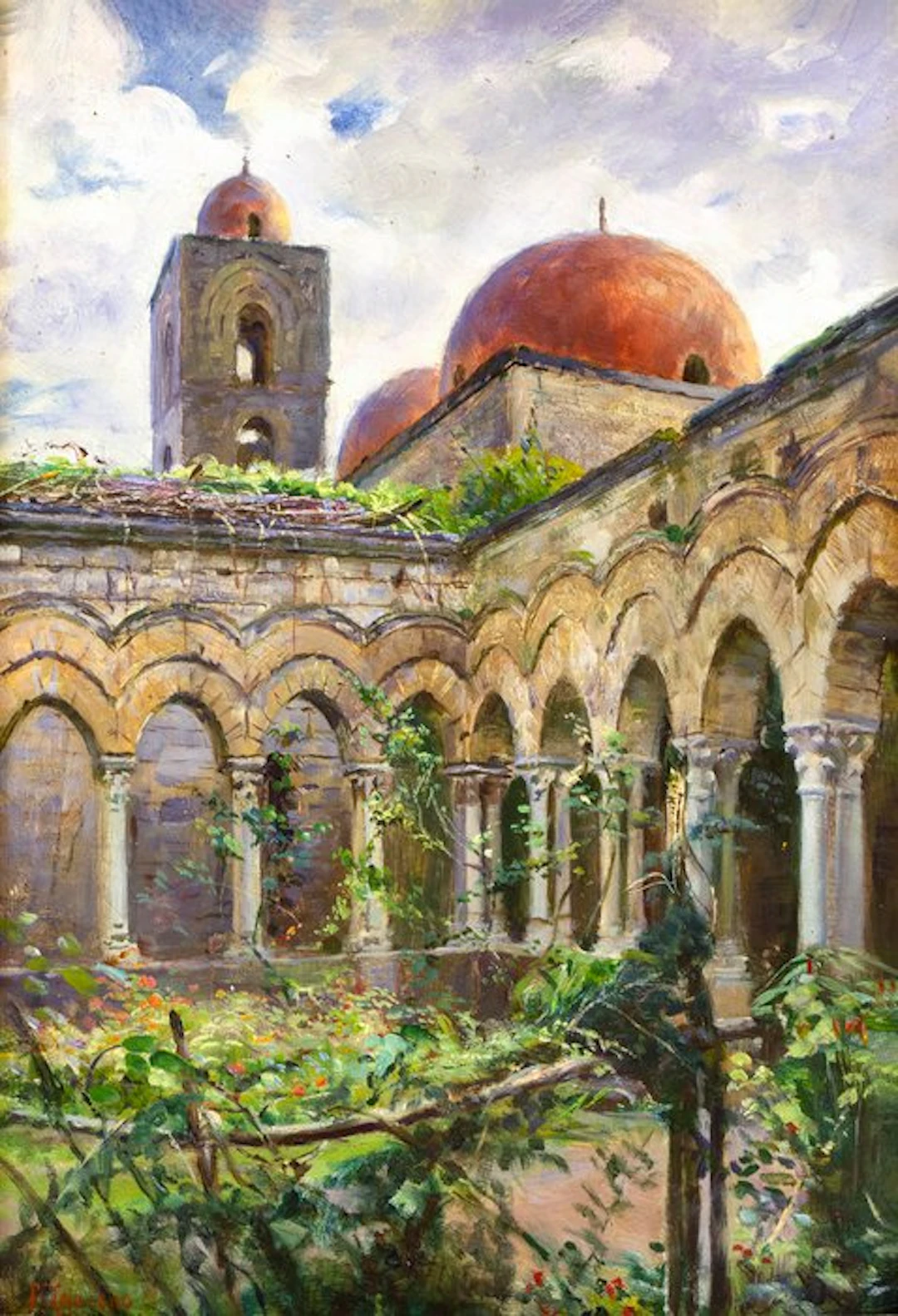
FRANCESCO LOJACONO (Palermo, 1838 – 1915) Chiostro di San Giovanni degli Eremiti in Palermo Oil on paper, 36 x 24.6 cm Signed on the left: “F. LOJACONO” Frame size, approx. 58 x 47 x 3 cm NOTE: Public catalog publication of the Intermidiart collection works (Pdf). Signed bottom left. Certificate of Legitimate Provenance. Work with gilded frame (defects): We present in the catalog an interesting painting attributable to the Sicilian school from the late 19th to the early 20th century, coming from a prestigious collection that has historically safeguarded it. The work, executed in the early 20th century by Francesco Lojacono (Palermo, 1838 – 1915), depicts the evocative Chiostro di San Giovanni degli Eremiti in Palermo, one of the city’s most famous monumental complexes, recognizable for its unmistakable red domes and the lush garden that characterizes its architecture. The San Giovanni degli Eremiti complex constitutes one of the most significant testimonies of Palermo’s Arab-Norman architecture, with the characteristic hemispherical red-plastered domes, pointed arches, and the famous medieval cloister, punctuated by twin columns and immersed in rich Mediterranean vegetation. Located in the heart of Palermo’s historic center and within the UNESCO-protected site “Arab-Norman Palermo and the Cathedral Churches of Cefalù and Monreale,” San Giovanni degli Eremiti has always been one of the city’s most evocative places. Its cloister, with the inner garden and the particular coexistence of medieval architecture and lush nature, already in the nineteenth century became a favorite subject of Grand Tour travelers and painters interested in depicting the Sicilian landscape. It is precisely this encounter between architecture, light, and nature that constitutes the core of Lojacono’s composition. An artist of extraordinary sensitivity, capable of grasping the multiple nuances of the island landscape with lyrical and atmospheric accents, the painter renders in his works both the dazzling luminosity of Sicily and the rugged, wild character of its nature. Rocks, seascapes, olive trees, fields, and Mediterranean vegetation thus become protagonists of a painting grounded in light and direct observation of natural data. In the painting under consideration, Lojacono concentrates his attention on the poetic and intimate dimension of the cloister. Vegetation occupies much of the scene and seems to freely expand among the ancient architectural structures, softening their geometric rigidity and giving the whole a romantic and contemplative character. The garden, conceived as a gathered and protected space, evokes by implication the concept of hortus conclusus: a secluded place where architecture and nature coexist in a suspended balance. Hedges and ornamental shrubs, Mediterranean plants, and climbing plants insinuate themselves between the columns and along the cloister paths, creating a dense interweaving of shapes, colors, and shadows. The richness of the vegetation, rather than merely descriptive, becomes in the work a true painting element, capable of modulating light and defining the depth of space. The absence of human figures further emphasizes the centrality of nature and helps create an atmosphere of quiet and suspension. The cloister appears not merely as an architectural subject, but as a timeless place where traces of history are slowly absorbed by vegetation. In Lojacono’s painting, the wild and romantic aspect of the garden stands out particularly, with vegetation that seems almost to “invade” the ruins of the ancient Norman colonnade. The architecture, while remaining a structural element of the composition, is thus integrated into the landscape and transformed into part of a larger natural organism. The composition follows a scheme frequently adopted by Lojacono in his landscape research: the presence of trees and plants in the foreground guides the eye toward the background, enhancing perspective depth and creating a calibrated succession of light and shadowed planes. The vertical format accentuates the ascensional development of vegetation and architecture, while the meticulous attention to the details of the cloister and flora is paired with a vibrant and free brushwork, capable of rendering the atmospheric quality of the scene. The foreground, rich in matter and detail, contrasts with the more ethereal brightness of the sky, clear and blue, crossed by faint clouds that seem to dissolve in the light. The painting technique appears free and varied: in some passages the paint is thick and paste-like, in others more fluid and synthetic. This alternation allows the artist to differentiate the rendering of surfaces and to suggest, rather than meticulously describing, the texture of the vegetation, stones, and atmosphere. The result is a painting in which naturalistic observation blends with an increasingly free and personal sensibility. Thus the work fits into Francesco Lojacono’s mature path, in which the tradition of landscape painting opens to a rendering ever more attentive to the effects of light, air, and atmosphere. The architectural subject, famous and immediately recognizable, is reinterpreted through an intimate and personal vision, in which nature assumes a predominant role. Francesco Lojacono (Palermo, May 16, 1838 – February 26, 1915) was one of the leading interpreters of Italian landscape painting in the nineteenth century and a central figure in defining the modern Sicilian landscape school. He trained initially with his father Luigi Lojacono and later with Salvatore Lo Forte; in 1856 he moved to Naples, where he came into contact with the artistic milieu linked to the Palizzi brothers’ school and with the tradition of the School of Posillipo. The Neapolitan sojourn and subsequent relationships with experiences of European landscape painting decisively contributed to shaping his language, based on truthful observation, light, and atmospheric rendering. In 1860 he participated in the Expedition of the Thousand led by Giuseppe Garibaldi and took part in battles, being wounded at the Battle of Milazzo. Returning to Palermo, he became one of the most prominent figures in Sicilian artistic life, participating in major national and international exhibitions. His exhibition activity brought him into contact with the main artistic circuits of the time, while his fame was consolidated through a landscape production in which Sicily is depicted in its full variety: from luminous seascapes to fields, from mountains to architectures immersed in vegetation. As a professor of landscape painting at the Accademia di Belle Arti di Palermo, Lojacono developed a painting increasingly sensitive to the effects of light and atmosphere. Photography also entered his practice as a tool to support image construction and the recording of natural data. Works such as The Unexpected Arrival (1883), After the Rain (1886), and Summer (1891) bear witness to the artist’s constant search for the rendering of light, air, and atmospheric conditions, elements that transform the landscape from a simple descriptive subject to a visual and poetic experience. His production is today represented in important public collections and Italian museum institutions, including the Galleria d’Arte Moderna in Palermo, and constitutes a fundamental reference for understanding the development of landscape painting in Sicily from the second half of the nineteenth century to the early twentieth. In the Chiostro di San Giovanni degli Eremiti, Lojacono addresses one of Palermo’s most emblematic places through a sensitivity deeply connected to nature: the ancient Norman architecture is not merely described, but becomes an integral part of a landscape in which light, vegetation, and architectural matter contribute to the construction of a profoundly lyrical image. The work, of excellent artistic and chromatic rendering, is in good conservation with signs of aging visible in the photos. On the bottom left bears the artist’s signature “F. Lojacono.” The painting, of good brushwork, is framed in a gilded frame, impressive in effect (frame size: approx. 58 x 47 x 3 cm). The frame shown in the photos above has been added to the artwork by the seller or by a third party. The frame is provided to you at no additional cost so that it is ready to display as soon as it arrives. The frame is included as a courtesy and is not considered an integral part of the artwork. Therefore, any potential damage to the frame that does not affect the artwork itself will not be accepted as valid grounds to open a claim or request order cancellation. Provenance: Private Sicilian collection, Work kept at the Fondazione L’Immacolata per l’Arte e la Cultura. Publication: - I Miti e il Territorio nella Sicilia dalle mille culture. INEDITA QUADRERIA general catalog of paintings from the cycle “I Miti e il territorio,” 2026 (Pdf). In the case of sale outside Italian territory, the buyer must wait for export procedures to be completed. #mediterranean_art
Utropspris:SEK 89,628.3
Till auktionenUtropspris:
SEK 89,628.3
Liknande föremål

Auktionsresultat för liknande föremål
Nå samlare över hela världen med din auktion!
Lista er auktion