






Alla auktioner / Böcker, Kartor och Texter / Giuseppe Malombra - (CARTOGRAPHY

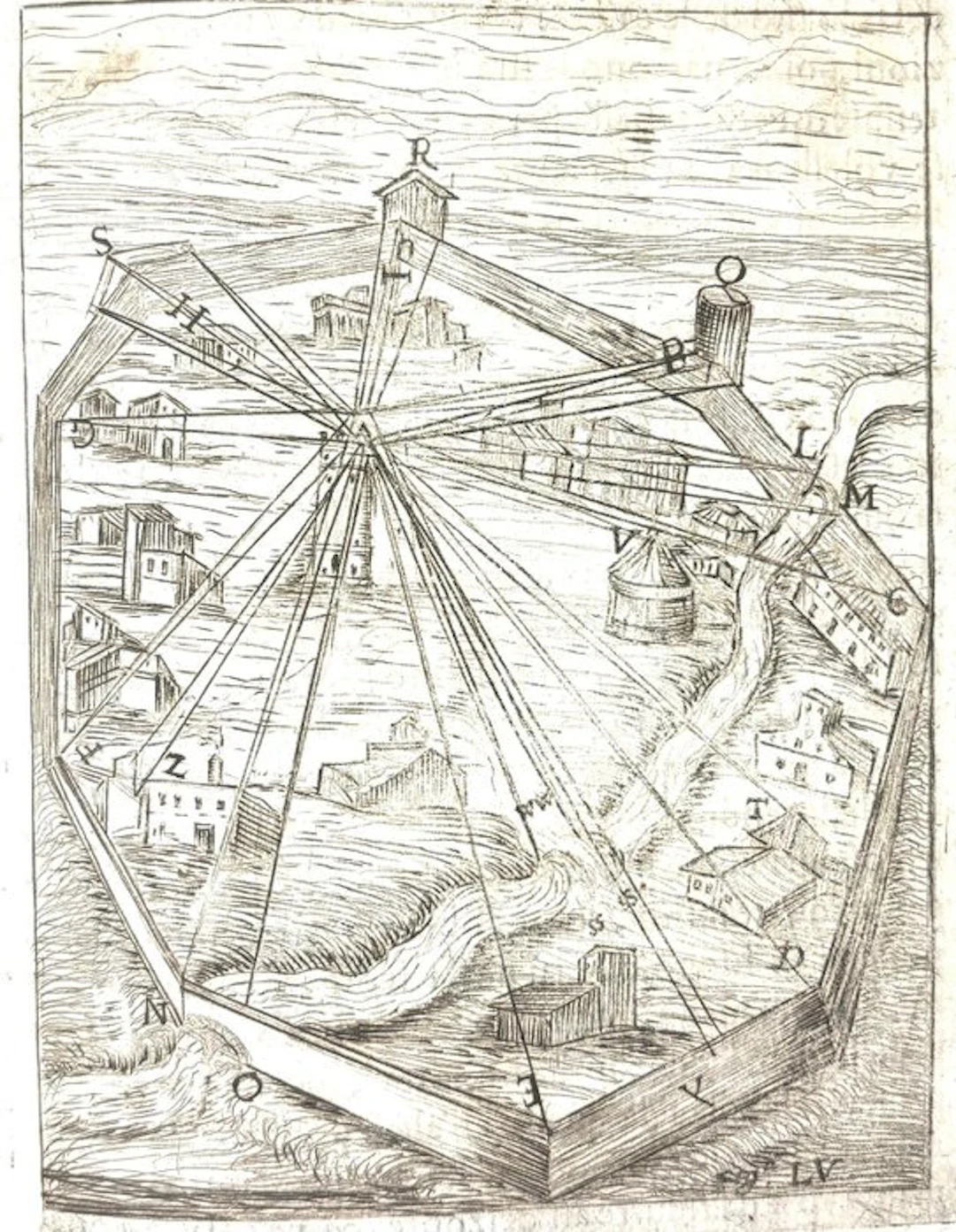
# Historical-artistic and bibliographic presentation of the Universal Practice, extremely easy and brief to measure by sight, by Giuseppe Malombra ''Florence, 1630 — History of printing, practical geometry and scientific culture of the Seicento'' --- ## 1. Introduction: a book as a testimony of an era The work we have the privilege to examine today is a significant testimony of the scientific and artistic culture of Sixteenth- and Seventeenth-Century Italy: the Universal Practice, extremely easy and brief to measure by sight, published in Florence in 1630 by Giuseppe Malombra. At first glance, the volume presents as an antique book of particular charm, characterized by an engraved title page, allegorical figures, classical architectural elements and a composition in which image and word cooperate to convey authority and knowledge. Behind this figurative appearance lies, however, a very concrete intellectual project: to make accessible geometric procedures useful for measuring distances, heights and dimensions through visual observation. We are, then, not merely looking at a fine book object. We are looking at a document that tells of a moment when the art of seeing, mathematics, cartography and the practical needs of territorial governance met, contributing to the formation of modern techno-scientific culture. Its importance resides precisely in this balance: the ability to transform specialized knowledge into a practical instrument, entrusted to transmission through printing and the communicative power of engraving. The date 1630 places us in a period of extraordinary intellectual vitality, where Renaissance tradition dialogued with new conceptions of nature, space and knowledge. ## 2. The author: Giuseppe Malombra, between art, mathematics and cartography The figure of Giuseppe Malombra, also known as Gioseffo, is particularly interesting because he stands at the crossroads of different disciplines. Biographical information about him is relatively fragmentary. Historical-biographical reconstructions place him in the Venetian milieu, where he received an education influenced by the artistic and mathematical interests of his family. His father Pietro, a painter, is remembered as an important figure in his humanistic, mathematical, astrological and artistic education. Malombra later moved to Florence, where he attempted to establish himself as a painter and cartographer. This path helps to understand the nature of his work. For a sixteenth- to seventeenth-century artist-cartographer, geometry was not merely theoretical knowledge: it represented an essential competence for describing space, constructing credible representations of the territory, and translating observations into measurable images. The 1630 volume must be read in light of the author’s professional aspirations. Malombra dedicated it to Ferdinando II de’ Medici, Grand Duke of Tuscany, in a context in which mathematical and cartographic skills could find application in territorial administration and in technical activities linked to the State. The publication may also have aimed to attest the author’s preparation and to facilitate his entry at the Grand Ducal court. It is, however, appropriate to distinguish this interpretation from strictly documented biographical circumstances. Malombra thus represents an emblematic figure of an era in which scientific knowledge was not separated from artistic practice, but constituted one of its foundations. ## 3. The printer: Simone Ciotti and Florence’s Seicento publishing scene A fundamental role in the material history of the volume is played by Simone Ciotti, whose name appears in the publisher’s imprint: In Firenze, appresso Simone Ciotti, 1630. Printing at that time was not merely a technical operation. The printer participated in the circulation of knowledge, helping to transform individual knowledge into a reproducible text, consultable and potentially usable by a community of readers. In the case of a treatise on practical geometry, this function takes on particular value. The precision of the type, the page layout and the presence of illustrated plates allowed procedures to be exposed that had to be understood and applied, not merely contemplated. Florence of those years held a long tradition of mathematical, perspective and cartographic studies, nourished by the city’s artistic requirements and the Grand Duchy’s administrative needs. The production of technical books thus fit into an environment where geometric knowledge could have concrete repercussions on representation and governance of the territory. It is appropriate to distinguish the documented data from interpretation: we know the printer’s name and the place of publication, but we do not have enough elements to attribute to Ciotti a specific scientific program or to quantify the edition’s commercial diffusion. His presence in the book remains essential: through editorial and typographic work, Malombra’s method took on a public and lasting form. ## 4. The frontispiece: a visual and intellectual program The frontispiece is one of the most evocative elements of the volume. The composition is organized around a monumental architecture, with columns, a frieze, a central emblem and a vegetal border that encloses the text. On the sides appear two human figures clothed according to an ancient figurative convention; in the upper part there are winged figures and instruments, while in the lower part there is a small landscape view. The whole constructs a sort of symbolic threshold: the reader enters not only a technical text, but an entire cultural universe in which knowledge is presented as an orderly form of understanding. The columns and the architectural structure evoke the classical language of authority and stability. The laurel crown surrounding the text helps to confer centrality. The objects and figures in the upper part seem to broaden the semantic field of the image, suggesting a relationship between knowledge, observation and representation. It is important to point out that not all figures can be identified with certainty on the basis of the image alone. It would therefore be inappropriate to assign them mythological names or specific meanings without comparing with a full copy and with specialist studies on the engraving. We can, however, formulate an overall interpretation: the frontispiece presents measurement not as an isolated procedure, but as part of an organized knowledge that unites reasoning, experience and the capacity to represent the world. Its figurative quality also shows how, in the Seicento, scientific communication could rely on the same aesthetic tools used in literary, religious and celebratory books. ## 5. The content: measuring with sight The title of the work is already, in itself, a scientific program: Pratica universale facilissima et breve di misurare con la vista. The expression measuring with sight points to the possibility of determining spatial magnitudes through observation and the application of geometric procedures, avoiding in certain circumstances the need to physically reach every point to be measured. The principle is simple in formulation but rich in applications: if one knows certain distances, certain geometric ratios or certain observation conditions, it is possible to derive other quantities through calculation. Imagine, for example, having to estimate the height of a tower without being able to reach it. A geometric procedure can allow one to derive it from the observer’s distance, the angle of observation or proportional relationships built on a known reference. Similar procedures can be applied to measuring buildings, lands, walls and distances between points in the landscape. For this reason, practical geometry had an interest that far exceeded the school context. Its possible applications included: - Cartography and description of the territory. - Measurement of lands and properties. - Perspective representation and artistic practice. - Activities of engineers, technicians and architects. - Some needs of military engineering and fortification. These are coherent areas with the nature of the tract and with the author’s professional profile. They should not be confused with an exhaustive list of topics actually treated in each chapter: to reconstruct the exact content of the volume one would need to examine the entire edition. The term universal in the title should also be read according to the editorial conventions of the time. It expresses the ambition to propose a broad and versatile method, not the demonstration that the system could be applied without limits to any situation. The promise of a practice that is “extremely easy and brief” is also significant. It communicates to the reader the intention of making a subject that, in its theoretical formulation, could appear complex, more accessible. In this sense, the volume belongs to the tradition of practical manuals: books conceived not only to preserve knowledge but to put it at the service of action. ## 6. The historical meaning: when geometry becomes a tool of knowledge To fully understand the meaning of the work, it is necessary to place it in the broader development of European scientific culture between the fifteenth and seventeenth centuries. The Renaissance had developed a new awareness of the representation of space. Perspective transformed the way images were built; cartography assumed increasing importance in navigation, administration and geographical knowledge; mathematics found ever more articulated applications in the arts and technical professions. In the Seicento these processes continued in a context characterized by greater attention to measurement, experience and the formulation of verifiable procedures. Malombra’s work is set in this cultural environment. His interest does not lie in introducing a completely new principle, but in contributing to the transmission of practical knowledge through a structured and illustrated publication. Visual measurement rests on a fundamental relation: that between what the eye perceives and what reason can determine. Vision provides observation; geometry offers the rules to interpret it; calculation allows transforming it into a measure. This relation gains broader significance when viewed through the lens of Seicento scientific culture, a time when knowledge of the natural and physical world was undergoing a deep transformation. ### The connection with Galileo Galilei An indispensable historical reference is Galileo Galilei, a protagonist of the scientific revolution. In 1630 Galileo was a central figure in the European debate on nature and method. He had published Sidereus Nuncius in 1610 and Il Saggiatore in 1623; Dialogo sopra i due massimi sistemi del mondo would appear in 1632. His activity testifies to the growing centrality of observation, mathematics and rational discussion in the construction of knowledge. It is important, however, not to confuse their respective domains: we do not have sufficient elements to say that Malombra was directly tied to Galileo or that his tractate derived from Galilean research. The connection is primarily historical and cultural. Both belong to an era in which observation assumed a decisive role, albeit with different aims, methods and levels of inquiry. The comparison helps to grasp a central feature of the scientific revolution: it was not constituted solely by great astronomical discoveries, but also by a multiplicity of technical, mathematical and instrumental practices that transformed the relationship between man and space. ## 7. Florence, the Medici and State needs A second fundamental connection concerns the Medici court and the role of mathematical knowledge in territorial management. The work is dedicated to Ferdinando II de’ Medici, Grand Duke of Tuscany from 1621 to 1670. The dedication is not merely ornamental: in the cultural system of the time, princely patronage represented one of the main ways through which scholars, artists and technicians could seek recognition and support. Tuscan Grand Duchy needed skills that allowed description, administration and control of the territory. Cartographic production could contribute to managing possessions, planning public works, defining boundaries and organizing infrastructure. The ability to estimate distances and heights, to render the landscape and to apply geometric rules thus constituted a concrete resource for institutions. In this context, Malombra’s publication can also be read as a form of presenting his professional competencies to a political and cultural environment where technical knowledge had economic and administrative value. The relationship with the Medici reminds us that in the modern era science and power were not separate realms. Knowledge could enhance the court’s prestige, while institutional support could foster production and diffusion of knowledge. It is not possible to prove, based on available bibliographic information, that the book caused specific administrative or military transformations. It is, however, historically grounded to acknowledge that the competencies it refers to belonged to a sector of interest for the Grand Ducal government. ## 8. Impact at the time: usefulness, circulation and limits of testimonies What, then, was the tract’s impact in the Seicento? To answer correctly one must distinguish between the importance of the publishing genre and the documented fortune of this specific edition. Practical geometry manuals answered real needs. Measurement techniques could be useful to people who, for professional reasons, had to describe places and objects without resorting to complex tools or costly long procedures. A text promising relatively simple and rapid procedures could thus meet the interest of readers from different technical backgrounds. Printing also made possible the reproduction of instructions and figures, offering a stable support for study and consultation. The book could be preserved, compared with other works and used as a reference. However, it would not be rigorous to attribute to the work exceptional commercial success, widespread European diffusion or direct influence on specific historical figures without data on print runs, reprints, citations and provenance of copies. The survival of copies catalogued in library catalogs constitutes evidence of the book’s presence in bibliographic tradition, even if it does not by itself prove how widespread it was at the time. Historical prudence does not diminish the value of the work: it allows appraising it without attributing unproven merits. ## 9. Historical and bibliographic curiosities ### The promise contained in the title The expression facilissima et breve reveals the author’s communicative strategy. Simplicity and speed are presented as essential qualities of the method, almost underscoring that mathematical knowledge can become an operative tool without losing its scientific dignity. ### The value of engraving Images in technical treatises were not mere ornaments. They could illuminate spatial relations, show geometric configurations and facilitate understanding of procedures difficult to describe purely in words. In this volume, the frontispiece also serves a celebratory function, distinct from the didactic function of any internal figures. ### A dedication that tells a professional strategy The reference to Ferdinando II places the book within the connections between intellectual production and princely patronage. For an author interested in cartography, presenting his competencies through a printed work could be a way to publicly establish his preparation. ### Time traces as material testimony Stains, yellowing, abrasions and signs of use are not mere aesthetic imperfections. They can testify to the material history of the individual copy. They do not, by themselves, reveal who owned it or what events it traversed: to do so would require annotations, ex libris, library records and other provenance elements. ## 10. Legends and mysteries: separating charm from documented history An ancient book can evoke particular fantasies. The presence of allegorical figures, Latin inscriptions, heraldic symbols and classical architectures can lead one to imagine secret meanings, esoteric connections or mysterious events tied to its origin. In the case of the Universal Practice, however, there are no documented historical legends specifically concerning the volume or its author. It would be incorrect to tell a purported tale of secret manuscripts, occult societies or forbidden formulas as if true. There is, however, an aspect that can be historically supported and that possesses no less intense fascination: the often irregular life of scholars and artists of the Seicento. Biographical information on Giuseppe Malombra is fragmentary. After his passage through the Florentine milieu and his attempt to gain entry at the Grand Ducal court, testimonies about his life become uncertain. The oldest biographical sources describe him as a restless and itinerant man, but they do not allow a secure reconstruction of the final years of his life. This uncertainty constitutes a genuine documentary gap, not proof of a legendary tale. And it is here that one of the most interesting reflections of historical bibliography emerges: a work can survive its author and continue to testify to his competences even when many life details have been lost. The book thus becomes a form of material memory. The pages preserve the result of an intellectual effort; catalogs record its existence; surviving copies enable scholars and readers to reconstruct part of the history of knowledge. The authentic mystery, then, is not a supposed secret hidden among the engravings, but the more concrete mystery of the distance that separates us from a historical world of which only partial testimonies survive. ## 11. Essential bibliographic references For a rigorous study of the work it is appropriate to start from the sources that allow verifying the author’s identity, editorial data and cultural context. - Cesare Preti, “Malombra, Giuseppe,” Dizionario Biografico degli Italiani, vol. 68, Treccani, 2007. A biographical reconstruction of the author, his formation, his relationship with Florence and the 1630 publication. - Giuseppe Malombra, Pratica universale facilissima et breve di misurare con la vista, Firenze, appresso Simone Ciotti, 1630. The primary source to examine to reconstruct the content, structure and apparatus of the tract. - University and national bibliographic catalogs. Tools useful for verifying the book’s editorial description, the presence of preserved copies and possible bibliographic variants. For specialist study it would also be advisable to compare multiple copies of the edition, verify the presence of typographic variants and study the copy’s provenance. These steps would allow moving from a historical-cultural presentation to a true scientific entry for the individual exemplar. ## 12. Conclusion: the enduring value of an ancient knowledge Ladies and Gentlemen, having reached the end of this presentation, we can recognize in the Universal Practice, extremely easy and brief to measure by sight, far more than a rare Sixteenth- or Seventeenth-Century volume. This work represents a meeting point between mathematics and art, between observation and calculation, between individual culture and collective needs. It gives us the image of an era in which the ability to understand space and translate it into measurements was a fundamental resource for knowledge, profession and territorial governance. The figure of Giuseppe Malombra invites us to consider the richness of those personalities who operated across disciplines, without recognizing rigid boundaries between artistic practice and technical research. The presence of Simone Ciotti reminds us how decisive printers’ work was in preserving and disseminating ideas. The frontispiece, with its symbolic architecture and figurative apparatus, speaks of a knowledge that wished to present itself with dignity and authority. The title returns us to the concrete dimension of research: measuring means observing carefully, establishing relationships, testing hypotheses and transforming perception into knowledge. It is a lesson that remains current. In a contemporary world dominated by the speed of images and the immediate availability of information, this book reminds us that every authentic form of knowledge requires method, precision and interpretive capacity. Technology may change, tools may become more sophisticated, but the relationship between what we observe and what we are capable of understanding remains essential. To preserve and study a work like this means preserving not only an ancient object, but a testimony to the path by which humanity learned to question the world, to represent it and to render it intelligible. Its deepest value lies precisely in this continuity: a page printed almost four centuries ago can still speak to us, not because it necessarily hides a secret, but because it preserves the trace of an intellect at work. And perhaps this is the highest dignity of the old book: to survive its own time and to continue generating knowledge, questions and wonder in those who, centuries later, return to open it. Collation and state of preservation: Splendid preservation, faint foxing but exemplar marginated and fresh. 34pp; (212pp) Express shipping in just 24 working hours across Europe and 48 working hours for non-EU countries.
Utropspris:SEK 14,463.73
Till auktionenVisa alla föremål frånCatawikiellerBöcker, Kartor och Texter
Utropspris:
SEK 14,463.73
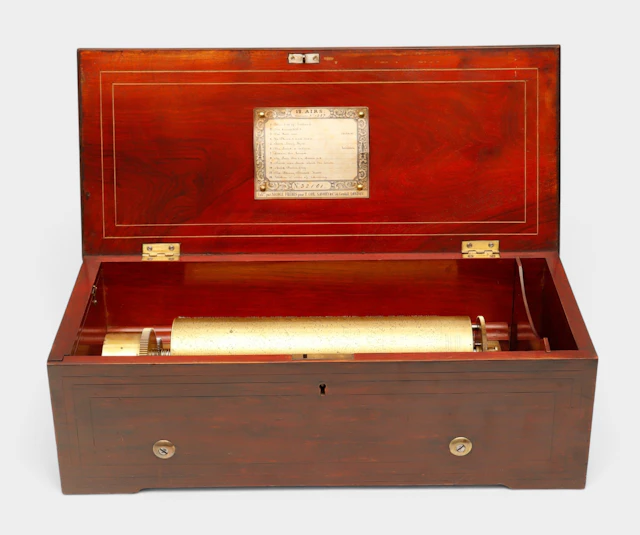
Caja de música suiza de doce canciones de Nicole Frères, hacia 1848-1852.
10/22/2026
SEK 15,020.02
Uppsk.: SEK 14,445.99
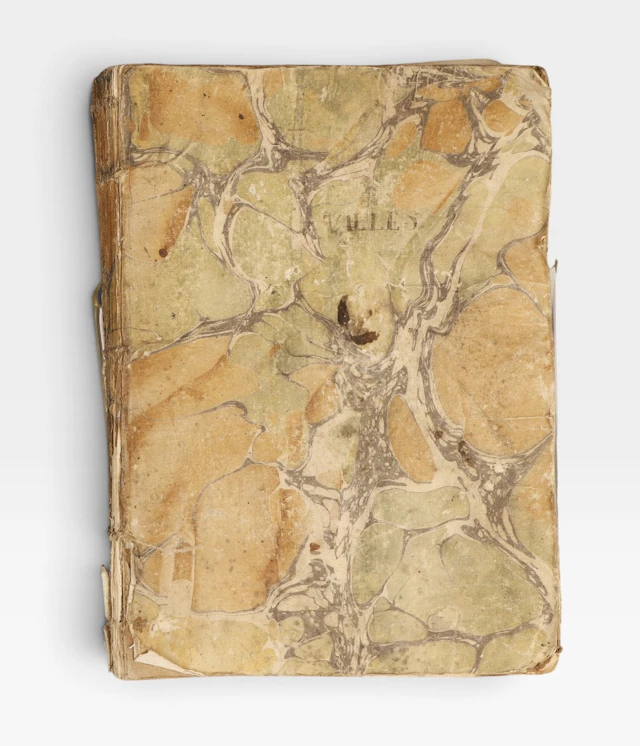
Guerra de la Independencia, Cataluña, 1808-1809.
10/22/2026
SEK 1,446.37
Uppsk.: SEK 1,582.63
Nå samlare över hela världen med din auktion!
Lista er auktionGenom att prenumerera godkänner du integritetspolicyn. Avprenumerera när som helst.
Barnebys HQ
Brahegatan 10
BOX 5038
114 37 Stockholm
