
Alla auktioner / Asiatisk keramik & konsthantverk / Kinkozan Kyoto Satsuma Square Vase with Courtly Figures and Garden

Kinkozan Kyoto Satsuma Square Vase with Courtly Figures and Garden
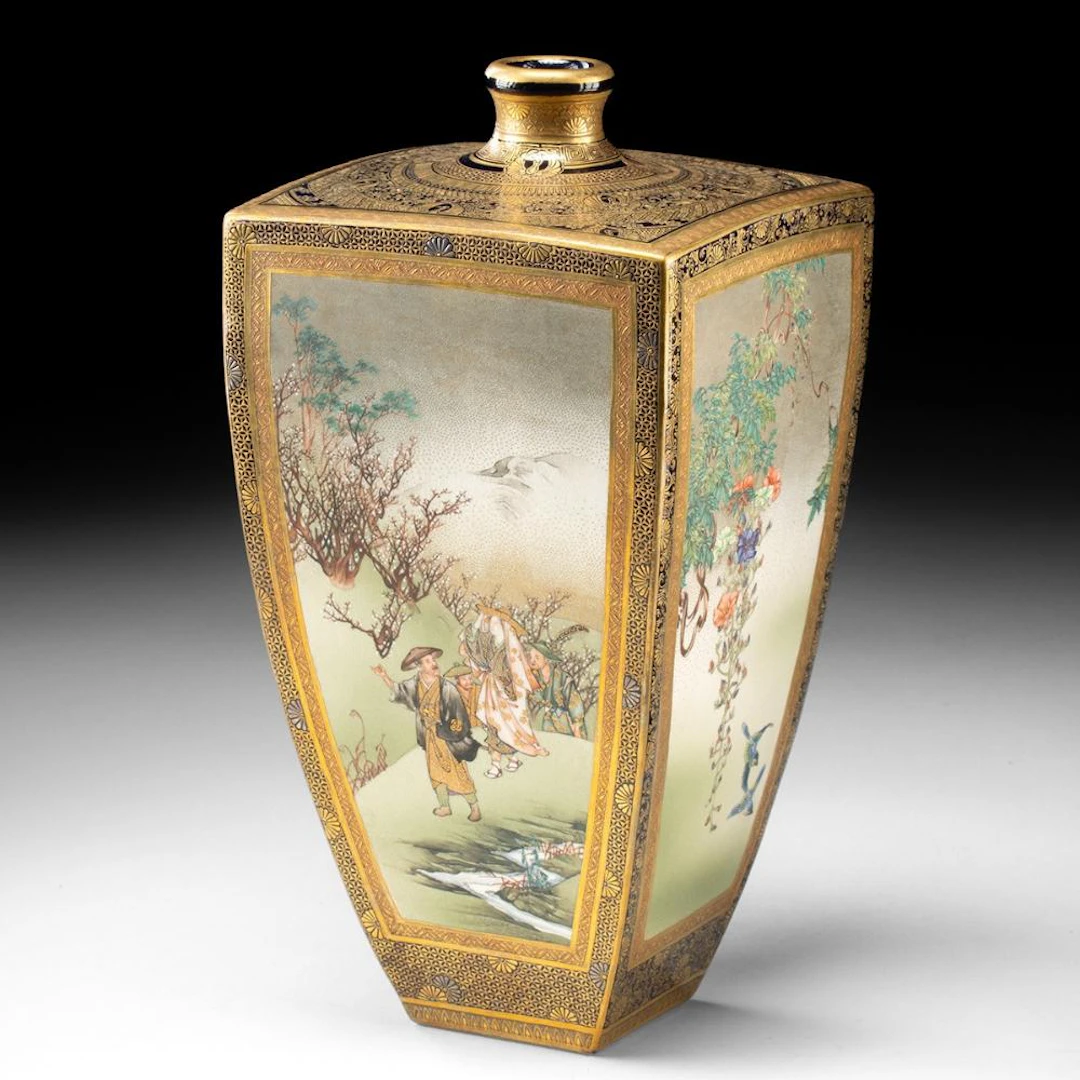
East Asia, Japan, Kyoto, Meiji Period. A square-section Kyoto Satsuma vase from the Kinkozan workshop. Its four gently bowed walls widen from a narrow foot to a flat shoulder, and a short waisted neck rises to a rolled lip glazed cobalt inside. The shoulder is worked as a gilded medallion of concentric bands: a raimon key collar, beaded rings, karakusa scrolls reserved on cobalt, small cartouches, and geometric diaper. Cobalt borders scattered with gilt chrysanthemum heads frame four panels whose silvery skies are sown with specks of gold. In one, a courtier holding a bow pauses beside a thatched cottage where a woman kneels. Travelers pass through a plum orchard in blossom in another. The two remaining faces show morning glories and flowering vines, with songbirds wheeling past. Analysis has confirmed the gilding as true gold, laid on in hair-fine lines and dots. The base bears the firm's gilt square seal reading Kinkozan zo. The Kinkozan family had potted in the Awata district of Kyoto since the Edo period. Under Kinkozan Sobei VI the firm began adapting the Satsuma manner to Kyoto production in 1872, and a display of the new ware won a prize at the Vienna International Exhibition the following year. His son, Kinkozan Sobei VII (1868 to 1927), took over in 1884 and made it the largest workshop in the district, with more than two hundred artists. The seal mark Kinkozan zo means "made by Kinkozan," and the name itself translates as "Brocade Light Mountain." The ware takes its name from the southern domain of Satsuma, where the ivory-glazed type first matured before the workshops of the old imperial capital took it up for export. Vases of this quality were made for foreign buyers and the international expositions. They were cabinet pieces, meant less to hold flowers than to be admired. The panels draw on a seasonal and literary vocabulary. The courtier at the humble cottage likely echoes a favorite convention of Heian literature: the nobleman who finds refinement in a modest dwelling, a plot the Tale of Genji found too useful to use only once. The plum flowers while frost still lingers, which made it both the herald of the new year and an emblem of fortitude. The morning glory opens for a single morning and is spent by noon, so it has stood for brevity in Japanese poetry since the Heian era (and for a quiet reproach to anyone who sleeps late). The chrysanthemum, scattered here across the borders, has long been associated with longevity and with the imperial house. Read in sequence, the four faces perhaps trace a turning year, from plum blossom to autumn chrysanthemum. Item # 205568
Utropspris:SEK 7,276.68
Till auktionenVisa alla föremål frånArtemis Fine ArtsellerAsiatisk keramik & konsthantverk
Utropspris:
SEK 7,276.68
Liknande föremål

Slutpriser för liknande föremål
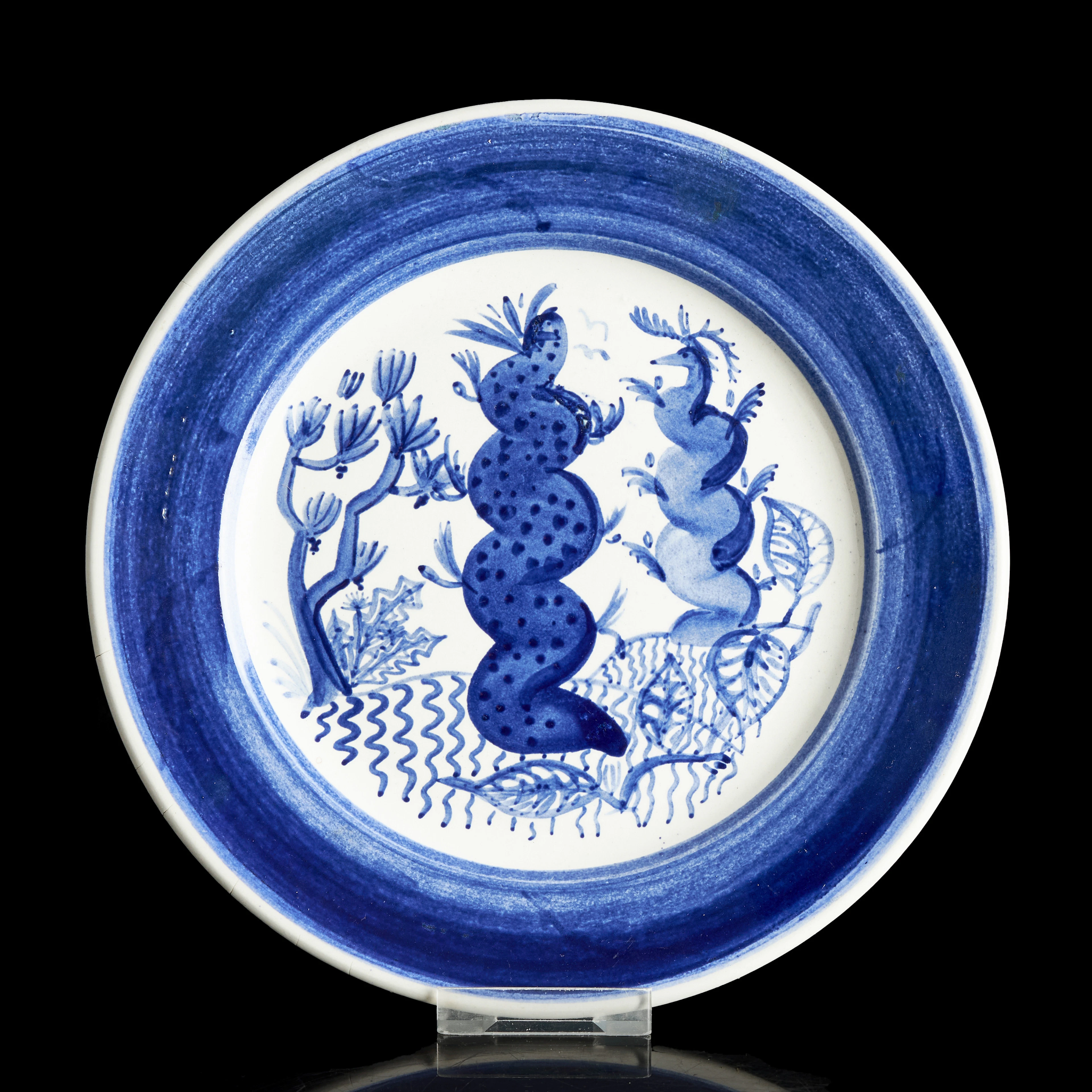
RENATA WREDE-BOËTHIUS (FINLAND 1923-1998 FINLAND). Fat, Gustavsberg
10/11/2026
SEK 350
Uppsk.: SEK 1,000
Nå samlare över hela världen med din auktion!
Lista er auktion