
Alla auktioner / Förhistorisk Konst / KIYOCHIKA – Hana moyō (Flower Patterns) – Beauty of the...

KIYOCHIKA – Hana moyō (Flower Patterns) – Beauty of the...
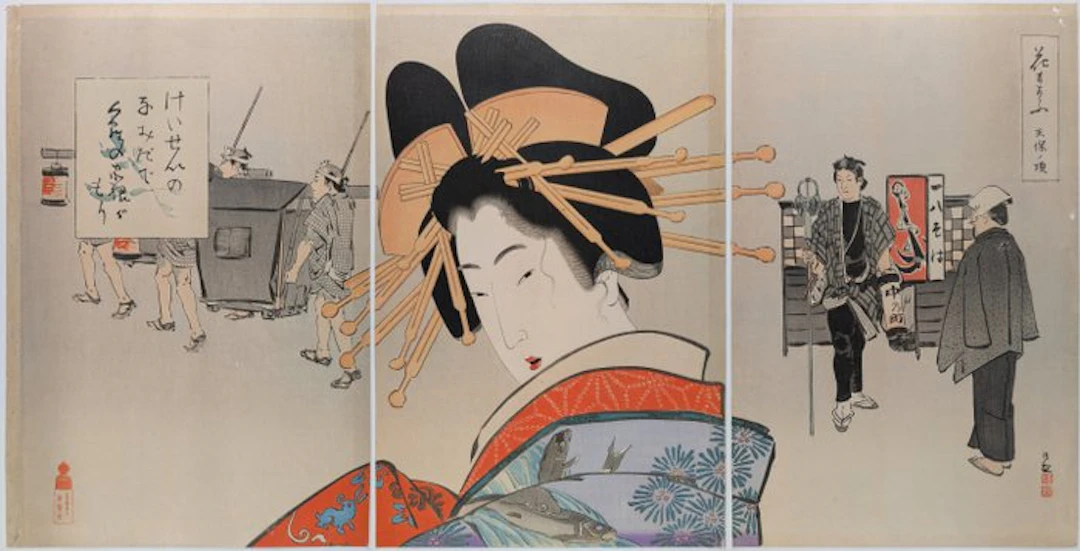
** A triptych from Kiyochika's Hana moyō (Flower Patterns), his best-known series of beauties and one of the most admired bijin-ga series of the 1890s. Each design in the series shows a woman of a different Edo period, set against the customs of her era. This sheet represents the Tenpō era (1830–1844), and the impression is very strong.. ** Artist: Kobayashi Kiyochika (小林清親), 1847–1915 Series: Hana moyō (花もよふ) – "Flower Patterns" Title: Tenpō no koro (天保ノ頃) – "The Tenpō Era" Subject: A courtesan of the Tenpō era (1830–1844) Date: Design first published 1896; this edition published by Kokkeidō, late 1890s Publisher: Akiyama Buemon (Kokkeidō, 滑稽堂), with the gourd-shaped publisher's seal Technique: Woodblock print (mokuhanga), nishiki-e (polychrome) Format: Ōban tate-e triptych (三枚続), three sheets, approx. [25 × 37 cm each] Signature: Kiyochika (清親), with seal CONDITION Impression & Colours: A strong impression with colors well perserved. Paper: Clean paper. At some point the sheets were backed and joined, now they are separate sheets. Together they present very well. The Series: Edo Beauties Seen from the Meiji Era Kiyochika is best known for his kōsen-ga, the "light-ray pictures" of 1876–1881 that showed the new Tokyo of gas lamps, trains and brick buildings in night light and shadow. Hana moyō belongs to a later and very different phase of his work. In late 1895 the publisher Takekawa Seikichi began a series of triptychs of women with him. Hana moyō followed, with ten designs dated between February and September 1896. A sequel series, Kodai moyō (Ancient Patterns), came in 1897. Each design names an era of the Tokugawa period, running from Keichō (1596–1615) to Tenpō (1830–1844). The "flowers" of the title are the women themselves. In the 1890s, publishers had a vogue for series surveying the fashions and hairstyles of earlier ages, and Chikanobu's Jidai kagami (Mirror of the Ages) is the best-known example. Kiyochika's answer is the most pictorial of these. One large, closely cropped figure fills the centre, with small scenes of everyday life behind her. That close-up format looks back to the golden age of the Edo beauty print. Utamaro made his name in the 1790s with ōkubi-e, "large-head pictures" of women that focused on the face and upper body. A century later, Kiyochika brought that kind of intimate, large-scale portrait into a Meiji series. He combined it with the even background tone and the open spaces of his own modern style. The Tenpō design shows a courtesan of the 1830s. In the background, a noodle seller's sign reads "Ichiya soba," a pun that can also be read as "one-night stand." Tenpō was the last era before the reforms of the 1840s cracked down on the pleasure quarters, and the final generation of the Edo floating world that Kiyochika himself was born into. Kiyochika: The Last Ukiyo-e Master Kobayashi Kiyochika was born in 1847, the son of a minor shogunal official, and fought on the losing side in the Boshin War before he turned to art. Richard Lane called him the last important ukiyo-e master and the first noteworthy print artist of modern Japan. Hana moyō is catalogued in Henry D. Smith II's standard reference, Kiyochika: Artist of Meiji Japan (1988). His work is held in the British Museum, the Museum of Fine Arts Boston, the Metropolitan Museum of Art and the Tokyo National Museum.
Utropspris:SEK 3,360.96
Till auktionenVisa alla föremål frånCatawikiellerFörhistorisk Konst
Utropspris:
SEK 3,360.96
Liknande föremål
Slutpriser för liknande föremål
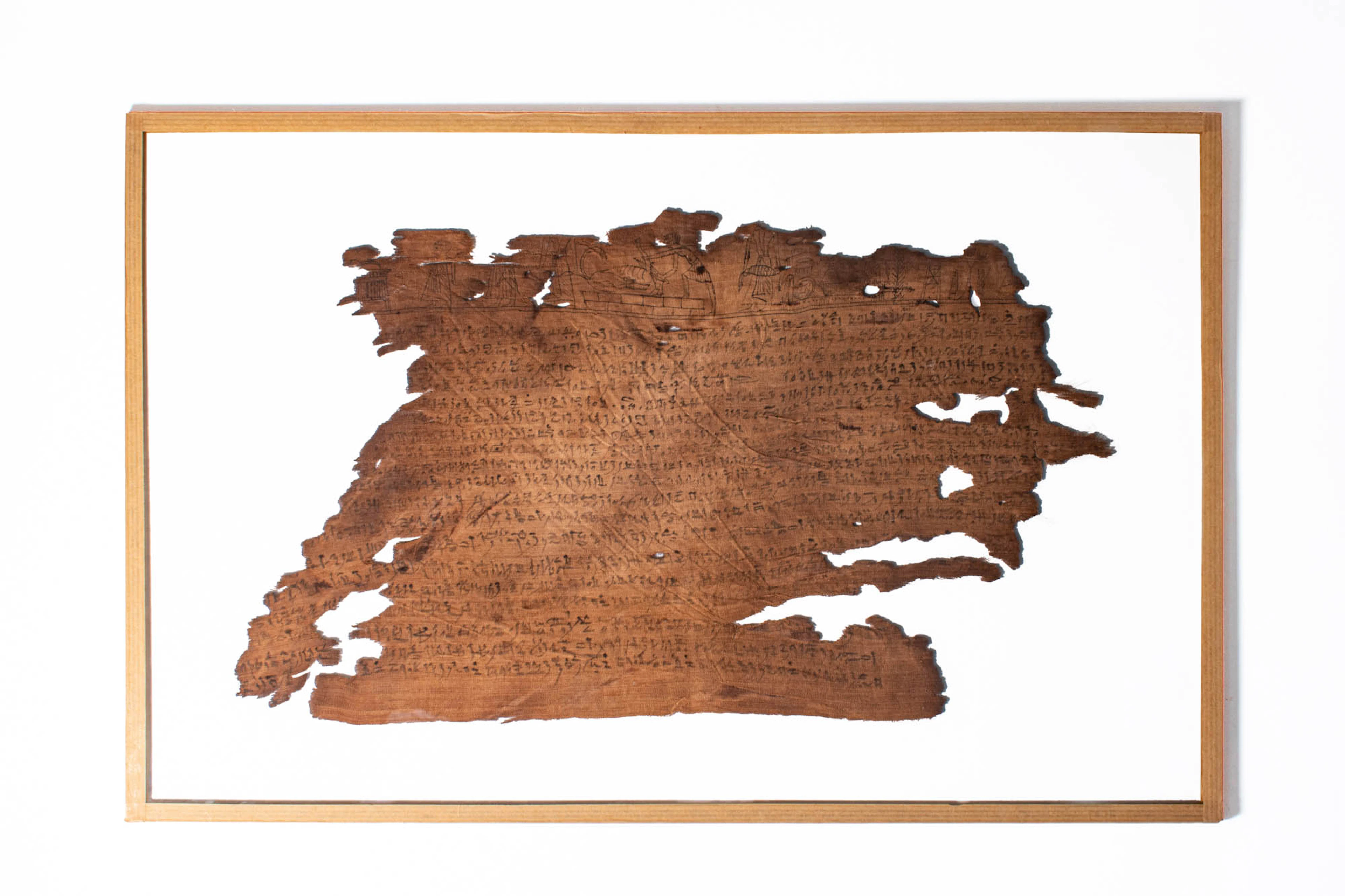
RARE EGYPTIAN MUMMY BANDAGE OF DJEDHOR - BOOK OF THE DEAD
06/21/2026

SEK 38,248.6
Uppsk.: SEK 37,454.41
Nå samlare över hela världen med din auktion!
Lista er auktion