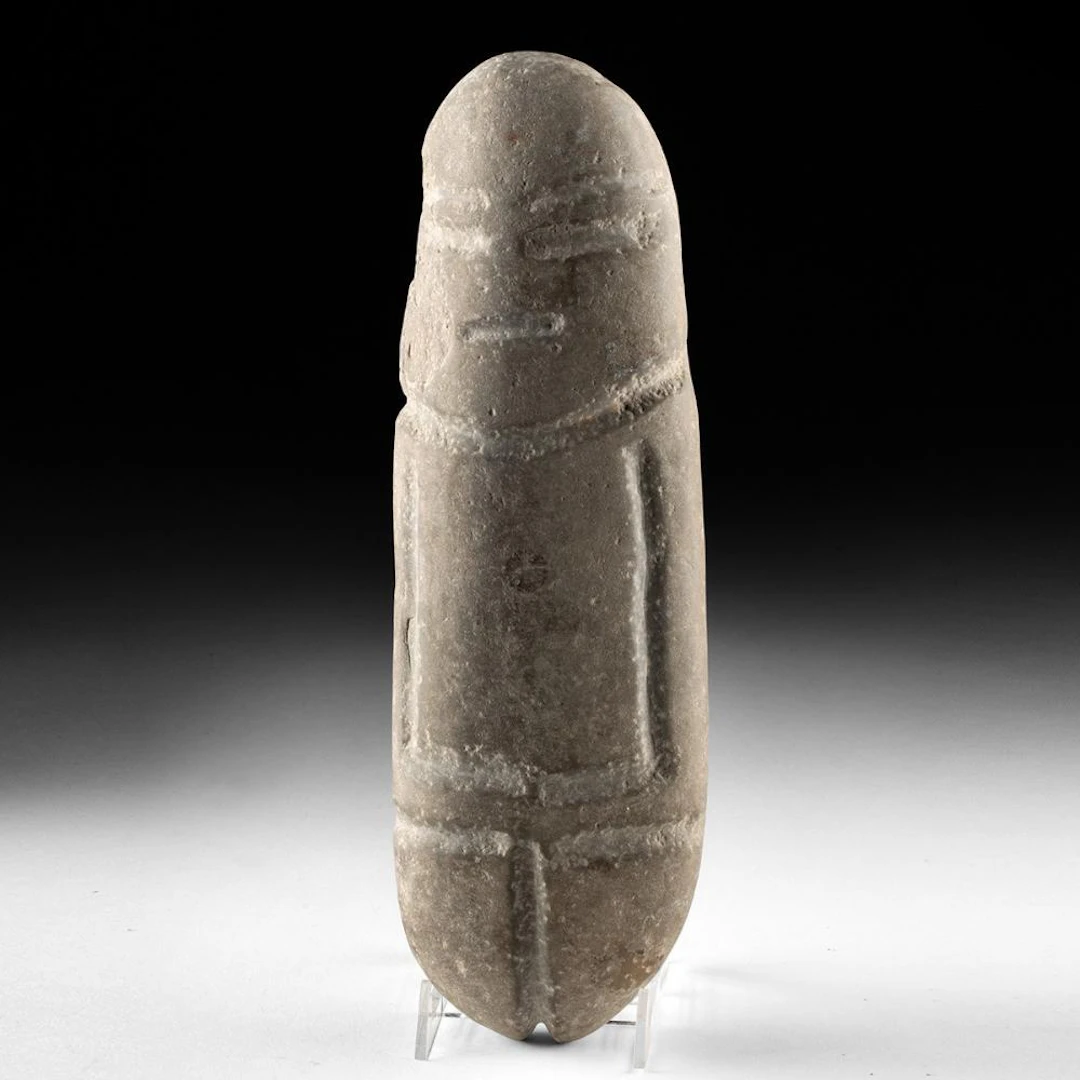
Large Guerrero Mezcala Stone Axe God Figure
Pre-Columbian, Mexico, Guerrero, Mezcala. A tall pebble of grey volcanic stone reduced, by patient abrasion, to the essential idea of a human being. The Mezcala lapidary worked with string-saw and abrader rather than metal, incising shallow channels that separate a domed head from a columnar body, laying in a linear brow, a slender nose, and a horizontal mouth, then bracketing the torso with framing grooves and a single vertical arm line. The reverse is left plain, the natural cobble contour intact. Such figures, known to collectors as "axe gods" for their celt-derived silhouette, were likely placed as offerings in caves, springs, and burials across the Balsas River drainage, and were valued enough that the Aztec later gathered them as antiquities. A generous scale for the type, with a matte, weathered surface. The Mezcala tradition takes its name from the Mezcala River, a tributary of the Balsas in the rugged interior of Guerrero, and it remains one of the least excavated of Mesoamerican lapidary cultures: nearly all known examples come from looted or chance finds, so the chronology (broadly ca. 700 BCE to 200 CE, with some scholars extending it later) rests largely on stylistic comparison and on the handful of pieces recovered in controlled contexts. Carl Gay's typology (Mezcala Stone Sculpture: The Human Figure, 1967) remains the standard framework, ranking figures from M-1, essentially an unmodified celt with a hint of a face, through M-22, fully articulated standing figures with separated limbs. This example sits in the middle of that continuum: the celt blank is still legible, but the incisions establish head, neck, torso, and arm as distinct zones. Their afterlife is remarkable. Excavations at the Templo Mayor of Tenochtitlan recovered Mezcala figures among Aztec offering caches, buried more than a millennium after they were made, evidence that the Mexica collected these ancient stones as potent relics of a deep past. Item # 203134
Utropspris:SEK 3,503.65
Till auktionenVisa alla föremål frånArtemis Fine ArtsellerEtnografica