
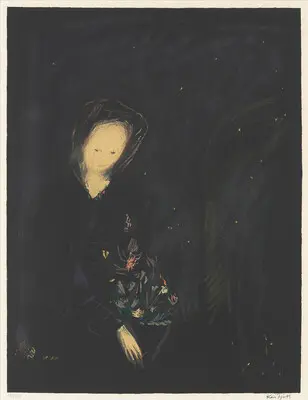



Alla auktioner / Diverse / Miquel Torner de Semir (1938) - Rostros femeninos de perfil


Signed by the artist at the bottom The work is presented matted (the frame shows some signs of wear) Artwork measurements: 46 cm high x 38 cm wide Frame measurements: 60 cm high x 51 cm wide Good condition BIOGRAPHY OF MIQUEL TORNER DE SEMIR. Miquel Torner de Semir was born in 1938 in the castle of Santa Pau, in La Garrotxa (Girona), as the last living person born in this emblematic building surrounded by volcanoes (he currently lives in San Feliu de Guísols). This fact marks his painting vocation. A man of old Catalonia, cultured, he has always felt drawn to the Middle Ages, Pyrenean Romanesque, and primitive Gothic. The trail of Italian Renaissance art, especially painters of the Italian Quattrocento such as Fra Angelico or Raphael, can be felt in many of Torner de Semir’s female portraits, including the one we have here. It is precisely this blend of the old and the new where the originality of his work lies. What seems to have shaped him most is the knowledge of Románic and Gothic art. His figures, often outlined with a thick dark line, evoke Gothic stained glass windows—luminous, beautiful in themselves and for themselves. A disciple of mural painter and engraver Ricard Marlet, he learns what he considers the most important thing: the discipline of drawing. Under Master Marlet, he becomes familiar with Modernism and Catalan Noucentisme. He studied at the School of Fine Arts in Sant Jordi in Barcelona and at the San Fernando school in Madrid, where he visited the Prado Museum and absorbed Velázquez’s painting, choosing to reproduce the meninas to his liking, with his own style, using bright colors such as pink and fluorescent violet that leave no doubt about the artist’s emphasis, modernity, and charm. Moreover, if you look closely, you can see the collage technique used by the artist, who embeds a piece of fabric, cardboard, or even a musical score. In Paris, he begins his work in the way he terms “between the old and the new.” He started holding solo exhibitions in Terrassa in 1968, later in other Catalan cities and in Paris (Espace and Boutique galleries). His work began in a Mediterranean figurativism, evolving into abstraction, and then returning to a figurative modern concept. He is considered, ultimately, one of the most important exponents of Mediterranean painting. All these tendencies were not unknown to him, as in Barcelona he had the chance to meet the group Dau al Set. In the Dau al Set school he encountered renowned artists such as Tharrats, Muxart, or Tapies. His painting is characterized by the use of bright, rich colors. His work can be defined in a single word: LIFE. Thus, the magnificent work of this Catalan painter is characterized by its rich, impasto coloring of great vivacity, which, together with the various materials he uses as support, yields a result of expressionist painting of high chromatic quality and strong personality, defining the artist as a master. The classical and the new fuse in Miquel Torner de Semir’s brush. Time dissolves, fades away. The dividing line between past and present is erased with his paintings, with his way of tracing on the canvas. Miquel achieves what very few before him have: to speak of the past with the voice of the present. His voice: his paintings. His method: passion. His achievement: all his work. The painter from Gerona is influenced by the ancients, Giotto, Italian Renaissance, and the informal search of abstract painters. All this is the starting point of his painting; he is as concerned with craft as with concept, trying to be a bridge between the past and the present, but also open to all that is new, in constant search. An interesting contrast in Torner de Semir’s work is how he presents people, places, and situations from ancient times, rendered with modern painting techniques. This illustrious Catalan painter has managed to break with the rules of time. So direct is Miquel Torner de Semir in defining lines and shapes that, at first glance, it seems the painting is actually a three-dimensional world reduced to a two-dimensional canvas. Some of his works have a notable Fauvist accent, with an intense and expressive color palette, contrasting with the serenity and empty look of the faces that invites the viewer to delve into the environment of the work and the artist’s thinking. Nevertheless, Torner de Semir has a personal style based on the simplicity of execution within a well-structured composition. The female figures have the calm shapes of religious art and express the calm of the spirit. The figure serves Semir to claim the order and rhythm of human actions. According to Joan Lluís Montañé, Barcelonese, member of the International Association of Art Critics, the prestigious Catalan painter Torner de Semir, in his extensive pictorial work, “is interested in composition and color, a generator of especially elaborated creations, where the imprint of determination and a contrasted color palette is evident. He exhibits figures, landscapes, and compositions that imply a clear exercise of pictorial academicism in which he does not renounce a certain formal and technical innovation, all within an unmistakable personal plastic signature.” Art critic Josep M. Cadena says of Semir: “The painter marks the silhouettes of the main elements of each composition with strong, precise lines and uses basic, pure colors to express feelings. When possible, he does the painting within the painting, and even tries to place interpretations and abstract signs in the backgrounds. Thus he achieves a positive relationship between the diverse forms of artistic expression that move him, and his plastic language is much richer and more attractive. He has a distinct style based on the simplicity of execution within a well-structured composition. His female figures have the calm forms of religious art and express the calm that must govern the realizations of the spirit. The figure serves to demand order and rhythm in human actions; his painting is ethical. He communicates easily positive sensations to those who know his work.” For J. Llop S.: “Drawing, the fundamental, strong, precise, incisive line establishes the form, defines spaces in the meditated compositions that Torner de Semir presents to us. And then comes the seeing in a different way, the imaginative, dreams that link with the reality he describes and clothes with a chromaticity that combines basic colors with soft tones. It is a personal style that discovers the other reality of the landscape, of the figure. An interesting and attractive work that grips the spectator and leads him along the path of the imaginative.” Consistent with his vision of the primitives, he has not worried much about social projection toward his teachers; these were sometimes unnamed and although his works are in many countries, he has exhibited in Europe, America, and Japan, making exhaustive compilation of his curriculum difficult. He currently exhibits permanently at La Galería Arcadia in Madrid. In 2003 he was chosen by the Museo de la Real Casa de la Moneda to have one of his works issued on a postage stamp and to participate in the XXV anniversary of the Spanish Constitution exhibition. In the meantime, the Museo de la Real Casa de la Moneda in Madrid has organized an exhibition of his works. Torner’s works have been exhibited in a large number of European and Spanish cities such as: Paris, Brussels, Frankfurt, Heidelberg, Strasbourg, Saint-Paul-de-Vence, Dijon, Clermont-Ferrand, Barcelona, Girona, Valencia, Seville, Pontevedra, Oviedo, etc. Now, below are some of the artist’s most important exhibitions: Most significant exhibitions Amics de les Arts. Terrassa - Barcelona. Pinacoteca. Sabadell - Barcelona. Society des Artistes Independants. Paris. Grand Palais. Paris. Dan Art, Béziers-France. Galerie Espace. Paris - Beaubourg. Lyions Club. Chartres Doyen - France. Guest of honor at the exhibition of the Cercle Espanyol. Dreux - France. Salon d’Automne. Clermont-Ferrand - France. Grand Prix la Femme et l’Imaginaire Jeanne Gatineau. Paris. Sala Gavina. Palamós - Girona. Sala Clará, Olot-Barcelona. Espai cultural Francolí-Barcelona. Galerie Boutique. Paris, France. La Galerie de l’Hotel Meridien. Paris. L’Atelier. Platja d’Aro, Girona. Ausstellungsräume der Mineralquelle Eptigen. Switzerland. Galería Arcadia- Madrid. Galería de arte Star. Colectiva. Madrid. Galería 4 Cantons. Olot. Girona. Galería Catalonia-Barcelona. Galería Art 16. Olot. Girona. Pedreguet Art espai contemporani. Girona. Galería Da Vinci Art. Girona. Galerie Ducs de Dijon. France. Galería Campo u Campo. Belgium. Galería B.C.S. Strasbourg. France. Haus Arnold. Frankfurt am Main. Germany. Haus Berlinghoff. Heidelberg. Germany. Naumilenium. Barcelona. Lart century art. Barcelona. Real Club Náutico de Sanxenxo. Pontevedra. Picassomio.com Madrid. Galeries d’Art Christian Dazy. Dijon-Megève-France. Exhibition commemorating the 25th Anniversary of the Spanish Constitution. Madrid. Sala Constanti Art, Reus. Christmas Collective, 2009-Tarragona. #parisapartment
Utropspris:SEK 2,191.44
Till auktionenUtropspris:
SEK 2,191.44


Nå samlare över hela världen med din auktion!
Lista er auktionGenom att prenumerera godkänner du integritetspolicyn. Avprenumerera när som helst.
Barnebys HQ
Brahegatan 10
BOX 5038
114 37 Stockholm
