Odisha (formerly Orissa)
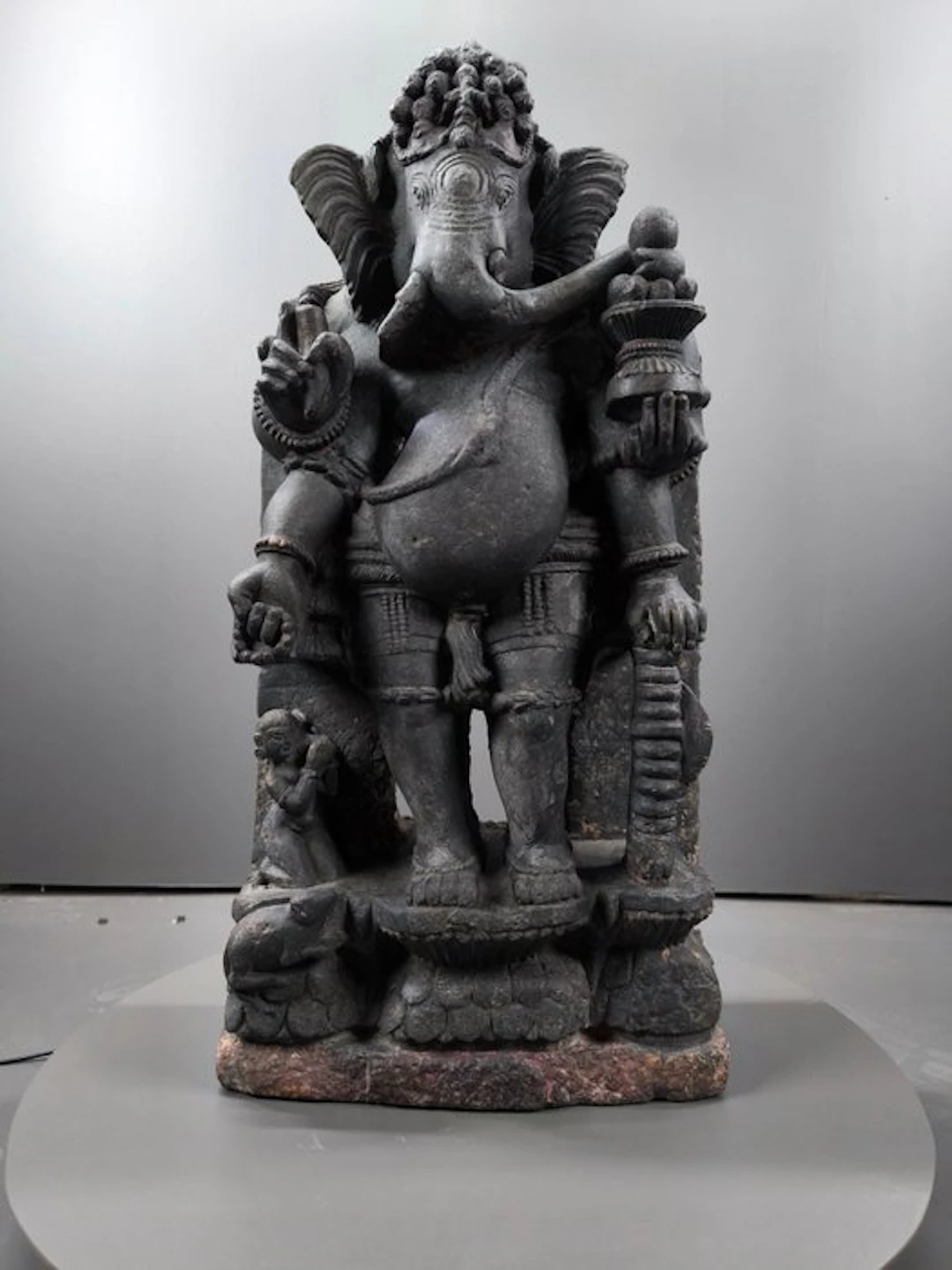
Important carved stele of **Ganesha** in black stone – Odisha (formerly Orissa), eastern India – late 12th to early 13th century, around 1200 Important and powerful representation of **Ganesha**, a major deity of the Hindu pantheon, carved in very high relief in a black, grainy stone traditionally described as granite. The work is attributed to **Odisha, formerly Orissa, in eastern India** and can be stylistically dated to the **late 12th or early 13th century, around 1200**. Ganesha is depicted standing, in a frontal, monumental attitude, on a substantial lotiform pedestal. His massive body, with a generously modeled belly, contrasts with the finesse of certain ornamental details and contributes to the strong sculptural presence of the whole. The deity has **four arms**. He holds several of his traditional attributes, notably a broken tusk, a rosary, a staff, and a vessel containing sweets. His long curved trunk extends toward the latter, directly evoking one of the most characteristic aspects of Ganesha’s iconography, a great lover of modaka, the sweets traditionally offered to him. The face is dominated by large ears that are widely flared and deeply lined. The forehead bears a clearly legible concentric circular motif. The head is crowned with an elaborate, highly sculpted headdress or crown that remains particularly expressive despite the old wear. The god wears a short dhoti, numerous beaded jewelry, and a sacred cord crossing the chest. The treatment of the belly, arms, legs, and ornaments preserves remarkable legibility and lends the figure a particularly sculptural presence. The composition is not limited to the figure of Ganesha. Beside him appears an **adoring kneeling** devotee, depicted in a gesture of devotion. At the base is also his traditional vehicle, the **rat or mouse (mushika)**, integrated into the iconographic program. These secondary elements reinforce the devotional character of the sculpture and contribute to the rich narrative of the whole. The sculpture is deeply freed from its background, with some volumes almost treated in the round. The side views clearly show the substantial depth of the relief and how the main figure stands out from the rear block. The **reverse is particularly interesting**: the stone has been largely hollowed out and left rough, revealing a massive structure as well as numerous inscriptions of sizing marks. This rear construction testifies to the architectural and devotional nature of the stele and is an important element for understanding its material conception. The surface shows an ancient patina, with various areas of wear, some traces of deposits and residual coloration. Nevertheless, the ensemble retains a particularly complete iconographic reading and a very strong visual presence. **Provenance** Collection of **Jean-Marc Andral, Belgium**. The sculpture was acquired from the **Galerie Carré des Antiquaires in Versailles, France, between 1995 and 2006**, according to a written provenance statement signed by Jean-Marc Andral on July 31, 2022. A copy of this provenance statement accompanies the piece. **Comparisons** Several institutional sculptures help place this representation within the corpus of medieval Ganesha of eastern India. An important Ganesha attributed to Odisha and dated to the 13th century is kept at the **British Museum**, London, under inventory number **1872,0701.59**. It shows several comparable features, notably the standing position, the lotiform pedestal, the large veined ears, and several similar iconographic attributes. Another Ganesha from Odisha kept at the British Museum forms a particularly interesting match in iconography and arrangement of its attributes. For a broader comparative frame, a granite sculpture of Ganesha from the Avery Brundage collection, now in the **Asian Art Museum in San Francisco**, inventory number **B63S45+**, also illustrates the monumentality and plastic power of this medieval representation. These museum comparisons are mentioned for comparative and documentary purposes; they do not imply identity of workshop. **Condition** Very good condition considering age. The sculpture is stable and retains excellent overall legibility. Signs of wear, losses and small chips, surface erosion traces, concretions and some ancient cracks. These alterations are coherent with the age and material history of the work and do not affect the overall understanding of the composition. Detailed photographs are part of the description and allow precise appreciation of the conservation state. **Dimensions:** 65 × 31 × 16 cm **Weight:** about 46 kg **Material:** black stone with visible grain, traditionally described as granite **Origin:** Odisha (formerly Orissa), eastern India **Dating:** late 12th–early 13th century, around 1200 By its size, weight, depth of sculpture, richness of iconography, and documented European provenance, this stele constitutes a particularly imposing and decorative representation of Ganesha in the medieval eastern Indian tradition. Video link: https://www.dropbox.com/scl/fo/a8j6kkd87sl5a487ucrdr/ADnrUpRUGfE-cPQdLYjHZ1s?rlkey=o5izjg3de43d1kt4adyitrgpo&dl=0
Utropspris:SEK 238,087.2
Till auktionenVisa alla föremål frånCatawikiellerFörhistorisk Konst