

OCT 8 | 3:00 PM

Nå samlare över hela världen med din auktion!
Lista er auktionGenom att prenumerera godkänner du integritetspolicyn. Avprenumerera när som helst.
Barnebys HQ
Brahegatan 10
BOX 5038
114 37 Stockholm
Alla auktioner / Böcker, Kartor och Texter / S.A. - L’Art du Poëte et de l’Orateur - 1768

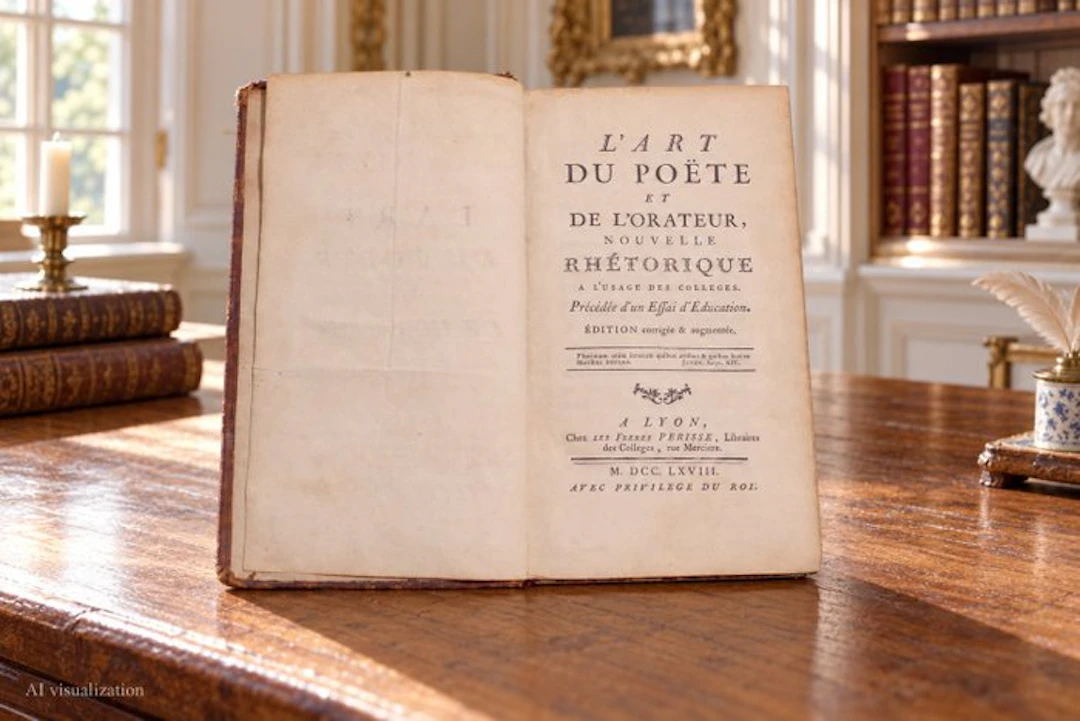
THE ART OF CONVINCEING AND MOVING: POETRY AND RHETORIC IN 18TH-CENTURY FRANCE ABSTRACT An interesting Lyon edition from 1768 of a fortunate eighteenth-century manual dedicated jointly to the art of poetry and eloquence. Conceived expressly for use in the collèges, the treatise teaches how to build poetry, discourse, and argumentation through precepts and examples drawn from great classical and French authors. The work deals with tragedy, epic poetry, style, thought, rhetorical figures, metaphor, allegory, hyperbole, apostrophe, and the main techniques of persuasion. Particularly significant is the initial presence of an Essai d’Éducation, which places rhetoric within a broader Enlightenment pedagogical project. Exemplary in its eighteenth-century full leather binding, with a richly gold-ornamented spine featuring raised bands and a red inlay reading “ART DU POETE.” WHY TO BUY Rhetoric of the Enlightenment – A complete compendium of eighteenth-century theory of eloquence, where the Aristotelian, Cicero, Quintilian, and Horace tradition dialogues with great French literature. POETRY AND ORATORY – The volume does not only address public speaking but also tackles tragedy, epic, style, poetic images, thoughts, passions, and figures of discourse. MANUAL FOR THE COLLEGES – The frontispiece explicitly states “à l’usage des Collèges”: a direct testimony of rhetoric teaching in the European education of the Ancien Régime. COEVA BINDING – Full eighteenth-century leather with raised spine, rich gilded floral ornaments, and red inlay with title, preserved despite evident signs of use. MARKET VALUE The work belongs to the collecting field of pedagogy, rhetoric, and eighteenth-century French literature. Its interest is mainly historical and didactic; the contemporary binding constitutes a positive element, while the conditions experienced limit its valuation. For a complete exemplar of the Lyon edition of 1768 in the conditions shown, a reasonable antique market range can be indicated at about €350–450. PHYSICAL DESCRIPTION AND CONDITION Contemporary full brown leather binding, five-raised-bands spine with compartments decorated with floral and ornamental ironwork impressed in gold; red morocco inlay with gold title “ART DU POETE.” A well-used exemplar. Binding with widespread abrasions and scuffing, wear to corners, headcaps and hinges, small leather losses and partial gilding loss; upper headcap particularly worn. Numerous engravings and terminal woodcuts. Pages with browning and physiological foxing. In old books with a long history, some imperfections may be present, not always noted in the description. This listing contains AI Viewings. Refer to the original photographs to verify the object's actual condition. Images are an integral part of the description. Pp. (2); 4to; 60; 404; (2). FULL TITLE AND AUTHOR L’Art du Poëte et de l’Orateur. Lyon, chez les Frères Perisse, 1768. S.A. CONTEXT AND SIGNIFICANCE In the European educational system of the Ancien Régime, rhetoric occupied a central position. Learning to speak and to write meant not only knowing grammar but being able to order thought, choose topics, evoke emotions, and adapt style to subject and audience. L’Art du Poëte et de l’Orateur arises precisely in this context. The subtitle “Nouvelle Rhétorique à l’usage des Collèges” reveals an eminently didactic purpose: to provide students with a systematic synthesis of the rules of literary composition and eloquence. The work continually links poetry and oratory. The poet and the orator use indeed common tools: invention, arrangement, imagery, rhythm, passions, and rhetorical figures. The treatise thus teaches not only how to construct a persuasive discourse but also how to produce aesthetic and emotional effectiveness. The Table des Matières allows for a precise reconstruction of its breadth. It covers the definition of eloquence, tragedy, epic poem, action, the marvelous, intrigue, episodes, unity of time and place, the outset, exposition, thoughts, style and its various forms. The final part constitutes a true repertoire of rhetorical figures: tropes, metaphor, allegory, allusion, periphrasis, repetition, communication, correction, antithesis, comparison, hypotyposis, apostrophe, deprecation, imprecation, exclamation, interrogation, gradation, reticence, and prosopopeia. Of particular interest is the method based on examples. Abstract rules are juxtaposed with passages from authors regarded as models of expressive efficacy, among which in the photographed pages appear Horace, Cicero, Virgil, Racine, Boileau, and other protagonists of classical and French tradition. BRIEF BIOGRAPHY OF THE AUTHOR The work appears anonymous on the frontispiece of the 1768 photographed edition: it is therefore not appropriate to attribute it to an author without specific bibliographic corroboration. The text clearly belongs to the French pedagogical tradition of the eighteenth century that sought to systematize classical rhetoric for teaching in the collèges. Aristotle, Cicero, Quintilian, and Horace constitute the theoretical background, while eighteenth-century French authors provide numerous modern examples. The Frères Périsse were members of a renowned Lyonese family of booksellers-publishers. The label “Libraires des Collèges” on the frontispiece is particularly coherent with the didactic nature of the work and with the school market to which the volume was destined. PRINTING HISTORY AND CIRCULATION The frontispiece defines this impression as “Édition corrigée & augmentée,” attesting to the existence of a preceding editorial development and the revision of the text for this edition. The edition was published in Lyon in 1768 by Frères Périsse, rue Mercière, one of the historic axes of Lyon’s bookselling activity. The presence of the “Privilège du Roi” documents the regular inclusion of the work in the French editorial system of the Ancien Régime. At the end of the volume is preserved the Approbation, dated Paris 10 June 1765 and signed Marin, followed by the Privilège général. These elements are particularly interesting for the material history of the book and for pre-censorship in France. The success of manuals of this kind must be read in the context of the centrality of rhetoric in eighteenth-century education: these were books intended for practical and repeated use by students and teachers, a circumstance that also explains the frequent survival of copies with heavily worn bindings. BIBLIOGRAPHY AND REFERENCES Bibliothèque nationale de France, catalogs of French works on rhetoric and eighteenth-century pedagogy. CCFr – Catalogue Collectif de France, census of editions preserved in French libraries. WorldCat, bibliographic records of L’Art du Poëte et de l’Orateur and related eighteenth-century editions. Catalogue général de la Bibliothèque nationale de France, catalogs of Lyonese publishing production. Bibliothèque municipale de Lyon, old collections and catalogs of the Périsse booksellers’ production. Bibliographic catalogs of Lyon’s eighteenth-century printing. Catalogs on the history of rhetoric teaching in the French collèges of the Ancien Régime. Historical bibliography on classical rhetoric and its reception in eighteenth-century French pedagogy.
Utropspris:SEK 11.3
Till auktionenVisa alla föremål frånCatawikiellerBöcker, Kartor och Texter
Utropspris:
SEK 11.3
OCT 8 | 3:00 PM
Nå samlare över hela världen med din auktion!
Lista er auktion
SEK 3,317.83
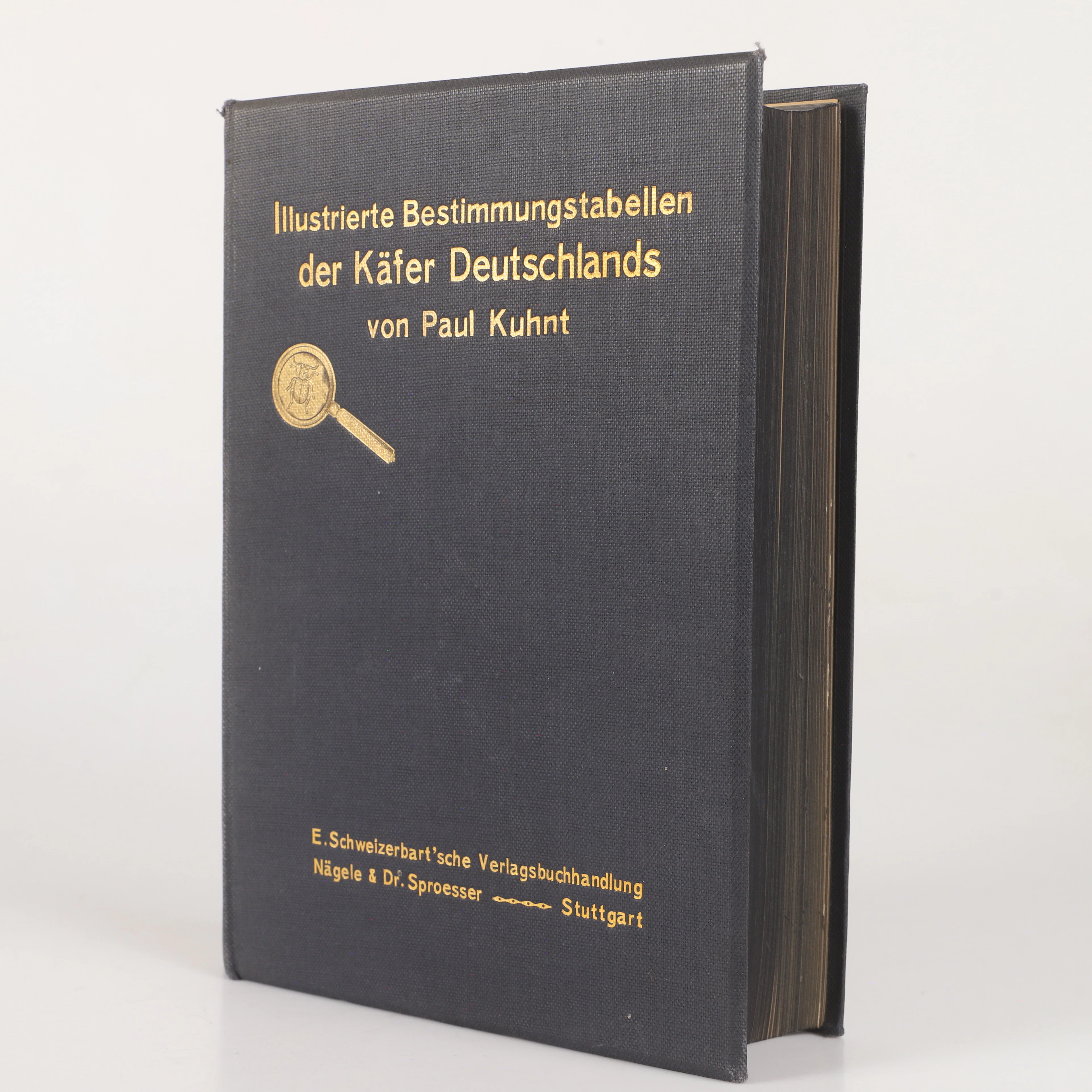
BOK, "Illustrierte bestimmungstabellen der käfer Deutschland"Paul
10/06/2026

SEK 300
Uppsk.: SEK 400