


OCT 8 | 3:00 PM

Nå samlare över hela världen med din auktion!
Lista er auktionGenom att prenumerera godkänner du integritetspolicyn. Avprenumerera när som helst.
Barnebys HQ
Brahegatan 10
BOX 5038
114 37 Stockholm
Alla auktioner / Mattor & Textilier / SENAULT (Louis). *Heures nouvelles tirées de la Sainte Ecrit - Lot 68

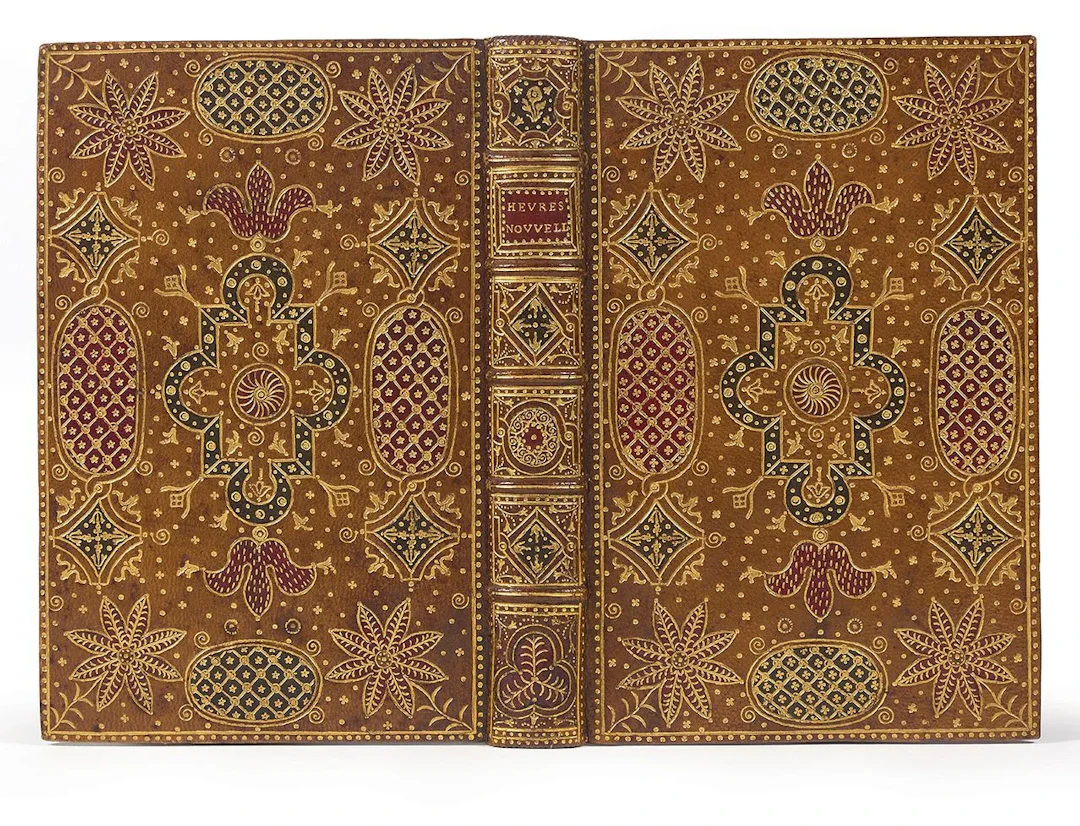
SENAULT (Louis). *Heures nouvelles tirées de la Sainte Ecriture*. Written and engraved by L. Senault. Paris, published by the author and Claude de Hansy, n.d. (after 1690). In-8, contemporary lemon-colored morocco binding, decorated covers, framed by a fillet embellished with gold dots, with mosaic compartments of red and green morocco symmetrically arranged on all four sides, the oval-shaped ones adorned with a repeating diamond pattern, the others, diamond-shaped, embellished with small metal motifs including a chalice; a starfish-shaped motif inlaid with red morocco and accented with small gilt fillets at the four corners, the center consists of a wide, four-lobed green morocco leather band bearing in its center a gilded toothed wheel on a red morocco leather background and surmounted by a fleur-de-lis motif also inlaid with red morocco leather, the entire design, like the background of the decoration, is embellished with numerous small gilded metalwork elements—dots, volutes, stars, and flame-like motifs—and a ribbed spine, each compartment adorned with a different gilded and mosaic motif; a wide straight lace border frames the lining, the lining, as well as the endpapers, covered with marbled paper on a gold-checked background adorned with a superb floral design accented with red, blue, pink, and white; gilt edges. One of the most beautiful books of the late 17th century, the work of engraver and calligrapher Louis Senault. Entirely engraved—both text and ornamentation—this volume, which follows the form of medieval books of hours while also innovating upon it, is delightfully decorated with a multitude of vignettes, headpieces, tailpieces, illustrated initials, and floral-decorated borders. Published around 1680 and dedicated to the Dauphine, it was frequently reprinted through the 18th century. In this edition, the epistle to the Dauphine (who died in 1690) has been omitted, and the mermaid’s breasts, on page 210, have been modestly concealed by seashells, but the “Prayer for Madame la Dauphine” still appears at the bottom of page 69. The copy has been enriched with five separate plates engraved after works by Guido Reni, Philippe de Champaigne, Coypel, Mignard, and Le Brun. Superb binding with an elaborate mosaic decoration by Augustin Duseuil. It was likely executed during the Regency (1715–1723) or shortly thereafter. It is known that it was during this period that Duseuil (1673–1746)—perhaps in collaboration with his cousin by marriage, Antoine-Michel Padeloup—created these bindings of an entirely new style, decorated with a mosaic of applied leathers in various colors. Known as “compartimented” bindings, these works—whose fanciful and exuberant style stood in stark contrast to the austere creations of the previous reign—“required extremely meticulous craftsmanship and were very costly to produce, which is why so few examples have survived to this day” (Michon, *Mosaic Bookbindings of the 18th Century*). Michon’s study of the early development of this style enabled him to identify a group of about ten bookbindings, all produced during the Regency and originating from a single workshop, as evidenced by a clear similarity in the composition of the decorations and the design of the motifs, as well as the use of the same metal tools. These bindings also share the fact that most were created for the Regent, his family, or members of his entourage. It was this observation, in particular, that allowed Michon to attribute their creation to Augustin Duseuil: “Born in 1673, Duseuil described himself in 1714 as the bookbinder to His Grace and Her Grace the Duchess of Berry (these were the Regent’s son-in-law and daughter, who died in 1714 and 1719, respectively). On February 26, 1717, he received the commission as the King’s official bookbinder upon the Regent’s recommendation. This position, in which he replaced no one, seems to have been created specifically for him...”. This binding exhibits all the characteristics common to this founding group, to which it clearly belongs, and of which it is one of the rarest and most remarkable examples, both in terms of the quality of its craftsmanship and the balance and harmony of its decoration. It can be compared, in particular, to the following bindings featuring similar decoration: - Three “Semaines Saintes de Paris,” Pepie, 1716: the first bearing the coat of arms of the Duchess of Orléans, wife of the Regent, in the BNF (Michon 148, with reproduction); the second (Michon, 149) bearing the coat of arms of Louise-Adélaïde, the Regent’s second daughter, which appeared in the Ripault (1924, no. 11) and Descamps-Scrive (I, 1925, no. 198, with reproduction), now in the British Library (acquired through the Henry Davis donation in 1978); the third bearing the coat of arms of the Regent (Michon, 147), from the Ripault (1924, no. 10), Bishop (1948, no. 220), Esmerian (1972, no. 82, sold for 105,000 francs including fees), and Paul-Louis Weiler (1998, no. 74, sold for 295,000 francs including fees). - A Diurnal Monastiq
Utropspris:SEK 225,970.1
Till auktionenVisa alla föremål frånGiquelloellerMattor & Textilier
Utropspris:
SEK 225,970.1
OCT 8 | 3:00 PM
Nå samlare över hela världen med din auktion!
Lista er auktionSEK 100